
By Daniel Schulz, residir GmbH · Last updated: 14 October 2026
Renting out a holiday apartment pays off above all in sought-after locations with high occupancy, provided you have the necessary permission and plan realistically for the ongoing workload. Commission, laundry, utilities and reserves all come off your overnight revenue, and every changeover takes organising. If you run the numbers beforehand, you can make a success of letting your holiday apartment rather than ending the first year disappointed.
This guide looks at things from the host’s side. Our author Daniel Schulz has managed more than 80,000 guest stays over eight years running serviced apartments, and many of the tips below come from that experience. Information correct as of October 2026. This article is a general overview and does not constitute tax or legal advice.
In this article:
- Is it worth it? Occupancy, costs, effort
- Requirements: permission and registration
- Letting it yourself or using an agency
- Setting your prices
- Furnishings and equipment
- Guest communication and check-in
- Changeover days, cancellations and damage
- Reviews and guest book
- Income and the tax office
- Checklist
- Tips from experience
- Conclusion
- Frequently asked questions
| Step | What it involves | Who is responsible |
|---|---|---|
| Get permission | Declaration of division (Teilungserklärung), landlord’s consent, local authority rules | Owners’ association, landlord, town or municipality |
| Register | Declare your income, register a business if required, registration forms for foreign guests | Tax office (Finanzamt), trade office (Gewerbeamt) |
| Market it | Booking platforms, your own website, software for calendar and messages | You or an agency |
| Run it | Prices, check-in, guest communication, changeovers, reviews | You, a cleaner, a property manager |
Renting out a holiday apartment: is it worth it?
The honest answer: it comes down to three numbers. How many nights a year is the apartment booked, how much is left per night after all costs, and how many hours do you put in yourself? Is a holiday let worth it if you end up with barely more than from a normal tenancy but have work to do every week? For many owners, no.
Estimating occupancy realistically
Occupancy varies hugely depending on location and season. In cities with trade fairs and major events, individual weeks book up quickly, with quieter spells in between. In holiday regions, summer and winter carry the year, while spring and late autumn often stay empty. It is better to plan with cautious occupancy and enjoy the good months as a bonus.
Some hosts fill the gaps with longer stays: tradespeople, project teams and commuters often book several weeks at a time. Our page on workers’ accommodation in Munich shows how this segment works in the city. For you as a host, that means fewer changeovers, though usually a lower nightly rate.
Worked example: annual income and costs
The calculation below shows the costs involved in renting out a holiday apartment. It is a purely illustrative example with assumed figures, not a forecast, and not tied to any particular city. It assumes a two-room apartment for up to four guests, an average of 120 euros per night, 65 per cent occupancy and an average stay of three nights.
| Item (example) | Assumption | Amount per year |
|---|---|---|
| Accommodation revenue | 237 nights × €120 | €28,440 |
| Platform commission | 15 % of revenue | – €4,266 |
| Cleaning at each changeover | 79 changeovers × €55 | – €4,345 |
| Laundry and consumables | 79 changeovers × €20 | – €1,580 |
| Electricity, heating, water, internet | flat rate | – €2,400 |
| Software, locking system | flat rate | – €500 |
| Maintenance and replacements | flat rate | – €1,500 |
| Result before financing, service charges, depreciation and tax | €13,849 |
For comparison: if the same apartment brings in 1,150 euros a month in basic rent as a long-term let, that is 13,800 euros a year with almost no ongoing work. Only when occupancy or price is noticeably higher does holiday letting become more attractive. In between sits medium-term letting, as used by providers of furnished apartments in Munich: fewer changeovers and more predictable income.
The workload few people talk about
The biggest item does not appear in any table: your time. Answering enquiries, keeping the calendar up to date, coordinating the cleaner, sorting out damage, responding to reviews. For a well-run apartment, that is a few hours a week as a rule of thumb, more in high season. If you want to buy a holiday apartment and have it managed for you, factor this work into your calculation as a management fee.

Letting your flat as a holiday apartment: permission and registration
Before your first listing goes live, you need to be sure you are allowed to let at all. Three parties may have a say: the owners’ association, your own landlord and the local authority. So how do you let a holiday apartment on a sound legal footing? The points below apply in general; each municipality sets its own detailed rules.
Letting an owner-occupied flat as a holiday apartment
Can I let my freehold flat as a holiday apartment? That depends first on the declaration of division (Teilungserklärung) and the community regulations (Gemeinschaftsordnung). If nothing in them stands in the way, letting to holidaymakers is generally regarded as permitted residential use. If the unit is designated purely as a residence and letting to changing guests is expressly excluded, you may not offer it as a holiday apartment.
A later ban is not straightforward: in 2019 the Federal Court of Justice (Bundesgerichtshof) ruled that owners cannot prohibit short-term letting by majority vote; this requires the consent of all owners (judgment of 12 April 2019, V ZR 112/18). Good relations with the neighbours still matter. Noise, rubbish and unfamiliar faces in the stairwell quickly cause trouble at the owners’ meeting.
As a tenant, only with permission
If you rent your home yourself, you need your landlord’s permission to let it to holidaymakers (Section 540 of the German Civil Code, BGB). Without permission, you risk a formal warning and, in the worst case, termination of your tenancy. Get the consent in writing, stating the period it covers.
Letting a holiday apartment with or without a registered business
Almost every new host asks whether they need to register a business (Gewerbe). If you let a single apartment without extra services, you are generally managing your own assets, so letting a holiday apartment without a registered business is the norm. It may count as a business if your offer resembles an accommodation establishment: breakfast, daily cleaning, a reception desk or many units with their own organisation.
No law sets a fixed number of apartments above which you need to register a business for holiday letting. What matters is the overall picture. Clarify your case with the trade office (Gewerbeamt) and the tax office (Finanzamt); the business registration itself is usually done quickly.
Registering a holiday apartment: where and what
Where do you register when letting a holiday apartment? You declare the income to the tax office in your tax return, and a business with the trade office of your municipality. In spa towns and holiday regions, many municipalities charge a visitor’s tax (Kurbeitrag or Gästebeitrag), which you collect from guests and pass on. Ask your municipality whether the holiday apartment needs a permit or registration.
One point has changed recently: since 1 January 2025, German guests no longer have to fill in a registration form (Meldeschein). For foreign guests, the registration requirement in accommodation establishments remains, and you must keep the forms.
The rules in Munich are stricter: anyone letting residential space to holidaymakers for more than a total of eight weeks a year needs a permit from the city. You will find the details in our guide to Airbnb in Munich.
54 professionally run apartments in Lehel
From autumn 2027, residir GmbH will let a total of 54 apartments at Ländstraße 6, each with its own kitchen, fast Wi-Fi and 24-hour safe check-in. Laundry, check-in and guest support are run there as a proper operation, not as a sideline. Find out how the building works on our page about our boarding house in Munich.
Letting your holiday apartment yourself or having it managed
If you want to let your holiday apartment yourself, you take care of the listing, pricing, messages and organisation. If you would rather have it managed, you hand these tasks to an agency or property manager and pay a share of the revenue in return. Both approaches work. The choice mainly depends on whether you live nearby and how much time you have.
Booking platforms and direct bookings
Which platform should you use for a holiday let? Large booking platforms bring reach and international guests, and charge commission or service fees for it, often in the double-digit percentage range if the host bears them alone. Regional platforms run by tourist boards are cheaper and reach guests who are looking for a specific region. Many hosts use two or three platforms in parallel to market their holiday apartment.
Your own website with direct booking saves commission but does not bring in guests on its own. It pays off mainly for returning guests and recommendations. So if you want to let your holiday apartment online, you need both: visibility through platforms and a way for happy guests to book directly next time.
Holiday rental software
Once you use two or more channels, the calendar becomes a risk: a double booking costs money and reviews. A channel manager synchronises availability and prices across platforms. Holiday rental software can also send messages, write invoices and notify the cleaner of changeover days. Our guide to the holiday rental invoice, complete with template, explains what details it needs. Keep an eye on the monthly costs relative to the number of apartments you run.
Agency or property manager
Depending on the contract, an agency takes care of marketing only or the entire operation, from the listing to handing over the keys. Only compare offers with the same scope of services, and ask which costs are charged on top, such as laundry or minor repairs. If you run several units and specifically target trade fair visitors, you are competing with professional providers of accommodation for Messe Munich and need different structures from a private host with a single apartment.
Setting prices: season, minimum stay, total price
A single price for the whole year leaves money on the table. Set seasonal rates and respond to events in your area: trade fairs, festivals, school holidays. Guests searching for holiday apartments in Munich or in any other city compare location, total price and reviews first. So check regularly what comparable apartments nearby are charging for the same dates.
- Minimum stay: two or three nights reduce the number of changeovers; in quiet weeks, one night helps fill gaps.
- Weekly and monthly discounts: longer stays save you laundry and work, and some of that saving can be passed on to the guest.
- Total price: mandatory fees such as final cleaning belong in the displayed total price; guests compare the final amount anyway.
- Early-bird and last-minute bookings: small discounts for gaps in the coming days are better than an empty apartment.
Letting a holiday apartment more successfully rarely means cutting the price. Better photos, a clear description and quick replies usually achieve more than a ten-euro discount per night.
Furnishings: what guests expect
Guests compare your apartment with hotel rooms and other holiday apartments. These days they expect a good bed, a working kitchen with the basics, fast Wi-Fi, towels and bed linen, and somewhere to work. If any of these is missing, it will appear in the first review at the latest.
If you are furnishing the apartment from scratch, plan for sturdy furniture, washable covers and enough storage space for luggage. You will find a detailed list in our guide to holiday apartment essentials; here, just the principle: less is more, as long as it is solid and easy to clean.
Guest communication and check-in
Most problems with guests stem from missing information. If you explain clearly in advance how arrival works, where the key is and what is allowed in the apartment, you will get fewer evening phone calls and better reviews. You will find a template to adapt in our guide to holiday rental house rules.
Messages before, during and after the stay
- After booking: confirmation with the address, check-in and check-out times and the most important house rules.
- Two to three days before arrival: directions, parking, access to the apartment and an emergency phone number.
- The day after arrival: a quick check that everything is fine. That way you hear about problems before they end up in a review.
- After departure: a thank-you and a request for a review.
Message templates save time, but you should tweak them briefly before sending. On many platforms, fast replies to enquiries also count towards your ranking in search results.
Check-in without waiting
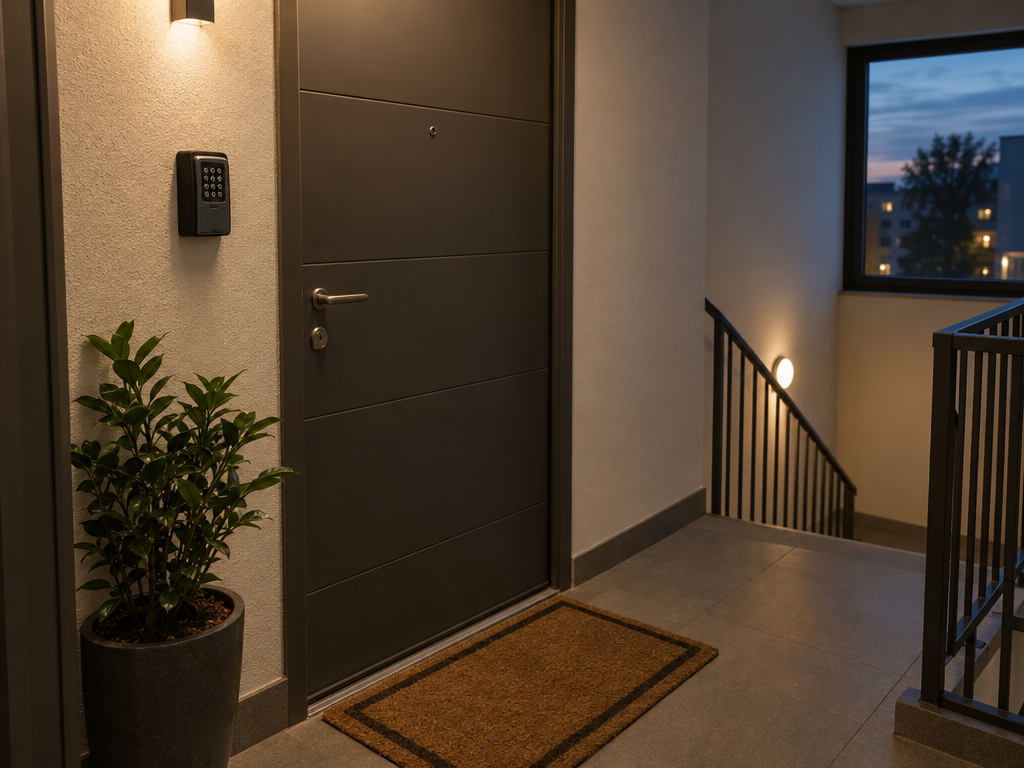
Handing over keys in person is friendly, but it ties you to your guests’ arrival time, and trains and flights are rarely on time. A key safe or electronic lock allows arrivals around the clock. What matters then is a precise description with photos of the entrance and an emergency contact who can also be reached in the evening.
That is why check-in at our building in Lehel runs around the clock via a safe system. Daniel Schulz’s experience: the fewer questions a guest has to ask on the evening they arrive, the more relaxed the stay begins.
Changeover days, cancellations and damage
Organising changeover days
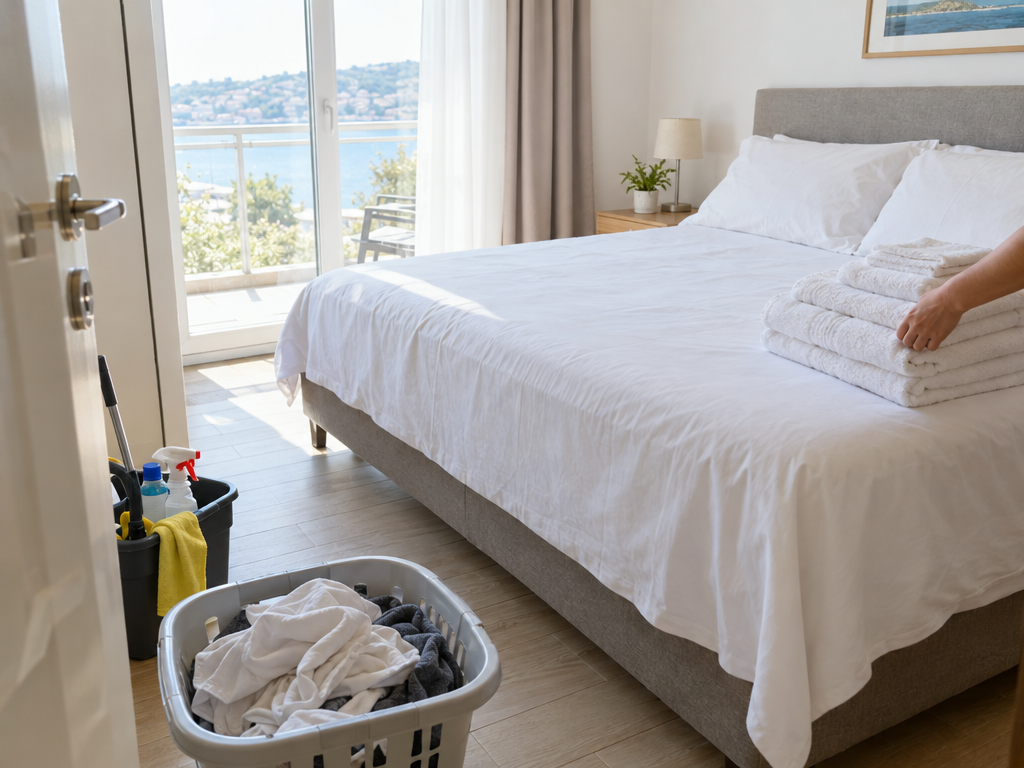
There are often just a few hours between check-out and check-in. You need a reliable cleaner with cover, enough sets of linen for at least two changeovers and a quick inspection after every departure. Our guide to the holiday rental cleaning fee explains how guests see final cleaning and what they should still do themselves. Set the fee transparently and include it in the total price.
Handling cancellations and rebookings
Without your own rules, statutory law applies to cancellations, and that is often unclear for both sides. So set deadlines and refunds before your first booking and state them in the listing and the confirmation. Our guide to holiday rental cancellation explains the legal position and how guests view cancelling. Moving a booking to another date is often better for both sides than a refund.
Protection against damage
A broken glass is normal; water damage is not. Check whether your buildings, contents and liability insurance cover letting to holidaymakers, as many policies do not include it automatically. Some hosts ask for a deposit, and on platforms their own damage protection schemes partly take on this role. Our guide to holiday rental insurance explains which policies are worth considering.
Reviews and guest book
Reviews help decide whether someone books. Ask politely after every stay and reply to every review, including critical ones. A factual response that acknowledges the problem and says what you have changed is often read more closely by future guests than the criticism itself.
A guest book in the apartment complements the reviews: guests leave tips and greetings that later visitors enjoy reading. For you, it is honest feedback on what people liked, including from guests who never write an online review.
Income and the tax office
Income from a holiday apartment is taxable, depending on the case as rental income or as business income, and VAT may also apply. Clarify which rules apply to you with the tax office or a tax adviser; our guide to holiday rental tax in Germany gives an overview.
Checklist: renting out a holiday apartment in twelve steps
This checklist sums up the points you should have dealt with before you start. It does not replace an assessment of your individual case.
- Check the declaration of division and community regulations; as a tenant, obtain your landlord’s consent.
- Ask your municipality about permits, registration and visitor’s tax.
- Check with the tax office and trade office whether you need to register a business.
- Check that your insurance covers letting to holidaymakers.
- Draw up a worked example with your own figures, including your time.
- Furnish the apartment and buy sets of linen and spare parts.
- Take photos in daylight and write the description and house rules.
- Choose platforms and your own booking channel, and connect the calendars.
- Set prices, minimum stay, booking and cancellation terms.
- Set up a check-in solution and prepare arrival information with photos.
- Arrange a cleaner with cover and a routine for changeover days.
- Prepare message templates, an emergency number and a review request.
If you are thinking of renting out a holiday apartment and work through this checklist beforehand, you will avoid the most common first-year mistakes.
Renting out a holiday apartment: tips from experience
From more than 80,000 guest stays, Daniel Schulz has picked up a few tips that apply to anyone who wants to let a holiday apartment.
- Describe it honestly: mentioning the noisy road or the steep stairs may cost you a booking, but it prevents bad reviews.
- Keep spares to hand: a second key, spare light bulbs, batteries for the remote control, a second mattress protector.
- Focus on repeat guests: anyone who was happy once will book again, with no commission to pay.
- Involve the neighbours: a phone number for complaints and brief house-rule information for guests take the pressure off the building.
- Review your figures every month: occupancy, average price and cost per changeover show early on whether the sums add up.
What you need to bear in mind when letting a holiday apartment fits into one sentence. Treat the apartment like a small business, with clear processes and honest figures.
Conclusion
Renting out a holiday apartment pays off if you have checked permission, occupancy and costs beforehand and consciously decide to shoulder the ongoing workload yourself or hand it over; if, on the other hand, you are looking for somewhere to stay yourself, you will find apartments with kitchens in Lehel from autumn 2027 – more on our page about accommodation in Munich.
Frequently asked questions about renting out a holiday apartment
Is it worth renting out a holiday apartment?
That depends on location, occupancy and how much time you put in. After deducting commission, laundry, utilities and maintenance, there is often considerably less left than the nightly rate suggests. Always compare the result with a normal tenancy and with your own workload.
Can I let my freehold flat as a holiday apartment?
In principle yes, provided the declaration of division and community regulations do not exclude letting to holidaymakers and the municipality either does not require a permit or has granted one. According to the Federal Court of Justice (judgment of 12 April 2019, V ZR 112/18), a later ban by majority vote of the owners is only possible with the consent of all owners. Check both documents before you invest.
Can I let a holiday apartment without registering a business?
Often yes: if you let a single apartment without hotel-style extras, you are generally managing your own assets. It may count as a business if the scale and services resemble an accommodation establishment, for example with breakfast, daily cleaning or many units. There is no fixed threshold; if in doubt, ask the trade office and the tax office.
Where do I have to register a holiday apartment?
Depending on your case, with the tax office, the trade office and the municipality. The income goes in your tax return, a business is registered with the trade office, and some cities require a permit or registration. Since 1 January 2025, only foreign guests have to fill in a registration form.
Which platform is best for renting out a holiday apartment?
There is no single best platform for everyone. Large platforms bring reach but charge commission; regional platforms and your own website with direct booking are cheaper but need returning guests and upkeep. Many hosts combine two or three channels and synchronise the calendars with a channel manager.
How much does it cost to have a holiday apartment managed?
Agencies and property managers usually charge a share of revenue; the amount depends on the scope of services: marketing only, or also guest communication, check-in, laundry and inspections. Always compare offers with the same scope of services and ask which costs are charged on top.
Do I need a permit for a holiday apartment?
Each municipality decides this for itself. In cities with housing shortages, permanently letting to holidaymakers often requires a permit, while in holiday regions planning law tends to play a bigger role. Ask your town or municipality before you publish your first listing.
What do I need to consider when renting out a holiday apartment?
First clarify permission (owners’ association, landlord, municipality), then registration and the tax office. After that come prices, booking terms, furnishings, check-in and a reliable routine for changeover days. The checklist in this article sums up the steps.

Daniel Schulz · Managing Director of residir GmbH
He has eight years’ experience in letting and managing serviced apartments and has looked after more than 80,000 guest stays. More about Daniel Schulz