
By Daniel Schulz, residir GmbH · Last updated: 14 October 2026
An accessible holiday apartment is accommodation that people with walking difficulties, wheelchair users and guests with visual or hearing impairments can use without outside help. In Germany the benchmark is the DIN 18040-2 standard, which distinguishes between “barrier-free” (barrierefrei) and the stricter “wheelchair-accessible” (rollstuhlgerecht). Because many listings use these terms loosely, what ultimately counts are specific measurements, photos and a verified certification.
This guide explains the terms, shows what lies behind the “Reisen für Alle” (Travel for All) certification and gives you a checklist and questions to ask the host when booking. Using Munich as an example, you will see how to get around with trains, buses and mobility aids. Information correct as of October 2026.
In this article:
- What does barrier-free mean?
- Barrier-free or wheelchair-accessible
- The “Reisen für Alle” certification
- Booking checklist
- Questions for the host
- Finding options: city, lake, coast
- Getting around Munich step-free
- Hiring mobility aids
- With an assistance dog
- Conclusion
- Frequently asked questions
| Term | Meaning | Suitable for |
|---|---|---|
| Barrier-free (DIN 18040-2) | Manoeuvring spaces 120 × 120 cm, interior doors from 80 cm, thresholds no higher than 2 cm | Guests with a rollator, walking stick or limited mobility |
| Wheelchair-accessible (“R”) | Manoeuvring spaces 150 × 150 cm, doors from 90 cm, no thresholds | Wheelchair users |
| Low-barrier (barrierearm) | not standardised, fewer obstacles | only after checking the measurements |
| Senior-friendly | not standardised, usually a lift and level-access shower | older guests, depending on facilities |
| “Reisen für Alle” | nationwide certification with on-site inspection | anyone who wants verified information |
What does barrier-free mean for a holiday apartment?
Under the German Disability Equality Act (Behindertengleichstellungsgesetz), barrier-free means that people with disabilities can use a facility in the usual way, without particular difficulty and, in principle, without outside help. For homes, DIN 18040-2 sets this out in concrete terms with measurements for doors, hallways, bathrooms and manoeuvring spaces. However, calling a holiday apartment barrier-free is not a legally protected claim.
That is exactly the problem when searching. Some hosts mean by barrier-free that there is a lift. Others have installed a level-access shower but have a step at the front entrance. If you rely on a wheelchair, read the word in a listing as a prompt to ask questions, not as a guarantee.
Low-barrier, senior-friendly and disabled-friendly
Besides barrier-free and wheelchair-accessible, listings use other terms too. Low-barrier and senior-friendly are not standardised and usually describe an apartment with few steps, a lift or a low shower tray. Disabled-friendly (behindertengerecht) is an older term that has largely been replaced by barrier-free. For all three, only concrete measurements will show whether the apartment suits you.
Barrier-free or wheelchair-accessible: the difference under DIN 18040-2
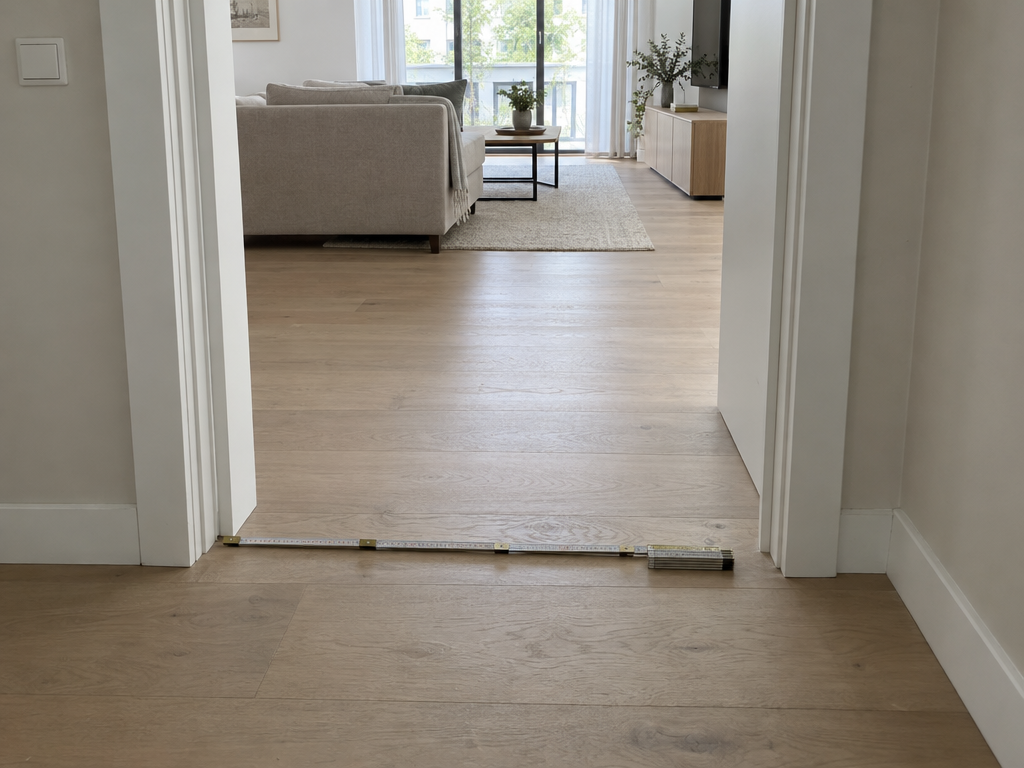
DIN 18040-2 has two levels. The basic level is “usable barrier-free”, and the stricter level is “fully usable by wheelchair”, often abbreviated to “R” in plans and listings. A wheelchair-accessible holiday apartment therefore meets more requirements than a barrier-free one, not the other way round.
| Feature | Barrier-free | Wheelchair-accessible (R) |
|---|---|---|
| Doors inside the apartment, bathroom, WC | clear width from 80 cm | clear width from 90 cm |
| Building entrance | from 90 cm | from 100 cm, ideally automatic |
| Thresholds | no higher than 2 cm, bevelled | no thresholds |
| Manoeuvring space in front of doors, in the bathroom, in the shower | 120 × 120 cm | 150 × 150 cm |
| Space beside the WC | 90 cm on one side | 90 cm on both sides |
| Washbasin | wheelchair-accessible underneath | wheelchair-accessible underneath |
| Car parking space | 350 × 550 cm | 350 × 550 cm |
The figures help you compare, but they are no substitute for your own measurements. A wide electric wheelchair needs more space than a narrow active wheelchair, and if you transfer sideways from your wheelchair onto the WC, you need the free space on the correct side. So before travelling, measure the width and turning circle of your wheelchair and compare these figures with the host’s information.
Accessibility is not only about wheelchairs. For guests with visual impairments, high-contrast edges, tactile controls and good lighting matter; for guests with hearing impairments, a smoke alarm with a visual signal and a doorbell with a flashing light. Include these points in your enquiry too.
The “Reisen für Alle” certification: verified rather than claimed
“Reisen für Alle” (Travel for All) is Germany’s nationwide certification system for accessible tourism offers. It was developed by the Deutsches Seminar für Tourismus in Berlin, and today Bayern Tourist GmbH acts as the national coordinating and inspection body. A host’s self-assessment is not enough: trained assessors measure and document the property on site.
- Accessibility information: detailed, verified information is available for you to assess yourself.
- Accessibility verified: the criteria are partly or fully met for certain groups, awarded as “partially accessible” or “accessible”.
- Pictograms: these show who the criteria apply to, for example walking difficulties, wheelchair users, hearing or visual impairments, deafness, blindness and cognitive impairments.
- Validity: three years, after which the data is updated.
The biggest advantage lies in the inspection reports. Instead of just “barrier-free”, they state, for example, how wide the bathroom door is and how high the WC is. If you book a holiday apartment with this certification, you can compare the information with your own measurements rather than relying on a description. Only a few holiday apartments carry the certification, but many hosts will share the data on request.
Checklist: how to recognise an accessible holiday apartment
The following points cover the most common obstacles. Not every point matters to every guest, so go through the list with your own requirements in mind.
Access, lift and parking
It starts with the route from the car or bus stop to the apartment door. Ask about steps at the building entrance, about a ramp and its gradient, and about the surface, as gravel or cobblestones slow down wheelchairs and rollators. If the apartment is not on the ground floor, you need a lift whose car you can use with a wheelchair and a companion. As a guideline for wheelchair users, the lift car should be at least 110 × 140 cm.
For many guests, a parking space right by the building matters more than anything else. DIN 18040-2 specifies 350 × 550 cm for a wheelchair-accessible parking space, so that the driver’s door can be opened fully. In city centres there is often only on-street parking, so check in advance whether there is a disabled parking bay nearby.
Doors and thresholds
Ask about the clear passage width of all doors, especially to the bathroom and bedroom. In older buildings, balcony and patio doors often have a high threshold. Rug edges, doormats and loose runners are also trip hazards that a host can remove before you arrive.
Bathroom: level-access shower and grab rails
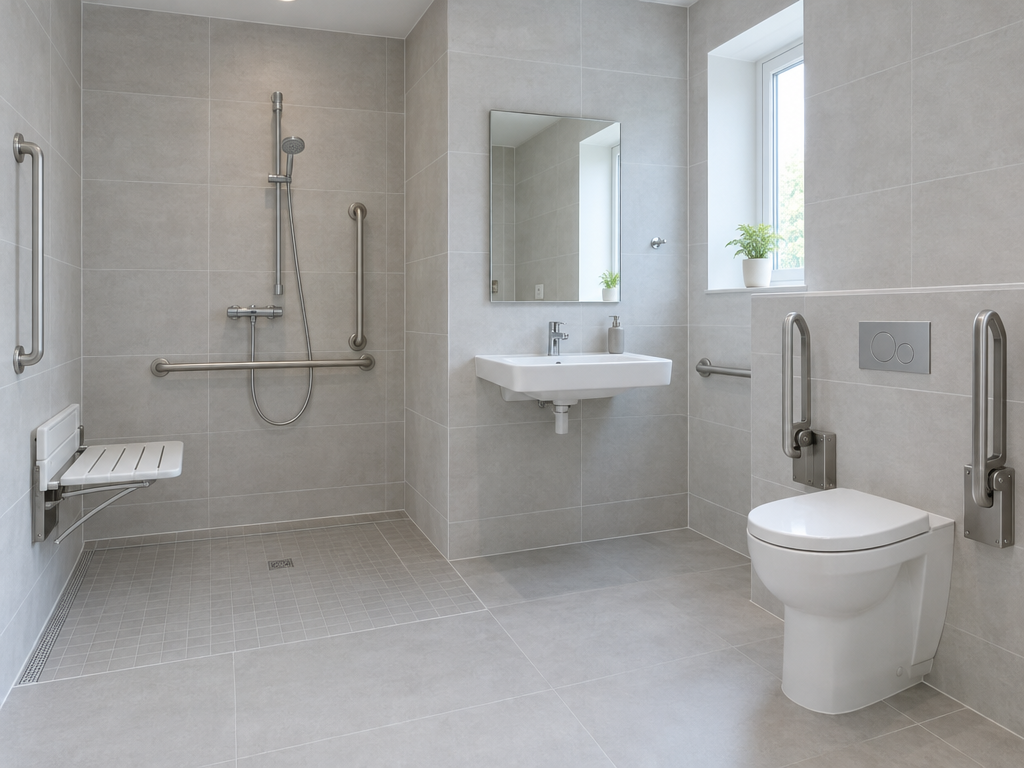
The bathroom is most often the deciding factor. What matters is a level-access shower with no lip, a fixed or folding shower seat, a single-lever mixer tap and a washbasin you can roll under. Hinged support rails help at the WC, on both sides in wheelchair-accessible bathrooms. For most wheelchair users, a bath is no substitute for a shower.
Bedroom and bed height
There needs to be enough space next to the bed to transfer. For wheelchair-accessible apartments, DIN 18040-2 requires a manoeuvring space 150 cm deep along one long side of the bed. The standard does not specify a bed height, so ask for the height of the mattress surface in centimetres and compare it with the seat height of your wheelchair. It also helps to know whether there is clearance under the bed so that a hoist fits underneath.
Kitchen, switches and controls
In the kitchen, what counts is a worktop you can roll under, a hob with front controls and cupboards at a reachable height. Light switches, sockets, window handles and the key box should be reachable from a seated position. For self check-in with a code lock, ask at what height the keypad is mounted.
- Access: step-free or ramp, firm surface, lift from 110 × 140 cm
- Doors: clear width of 80 cm (barrier-free) or 90 cm (wheelchair-accessible), no high thresholds
- Bathroom: level-access shower, shower seat, grab rails, washbasin you can roll under
- Sleeping: bed height in cm, space beside the bed, clearance under the bed
- Parking: space by the building or disabled parking bay nearby
- Safety: emergency call option, smoke alarm with visual signal for hearing impairments
Questions to ask the host before booking
A good enquiry saves you a nasty surprise on arrival. Be specific about what you need, and ask for measurements rather than a vague “yes, that’ll be fine”. These questions have proved useful:
- Are there any steps, thresholds or slopes between the parking space or stop and the apartment door?
- How big is the lift car, and how wide is the lift door?
- How wide are the doors to the bathroom and bedroom, measured as clear width?
- Is the shower level-access, how big is it, and is there a shower seat?
- Are there grab rails at the WC, and on which side of the WC is there space?
- How high is the bed, and how much space is there next to it?
- Could you send me photos of the entrance, bathroom and bedroom?
- Who can I contact if there is a problem during my stay, for example if the lift breaks down?
Get the answers in writing and keep the message. If it turns out on arrival that promised features are missing, you then have a basis for finding a solution with the host. Business travellers with disabilities ask the same questions, for instance when looking for accommodation for Messe Munich with long distances to cover on the exhibition grounds in Riem during the day.
Finding an accessible holiday apartment: city, lake or coast
The search is more laborious than for ordinary accommodation. Large booking platforms have accessibility filters, but the information usually comes from the hosts themselves. If you simply type “accessible holiday apartment” into the search box, you will get plenty of results, only some of which suit wheelchair users. The “Reisen für Alle” database and the websites of regional tourist boards, which list verified offers separately, are more reliable.
Wheelchair-accessible holiday apartments by the sea are especially in demand; on the North Sea and Baltic coasts there are now beach access mats and beach wheelchairs to hire. An accessible holiday apartment by a lake is also popular, for example at Lake Constance with its flat lakeside paths, or in the Allgäu with views of the mountains. If you are looking for a wheelchair-accessible holiday apartment in Germany, you will often find more verified options in holiday regions than in big cities.
In the city, supply is tighter, because many apartments are in period buildings with steps and no lift. Accessible options are rare among holiday apartments in Munich too, especially in the late-19th-century districts with raised ground floors. You are more likely to find an accessible holiday apartment in Munich in new-build properties, but always check the details case by case.
Besides classic holiday apartments, it is worth looking at newer buildings with apartments and hotel services. Lifts and step-free access are more common in new builds, because building regulations now require barrier-free homes. Whether an aparthotel in Munich also has wheelchair-accessible apartments is not a given, however, so ask for measurements there too.
Accessible travel: getting around Munich
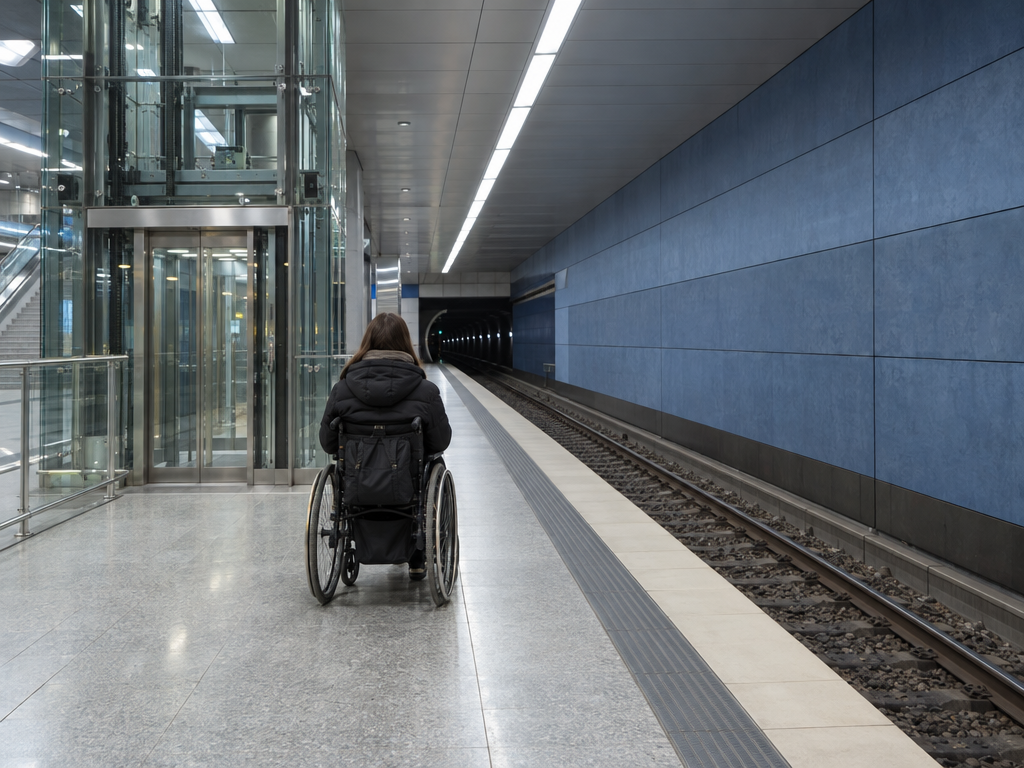
Once you have found suitable accommodation in Munich, getting around the city is comparatively easy. According to the MVV (Munich transport network), all 100 U-Bahn stations have step-free access, as do around 85 per cent of the 150 S-Bahn stations (as of October 2026). To find out whether a lift is currently working, call the U-Bahn operations centre on 089 21 91 33 33, or for the S-Bahn the 3S control centre on 089 1308 1055.
U-Bahn, tram and bus
Almost all trams are accessible via platform lifts or folding ramps, and 126 of the 148 tram stops are classed as barrier-free. City buses displaying the wheelchair symbol have a folding ramp at the middle door that can take up to 250 kg; a red button next to the door alerts the driver. On the U-Bahn, wait at the front end of the platform: since 2026, drivers on the older B-series trains will put down a folding ramp at the first door on request.
For journeys you would rather not make alone, the City of Munich offers a free escort service for buses and trains. It operates Monday to Friday from 8 am to 6 pm within the city and must be booked at least two working days in advance by phone on 089 544 91 89 20 (as of October 2026).
City tours and attractions
München Tourismus arranges an accessible old town tour on which trained guides adapt the route from Marienplatz via the Frauenkirche and Odeonsplatz to the Viktualienmarkt for guests using a wheelchair or with walking difficulties, visual or hearing impairments. The tour lasts around two hours and is booked as a group. The Tourist Information at Marienplatz answers questions on site, and a lift takes you up the town hall tower.
At Nymphenburg Palace, according to the palace administration, there is step-free access to the left of the main entrance, a lift with a 135 × 87 cm car takes you to the state rooms on the upper floor, and the Marstallmuseum (carriage museum) is at ground level. Most of the paths in the park are wheelchair-friendly; the Amalienburg can be reached via mobile ramps, while the Badenburg and Magdalenenklause are only accessible via steps.
According to FC Bayern, football fans will find 324 wheelchair spaces, 130 disabled parking spaces and audio description for visually impaired fans at the Allianz Arena, and on non-match days there are special tours for wheelchair users. Tickets for wheelchair spaces are sold from a separate allocation, which you should request early.
According to the operator, the path from the tram stop to Bavaria Filmstadt is tarmacked and step-free, and visitors with a severe disability receive a discount at the ticket office. Whether all the film sets on the tour are wheelchair-accessible and whether you can use the 4D cinema is best checked directly with the operator in advance.
Hiring mobility aids locally
Not every mobility aid fits in the car or on the train. Many medical supply shops (Sanitätshäuser) hire out shower stools, raised toilet seats, rollators, wheelchairs and sometimes care beds by the day or week and deliver to your holiday address. In Munich, München Tourismus lists a hire service for wheelchairs, rollators and mobility scooters at Stachus.
Order early, especially care beds and hoists, and check with the host whether the bed will fit through the door and hallway and whether someone can accept the delivery. For public toilets, the Euroschlüssel (Euro key) is worth having, as it opens many accessible WCs in Germany. The city also has a toilet finder showing accessible toilets in Munich.
Staying in a holiday apartment with an assistance dog
Since 1 July 2021, Section 12e of the German Disability Equality Act has provided that people with disabilities may enter facilities open to the general public with their assistance dog, such as a guide dog. For restaurants, shops and museums, this is clear. For an individual privately let holiday apartment, the situation is less clear-cut, so mention your assistance dog in your very first enquiry.
Legally, an assistance dog is not a pet, but many hosts do not make this distinction and point to a general ban on dogs. Written confirmation before booking saves discussions on arrival. If you are travelling with a family dog that is not an assistance dog, you will find tips on dog-friendly apartments in Munich on a separate page. This information is general guidance and not legal advice.
Conclusion
The safest way to find an accessible holiday apartment is through verified information such as “Reisen für Alle” and specific measurements for access, doors, shower and bed, which you have confirmed in writing before booking.
Frequently asked questions about accessible holiday apartments
What is the difference between barrier-free and wheelchair-accessible?
Wheelchair-accessible is the stricter level. Under DIN 18040-2, a barrier-free apartment needs manoeuvring spaces of 120 × 120 cm and interior doors with a clear width of at least 80 cm, whereas wheelchair-accessible (“R”) requires 150 × 150 cm, doors from 90 cm and threshold-free transitions. A barrier-free holiday apartment may therefore suit guests with a rollator but be too narrow for a wheelchair.
How can I recognise a verified accessible holiday apartment?
Most reliably by the “Reisen für Alle” certification. Trained assessors collect the data on site, and the certification is valid for three years. The “Accessibility verified” level uses pictograms to show which groups the criteria are partly or fully met for.
What door width does a wheelchair-accessible holiday apartment need?
Under DIN 18040-2, at least 90 cm clear width for doors inside the apartment and to the bathroom and WC; in wheelchair-accessible buildings the main entrance should be 100 cm wide. Ask for the clear width, i.e. the distance between the frame and the open door leaf, not the width of the door leaf itself.
What does low-barrier mean for a holiday apartment?
Low-barrier (barrierearm) is not a standardised term. It usually means there are fewer steps and a level-access or low shower, but the DIN 18040-2 measurements are not fully met. For such offers, always ask for specific measurements and photos.
What questions should I ask the host of an accessible holiday apartment?
Ask about steps at the entrance, lift dimensions, clear door widths, the shower (level access, size, shower seat), grab rails at the WC, the height of the bed and the space beside it, and a parking space close to the entrance. Ask for photos of the entrance, bathroom and bedroom and get the answers confirmed in writing.
Is Munich accessible by public transport?
Largely, yes. According to the MVV, all 100 U-Bahn stations have step-free access, as do around 85 per cent of the 150 S-Bahn stations, and almost all trams and city buses have low floors or folding ramps (as of October 2026). It is worth checking the journey planner before you travel, as individual lifts can be out of service.
Can I stay in a holiday apartment with an assistance dog?
Since 1 July 2021, Section 12e of the German Disability Equality Act has governed access with an assistance dog to facilities open to the general public. Whether this applies to an individual privately let holiday apartment is not clear-cut, so clarify it in writing with the host before booking.

Daniel Schulz · Managing Director of residir GmbH
He has eight years’ experience letting and managing serviced apartments and has looked after more than 80,000 guest stays. More about Daniel Schulz