

By Daniel Schulz, residir GmbH · Last updated: 14 October 2026
A workation combines regular working days with a stay somewhere else, for example two weeks in a holiday apartment. It requires your employer’s consent, as there is no legal entitlement. What makes it a success is reliable Wi-Fi, a quiet place to work and accommodation where you can organise everyday life easily.
We are currently fitting out a building with 54 apartments in Lehel, and some of the enquiries are already coming from people who want to come to Munich not for a holiday or a trade fair, but for a spell of work with the city around them. This guide explains what a workation is, what to agree with your employer, what matters in the accommodation and what a week in Munich might look like. Information as of October 2026.
In this article:
- What is a workation?
- Your employer and the legal requirements
- Working remotely abroad
- The right workation accommodation
- A workation in Munich
- Sample weekly plan
- Checklist
- Family workations and team workations
- Pros and cons
- Conclusion
- Frequently asked questions
| Question | Short answer |
|---|---|
| What is it? | Working in a different place, with leisure time around it |
| Entitlement? | No, only with your employer’s consent |
| Within Germany | Working Hours Act, data protection and availability apply as when working from home |
| Elsewhere in the EU | An A1 certificate is usually required; check tax issues |
| Accommodation | Wi-Fi with good upload speed, workspace, peace and quiet, kitchen, washing machine |
| Sensible length | One to three weeks |
What is a workation? Meaning and definition
So what exactly is a workation? The word blends “work” and “vacation”. A common definition is: for a limited period, you work from a place where you would otherwise go on holiday and carry out your normal job there. Before and after the working day, and at weekends, you have time to explore the area.
What does a workation mean in practice? Working days remain working days, so you do not use up any annual leave. If you add holiday days on top, mark them clearly in your calendar. The point of a workation is therefore less about the holiday and more about the change of scene: the same work, but with a different view from the window and a new way to spend your evenings.
How it differs from remote work, bleisure and digital nomads
Remote work is the umbrella term for working outside the office, usually on a permanent basis from home. A workation, by contrast, is limited in time and tied to a specific place. With bleisure, business travellers extend a work trip by a few personal days, so the reason for the trip is professional.
Digital nomads, finally, have no fixed place of work and move from place to place over months, often as freelancers. If, on the other hand, you are employed and work for two weeks from an apartment in another city, that is a workation. So what is a workation at its core? A temporary change of location, agreed with your employer.
A workation in Germany: your employer and the legal requirements
A workation in Germany is legally fairly straightforward, as long as your employer agrees. This applies to any workation within Germany, i.e. without crossing a border. There is no legal entitlement. Your employer determines your place of work within the scope of your employment contract through its right to give instructions under Section 106 of the German Trade Regulation Act (Gewerbeordnung). Simply working from somewhere else without consent can therefore have consequences under employment law.
How do you put a workation on a sound legal footing? Record the agreement with your employer in writing; a short email is often enough. The key requirements are:
- Dates and location of the workation, including the address of the accommodation
- Working hours and availability, including any time difference
- Data protection: VPN, privacy screen, no confidential conversations in public spaces
- Work equipment: who is liable for the laptop and accessories while travelling?
- Who pays for what: travel and accommodation are usually paid by the employee
Many companies now have their own workation policy. If there is a works council, it has a right of co-determination over how mobile working is organised (Section 87(1) No. 14 of the Works Constitution Act). So ask first whether there is a works agreement. Involving your employer and team early on saves discussions about availability later.
The Working Hours Act (Arbeitszeitgesetz) also applies on a workation: as a rule, no more than eight hours per working day, up to ten with compensation, and a rest period of eleven hours between two working days. Working on holiday, i.e. answering emails on genuine days off, is something else and should remain the exception, especially on a workation. This information is general and does not constitute legal or tax advice.
Workation tax and costs within Germany
For workation tax within Germany, there is a simple rule of thumb: if you choose the location yourself for personal reasons, travel and accommodation are private expenses and usually cannot be deducted as work-related expenses. If your employer covers such costs, this may be taxable as salary. Your payroll department can tell you whether an allowance remains tax-free.
Working remotely abroad: A1 certificate and social security
This guide focuses on Germany, but here is a brief word on working remotely abroad. If you work temporarily in another EU state, the EEA or Switzerland, you usually remain in the German social security system, but you have to prove this with an A1 certificate. For a workation, your employer applies for it electronically, depending on the case either with your health insurance fund or with the German Pension Insurance (Deutsche Rentenversicherung).
In 2026 the EU provisionally agreed that an A1 certificate should no longer be required for very short business stays of up to three days within 30 days. As of October 2026, this rule is not yet in force, and it is aimed at business trips, not a workation lasting several weeks. For workation social security purposes, the A1 certificate therefore remains mandatory for the time being.
Then there are tax questions: longer stays abroad can trigger a tax liability there, and for companies the risk of creating a permanent establishment is also an issue. Outside the EU, you may need a work permit. That is why many employers limit workations abroad to a few weeks a year or only allow destinations within Germany.
Workation accommodation: why a holiday apartment with Wi-Fi beats a hotel room
When choosing workation accommodation, many people underestimate how different two weeks of work feel from two weeks of holiday. A hotel room is practical for three nights, but it often lacks a proper table to work at, and every meal has to be eaten out. A holiday apartment with Wi-Fi offers more space, your own kitchen and a daily rhythm that feels like home.
Workation hotels now advertise coworking corners and package prices, and for short stays a workation hotel can be a good fit. If you are staying longer, you are usually better off with a workation apartment, because cooking, laundry and a separate work area keep everyday life running smoothly.
Check the Wi-Fi before you book
“Fast Wi-Fi” appears in almost every listing. So ask specifically about download and upload speeds in Mbit/s or for a recent speed test. For video conferences, the upload speed is what counts, and that is exactly what is weak on some connections.
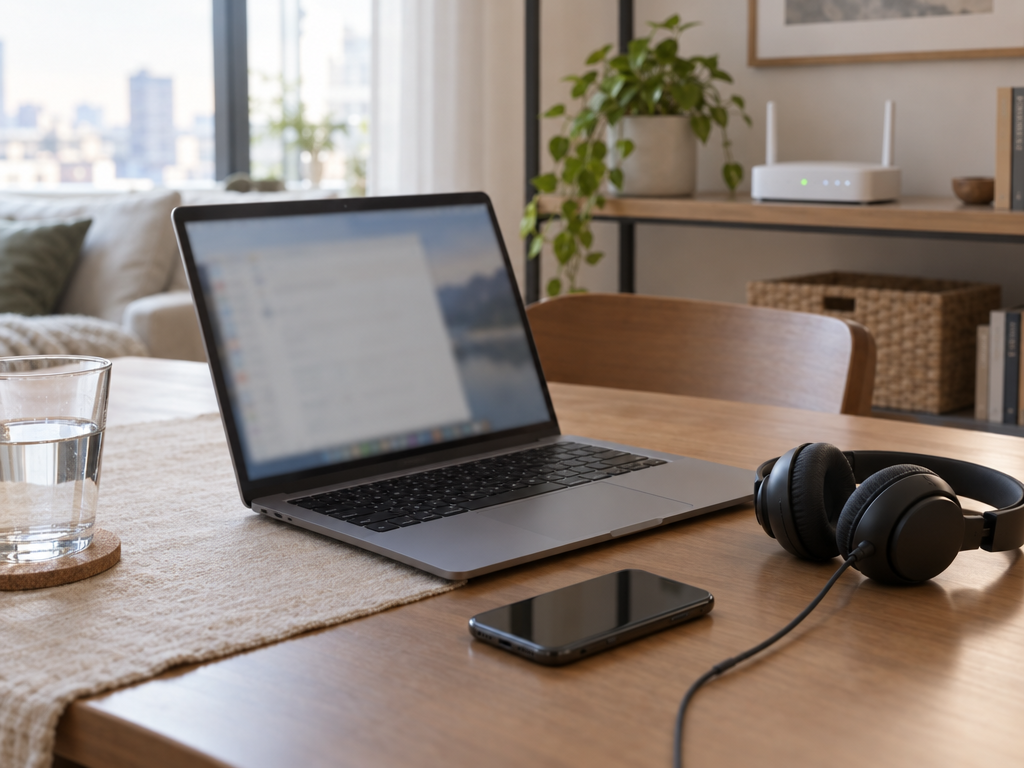
With holiday apartment Wi-Fi, also check whether the apartment has its own network or shares one with the whole building, and whether there is a LAN connection. Pack a mobile hotspot with enough data as a backup. If you have calls every day, test the connection first on the day you arrive, and only then explore the city.
Workspace, peace and quiet, kitchen and washing machine
- Workspace: a table at working height and a chair you can sit on for eight hours; ask for photos of the dining area or desk.
- Peace and quiet: facing the courtyard or the street, building work nearby, separation of sleeping and working areas.
- Kitchen: cooking lunch yourself saves time and money, as does a fridge for the weekly shop.
- Washing machine: for stays of a week or more, you can travel much lighter with half a suitcase.
- Light and sockets: daylight at your workspace and enough sockets within reach.
A holiday apartment in Munich with these basics is often more practical for a workation than a room on the outskirts, because distances stay short and your lunch break does not disappear on the U-Bahn. Check how close it is to the U-Bahn and S-Bahn so you can get to coworking days or appointments without detours.
If you are staying for several weeks and would like services such as laundry and cleaning included, a boarding house offers a mix of apartment and hotel service. Whatever you choose, have the terms, additional costs and holiday apartment essentials confirmed in writing before booking.
Work in Lehel, unwind by the Isar
In autumn 2027, a total of 54 apartments open at Ländstraße 6, each with its own kitchen, fast Wi-Fi and 24-hour safe check-in, plus washing machines and dryers in the building. We will tell you how the individual categories are set up for working when you enquire. For company bookings and longer projects, find out more on our page about serviced apartments in Munich.
A workation in Munich: coworking, breaks by the Isar and short distances
Munich is well suited to a workation because work and leisure are close together here. From Lehel you can walk to the old town, the Isar is a few minutes away on foot, and with the U4/U5 from Lehel or the S-Bahn from Isartor you can quickly reach the rest of the city. S-Bahn lines S1 and S8 run along the main trunk line and therefore also go from Isartor to the airport.
Coworking in Munich
Coworking in Munich usually works with day or week passes that you book online. A coworking space in Munich is particularly worthwhile on days with lots of calls, when you want company or need a fixed monitor. Many providers have locations in the city centre, in Schwabing and in the Werksviertel; it is best to check prices and opening times directly on their websites.
A mix has proved its worth: focused work in the apartment, plus one or two coworking days a week for variety and contact with others. Check with your employer beforehand whether working in a coworking space is acceptable from a data protection point of view.
Breaks by the Isar and in the English Garden
A lunch break by the Isar is one of the reasons Munich works so well for a workation. From Lehel it is just a few minutes to the riverbank, around 18 minutes on foot to the Eisbach and under 20 minutes to the English Garden in Munich. A stroll by the water after your last call replaces the commute home from the office.
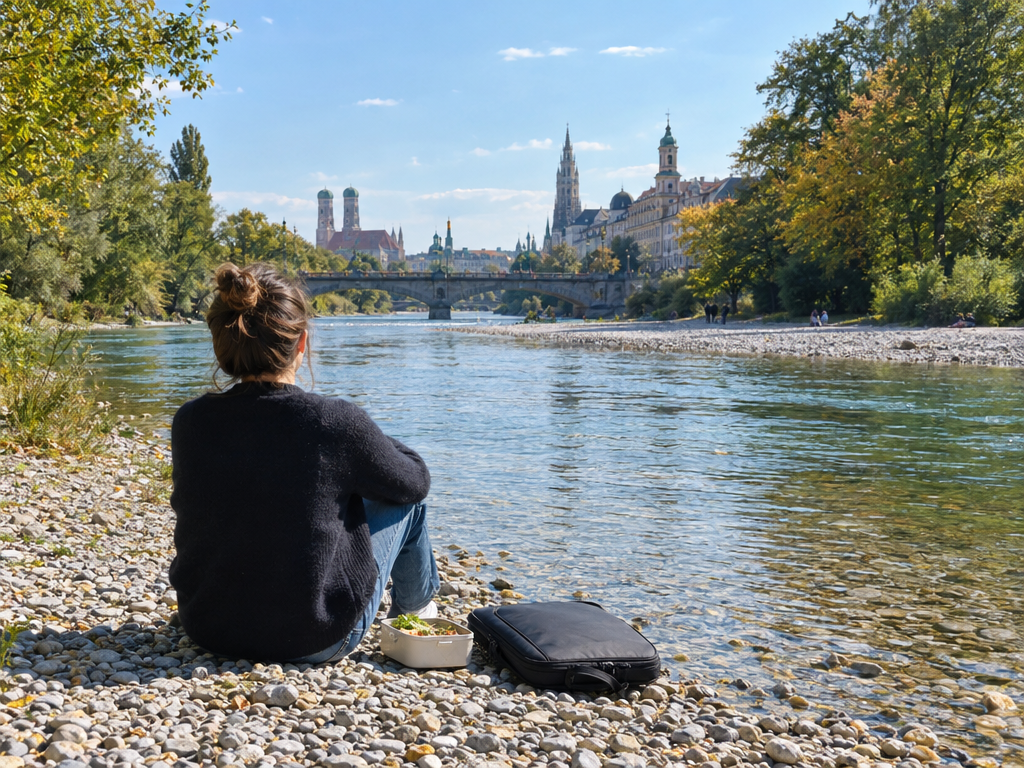
After work, a sauna or swim is a good idea, for example at the Müllersches Volksbad by the Isar; you will find more addresses in our guide to Munich spa and wellness options. The building at Ländstraße 6 has an outdoor sauna that you can use after a long working day without having to travel anywhere.
Public transport
You do not need a car for a working week in Munich. U-Bahn, S-Bahn, tram and bus are all part of the MVV network, and the Deutschlandticket is valid throughout. If you are only planning a few journeys, a strip ticket or day ticket will do. Fares and prices change regularly, so check the latest information on the MVV website.
If you would rather head to the mountains at weekends, many destinations in the Alpine foothills are around an hour away by regional train. A workation in the Alps is an alternative with more nature but often a weaker signal; Munich as a base with day trips combines both.
Planning a workation: a sample weekly plan
When planning a workation, schedule your free time as deliberately as your work, otherwise your workation turns into a week of working from home in a different bed. The following weekly plan is an example of a working week from Lehel, with fixed work blocks and short distances.
| Day | Work | Breaks and evenings |
|---|---|---|
| Sunday | Arrive, test the Wi-Fi, set up your workspace | Weekly food shop, walk along the Isar |
| Monday | 8:30–17:00 in the apartment | Lunch break on the banks of the Isar, cook in the evening |
| Tuesday | Coworking day for calls and networking | Evening in the old town, Viktualienmarkt around 9 minutes on foot |
| Wednesday | 8:30–17:00 in the apartment, laundry on the side | Evening stroll through the English Garden |
| Thursday | Focus day without meetings | Sauna or swim after work |
| Friday | Early start, early finish | Museum or beer garden in the afternoon |
| Saturday/Sunday | free | Day trip to a lake or the mountains |
Try not to schedule fixed-time appointments on the day you arrive, and keep your first working day free of important presentations. A fixed end to the working day helps you actually make the most of your free time, especially when work and living space are in the same room.
Checklist for your workation holiday apartment
This checklist sums up what you should take care of before and during a workation in a holiday apartment. You will find the general list for clothes, kitchen and bathroom in our holiday apartment packing list.
- Your employer’s consent in writing, with dates and address
- For destinations abroad: clarify the A1 certificate and tax questions via your employer
- Ask the host about Wi-Fi upload and download speeds, pack a mobile hotspot
- Request photos of the workspace; bring a laptop stand and external keyboard if needed
- Headset with microphone for calls in rooms with thin walls
- Multi-socket extension lead and chargers
- Test VPN access and two-factor authentication before you leave
- Weekly plan with work blocks and fixed breaks
- Have the washing machine and kitchen equipment confirmed in advance
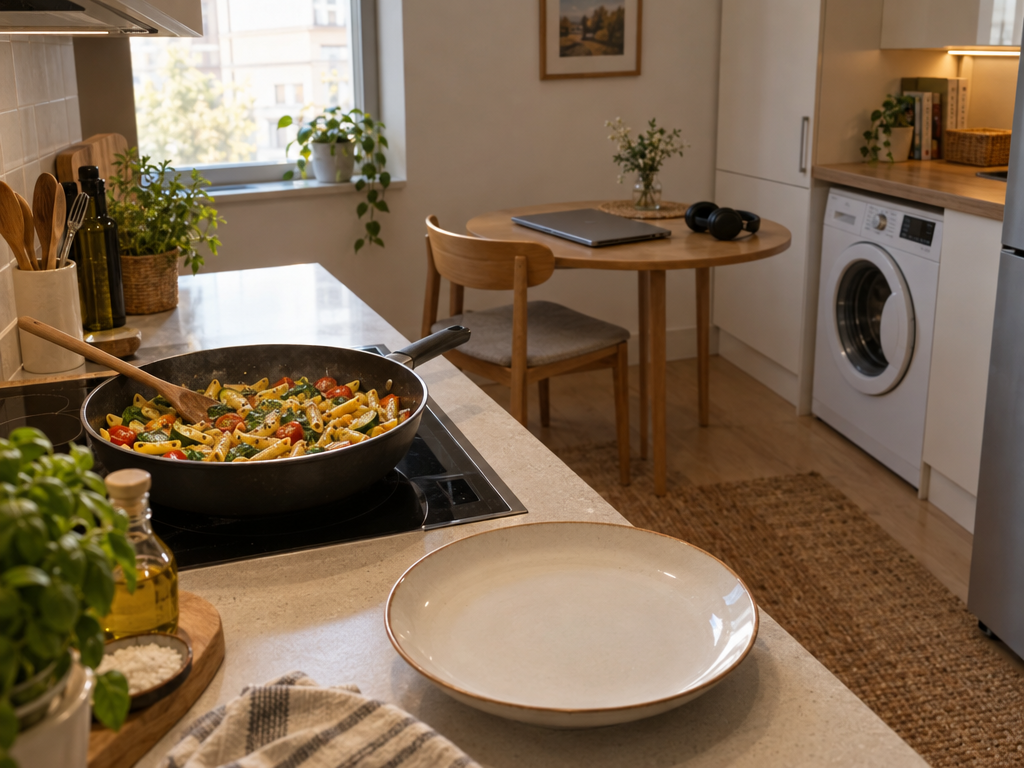
With workation deals from platforms and hotels, it pays to look at the details: is the Wi-Fi promise measurable, is there a table at working height, and are cleaning and laundry included in the price? If you book a workation directly with the host, you can clarify such questions in advance and get them confirmed in writing.
Family workations and team workations
On a family workation, one or both parents work while the children are on holiday. This only works with a clear division of roles: who is looking after the children when, and who is working when? An apartment with a separate bedroom that can be used for work during the day matters more here than the location.
A team workation brings several colleagues together in one place for a week, often for strategy days or a joint project. This requires neighbouring apartments and a room for group sessions. For trade and installation teams, there is also dedicated workers’ accommodation in Munich designed for longer assignments.
Pros and cons of a workation
The benefits of a workation are mainly in the mind: a new place breaks the routine, and many employees report greater motivation and concentration. For employers, workations are a selling point when recruiting skilled staff. And you get to see a city in everyday life, not just at holiday pace.
The downsides are just as clear. The line between work and leisure easily blurs, poor Wi-Fi can ruin a whole week, and you are harder for your team to reach. On top of that come the costs of accommodation and travel, which you usually pay yourself.
| Pros | Cons |
|---|---|
| New surroundings, more motivation | Work and leisure easily blur |
| No annual leave needed | Costs for accommodation and travel |
| Experience a city’s everyday life | Dependent on Wi-Fi and workspace |
| Attractive for skilled workers | Abroad: extra effort with A1 and tax |
If your workation turns into a longer stay, for example for a project lasting several months, furnished apartments in Munich rented on a temporary basis are often a better fit than a holiday apartment charged by the night.
Conclusion
A workation in a holiday apartment works when three things are right: your employer’s written consent, Wi-Fi with a good upload speed and a place where you can genuinely switch off after work – in Munich, for example, with the Isar just minutes from your door. If you are staying longer and value services such as laundry and cleaning, also take a look at a boarding house in Munich.
Frequently asked questions about workations
What is a workation?
A workation is a stay in a different place during which you work for your employer as normal and use the free time before and after for a holiday. The word combines “work” and “vacation”; legally, the working days are regular working time, not annual leave.
Am I entitled to a workation?
No, there is no legal entitlement to a workation in Germany. Your employer determines where you work within the scope of your employment contract, so every workation needs its consent, ideally in writing.
Do I need an A1 certificate for a workation abroad?
Yes, if you work temporarily in another EU state, the EEA or Switzerland, you usually need an A1 certificate, which your employer applies for. A relaxation provisionally agreed by the EU in 2026 only covers very short business trips and, as of October 2026, is not yet in force.
How fast should the Wi-Fi be for a workation?
For video calls, the upload speed matters most, not just the download. Ask the host for both figures in Mbit/s or for a recent speed test before booking, and bring a mobile hotspot as a backup.
Is a holiday apartment or a hotel better for a workation?
For stays of around a week or more, a holiday apartment is usually more practical, as you have more space, your own kitchen and often a washing machine. A hotel is more worthwhile for a few nights, when breakfast and service matter more than space to work.
How much does a workation cost?
The costs are mainly accommodation, travel, food and possibly a coworking pass. Because you can cook for yourself in a holiday apartment, food costs stay manageable, and you do not use up any annual leave for the working days.
Can I deduct the costs of a workation from my taxes?
Usually not, because a workation is a private matter if your employer does not require the change of location. If your employer covers costs, this may count as taxable salary; clarify individual cases with your payroll department or a tax adviser.
How long should a workation last?
One to three weeks has proved effective. Anything shorter rarely justifies the effort of travelling there and back; anything longer usually needs a more detailed agreement with your employer and accommodation with a washing machine.

Daniel Schulz · Managing Director of residir GmbH
He has eight years’ experience in letting and managing serviced apartments and has looked after more than 80,000 guest stays. More about Daniel Schulz