
By Daniel Schulz, residir GmbH · Last updated: 13 October 2026
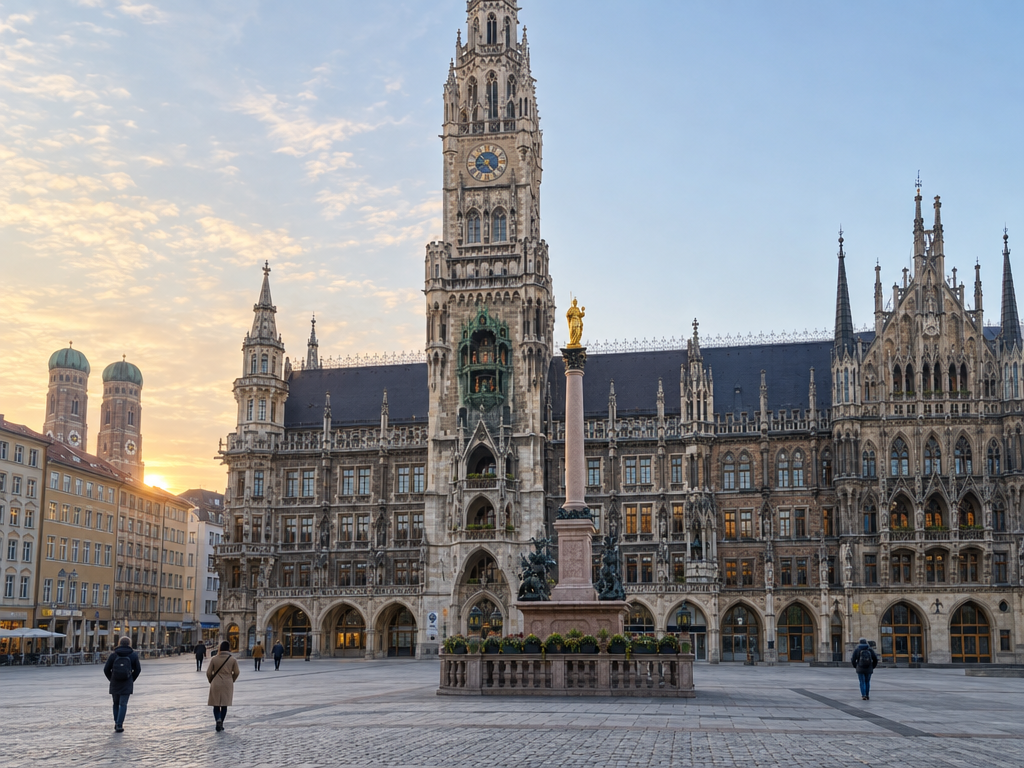
Marienplatz in Munich has been the heart of the city since it was founded in 1158, and it costs nothing to visit. On its north side stands the New Town Hall with the Glockenspiel, which plays daily at 11 am and 12 noon, and from March to October also at 5 pm. The Mariensäule (Column of St Mary) rises in the centre, and on the east side is the Old Town Hall with the Toy Museum.
From our building on Ländstraße in Lehel it is around a twelve-minute walk to Marienplatz, through the Isartor gate and along the Tal. This guide shows you what to see on the square, when the Glockenspiel plays, how to get up the town hall tower and at what time of day it is less crowded. Times and prices are a guide, as of October 2026.
In this article:
- Marienplatz Munich at a glance
- New Town Hall and town hall tower
- Glockenspiel: times and figures
- Mariensäule and Fischbrunnen
- Old Town Hall and Toy Museum
- Walking tour from Lehel
- Food and cafés on Marienplatz
- Getting there and parking
- Christmas market, title celebrations and Pride
- Best time and crowds
- Conclusion
- Frequently asked questions
| Topic | Quick answer |
|---|---|
| Glockenspiel | daily at 11 am and 12 noon, March to October also 5 pm, night performance 9 pm |
| Town hall tower | lift, daily 10 am to 8 pm, from €7 for 20 minutes |
| Mariensäule | erected in 1638, zero point for distances to Munich |
| Toy Museum | in the tower of the Old Town Hall, daily 10 am to 5.30 pm |
| Getting there | S-Bahn (Stammstrecke), U3 and U6 to Marienplatz |
| On foot from Lehel | about 12 minutes |
| Admission to square and Glockenspiel | free |
Marienplatz Munich at a glance: location and history
Marienplatz lies right in the middle of Munich’s old town, where, according to Munich Tourism, two important trade routes already met when the city was founded. To the west, the pedestrian zone leads along Kaufingerstraße to Stachus; to the east, you pass through the Old Town Hall into the Tal and on to the Isartor. International visitors search for it as Marienplatz Munich, and it is always the same place.
According to Munich Tourism, the square was a grain market for a long time and was therefore called Schrannenplatz until 1854. On 9 October 1854 the city council renamed it Marienplatz, in the hope of bringing a cholera epidemic to an end. The food market had already moved a few steps away in 1807 and is today’s Viktualienmarkt.
Today Marienplatz is Munich’s meeting point, transport hub and stage all at once. Many guided city tours start here, FC Bayern celebrates its titles here, and during Advent the stalls of the Christkindlmarkt (Christmas market) fill the square. Thirty minutes are enough for the square itself; add the town hall tower and Alter Peter church and it becomes half a morning.
Munich’s New Town Hall and the town hall tower
The New Town Hall (Neues Rathaus) dominates the entire north side of the square. According to muenchen.de its façade is 98.5 metres long and looks medieval, but it was only built between 1867 and 1905 to designs by Georg von Hauberrisser. The Lord Mayor and city council still sit here today, so Munich’s town hall is a working building rather than a museum.
Right at the top of the 85-metre tower stands the Münchner Kindl, a figure by the sculptor Anton Schmid. It is the city’s heraldic symbol, and you will come across it all over Munich on manhole covers, beer steins and trams.
Going up the town hall tower: opening hours and prices
You reach the top of the town hall tower by lift, so there are no stairs to climb. The ride starts on the 4th floor, and you will find the entrance in the passage to the Prunkhof courtyard. According to Munich Tourism, the viewing platform is open daily from 10 am to 8 pm, with the last ride up at 7.40 pm (as of October 2026).
- Tickets: from €7 for a 20-minute time slot, online or at the Tourist Information office on Marienplatz.
- Space: a maximum of 30 people on the platform at once, so booking ahead is worthwhile.
- Luggage: rucksacks and larger bags are not allowed, and there are no lockers.
- Closed: according to muenchen.de, on New Year’s Day, Epiphany, Shrove Tuesday, 1 May, All Saints’ Day and over Christmas, among other days.
The view from the town hall tower stretches across Munich’s rooftops to the Frauenkirche and, when the Föhn wind clears the air, all the way to the Alps. It is similar to the view from Alter Peter opposite, just without the roughly 300 steps. If you want to compare both, take the lift here and save the stairs for another day.
Prunkhof and town hall tours
Through the tower portal you can enter the Prunkhof, one of the six inner courtyards, free of charge. A mosaic in the form of a labyrinth is set into the ground. If you also want to see the halls and the town hall balcony, book a town hall tour with Munich Tourism; according to muenchen.de these cost from €28 and last 90 to 120 minutes.
Guests in town on business often only have one free evening. If you are coming for a trade fair, it is best to fit in the town hall tower before dinner; accommodation for Messe Munich in the city centre keeps these journeys short, and you reach the Messe in Riem with a single change to the U2.
Munich Glockenspiel: times, figures and the coopers’ dance
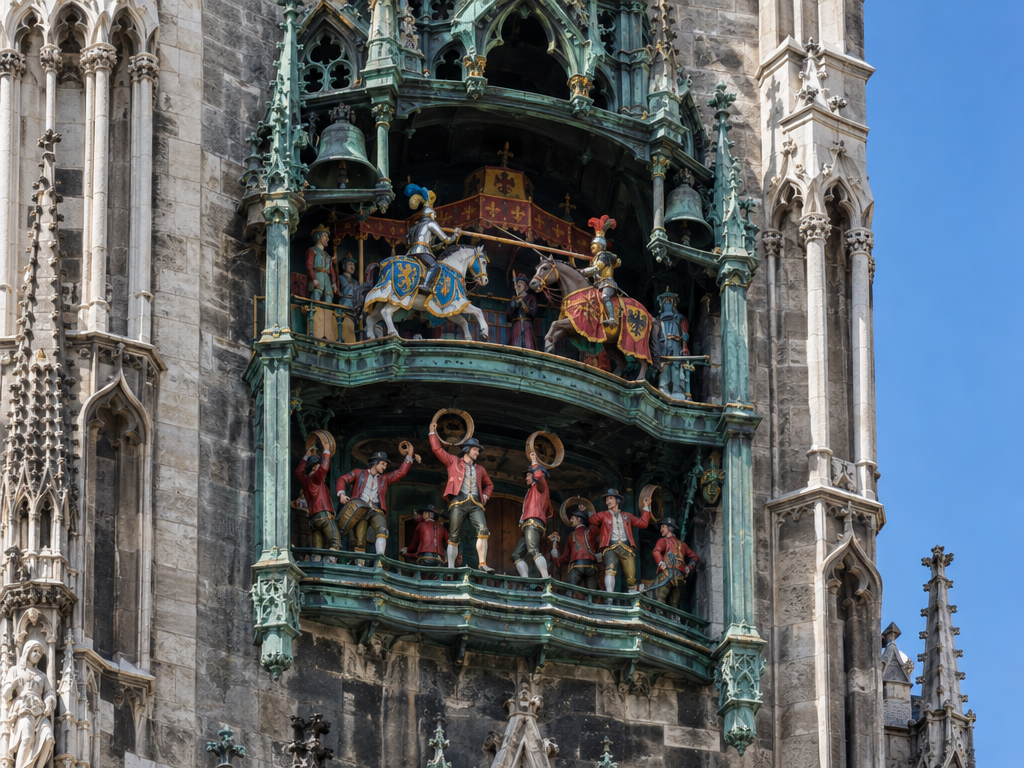
The Munich Glockenspiel hangs in the oriel of the town hall tower and is the reason hundreds of people gather in front of the New Town Hall shortly before eleven. According to muenchen.de, 43 bells ring out while moving figures turn on two levels. The mechanism was restored in 2007.
Glockenspiel times in Munich
| Performance | Time | Period |
|---|---|---|
| Daytime performance | 11 am | all year |
| Daytime performance | 12 noon | all year |
| Daytime performance | 5 pm | March to October |
| Night performance | 9 pm | all year |
When is the most pleasant time to watch the Glockenspiel in Munich? At 11 am it is at its busiest, because that is when the guided tours arrive. At 12 noon it is hardly any emptier, while at 5 pm in summer it is usually more relaxed. One performance lasts around ten minutes, so it is better to stand slightly to the side rather than right in front of the Fischbrunnen.
What the Marienplatz Glockenspiel shows
On the upper level, the Glockenspiel on Munich’s town hall re-enacts the wedding of Duke Wilhelm V and Renata of Lorraine in February 1568, complete with a knights’ tournament on Marienplatz. Below, the Schäffler, the city’s coopers (barrel makers), dance. At the night performance at 9 pm a night watchman, an angel and the Münchner Kindl appear, accompanied by the night watchman’s call and a lullaby by Brahms.
The coopers’ guild only performs the real Schäfflertanz (coopers’ dance) every seven years during carnival season, most recently in 2026, so the next time will be 2033. The figures in the town hall tower keep the memory alive all year round.
If you are working in Munich for a longer period, at some point you will see the Glockenspiel more in passing on your way to an appointment. For tradespeople and project teams staying several weeks, workers accommodation in Munich with its own kitchen is often more practical than a hotel room.
Twelve minutes to the Glockenspiel
From autumn 2027 we will be letting 54 apartments at Ländstraße 6 in Lehel, each with its own kitchen, fast Wi-Fi and access to an outdoor sauna. Marienplatz is about a twelve-minute walk away, Viktualienmarkt nine. You will find categories and sizes on the page about our holiday apartments in Munich near the old town.
Mariensäule and Fischbrunnen on Marienplatz
Mariensäule (Column of St Mary)
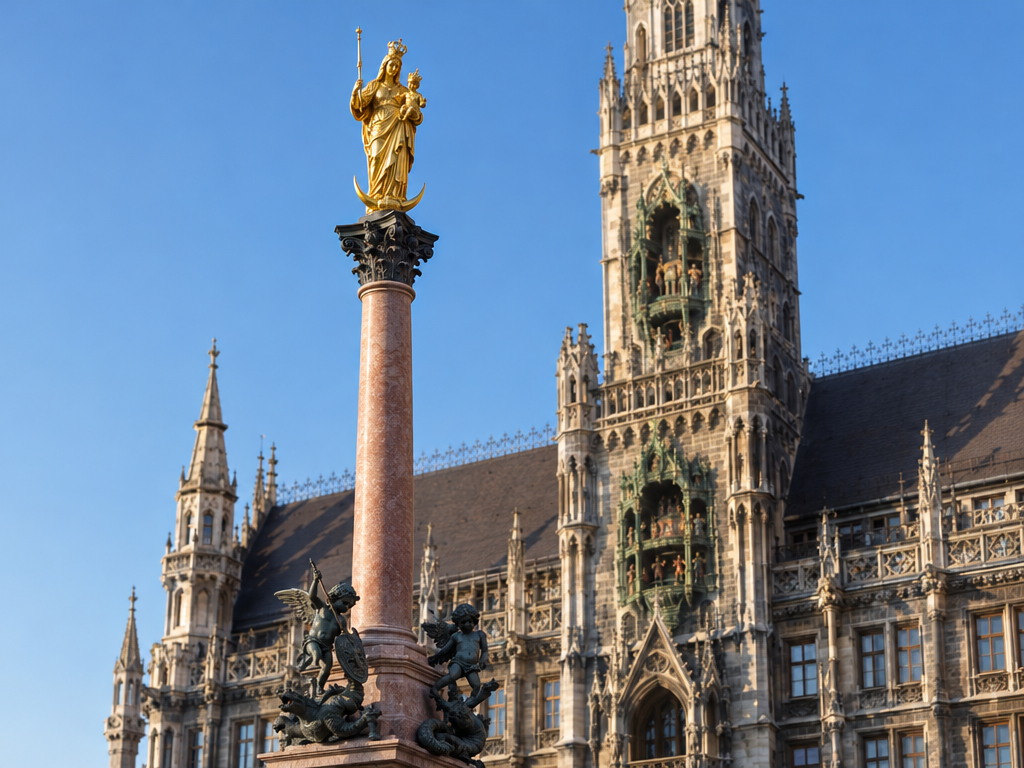
The Mariensäule stands in the middle of the square and, according to muenchen.de, is more than eleven metres high. Elector Maximilian had it consecrated on 7 November 1638 in thanks for Munich not being destroyed during the Thirty Years’ War despite the Swedish occupation. At that time the square was still called Schrannenplatz.
At the top is the gilded figure of the Virgin Mary as Patrona Bavariae, patron saint of Bavaria. It dates from 1593 and is attributed to Hubert Gerhard. Since 1641, four cherubs at the base have been battling heresy, war, famine and plague, depicted as a serpent, lion, dragon and basilisk. Today’s figures are copies; the originals are in the Munich City Museum.
The column is also regarded as the zero point: distances to Munich on road signs are measured to the Mariensäule. So if a sign says “München 60 km”, you are 60 kilometres from Marienplatz.
Fischbrunnen (Fish Fountain)
The Fischbrunnen on Marienplatz stands in front of the New Town Hall, where the fish market was in the Middle Ages. It was given its current form in 1954. For locals it is the classic meeting point: everyone in Munich understands “See you at the Fischbrunnen”.
On Ash Wednesday the Lord Mayor washes the city purse here in the Geldbeutelwaschen (purse-washing) ceremony; anyone who joins in is said to have no money worries for the rest of the year. At the Metzgersprung (butchers’ leap), apprentice butchers jump into the fountain after completing their training, a custom that Munich Tourism also mentions.
Munich’s Old Town Hall and Toy Museum
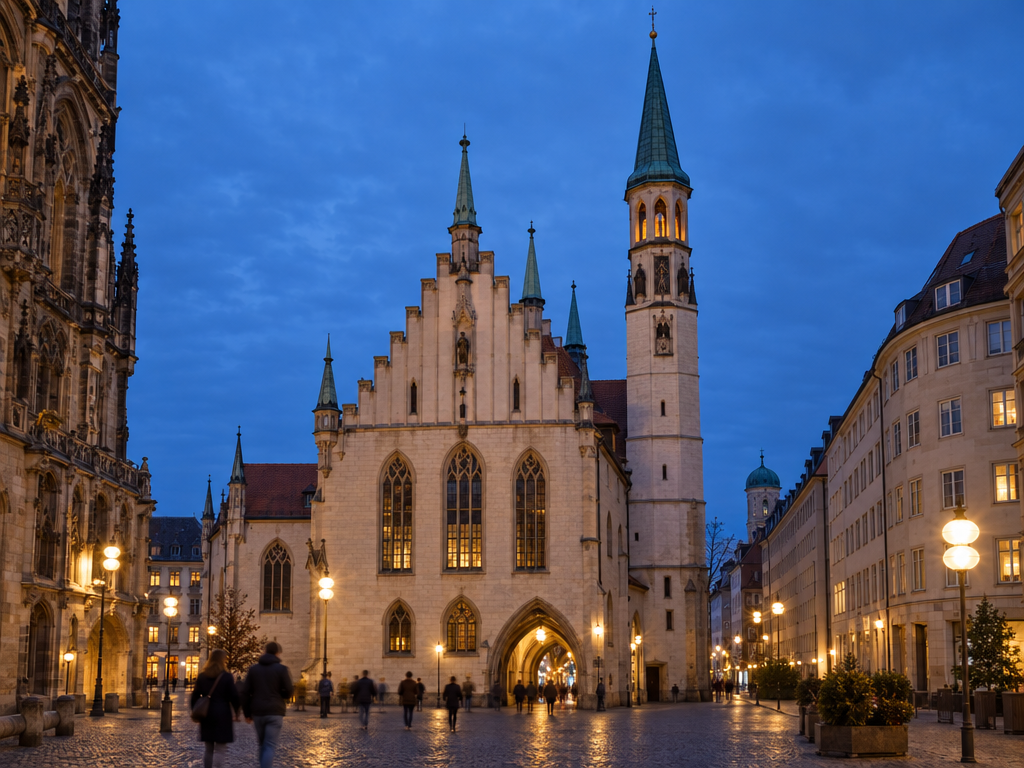
The Old Town Hall (Altes Rathaus) closes off Marienplatz to the east. According to muenchen.de, a town hall is mentioned on this spot as early as 1310; from 1470 Jörg von Halspach, known as Ganghofer, built the late Gothic building. He was also the master builder of the Frauenkirche, which you can reach from Marienplatz in a few minutes.
On the first floor is the barrel-vaulted ceremonial hall, where the city now holds receptions and award ceremonies. Erasmus Grasser carved the famous Morris dancers for it. Of the original 16 figures, 10 survive; copies stand in the hall, and the originals are on display in the City Museum.
After the city administration moved into the New Town Hall in 1874, the ground floor became a thoroughfare. Today you walk through this archway from Marienplatz into the Tal. The Old Town Hall was badly damaged in the Second World War and afterwards rebuilt on its Gothic model.
Toy Museum in the town hall tower
Since 1983 the 56-metre tower of the Old Town Hall, a former city gate, has housed the Munich Toy Museum. Over four floors you will see European and American toys from around 1800 onwards, from wooden figures and tin toys to dolls’ houses and comic characters. According to muenchen.de it is open daily from 10 am to 5.30 pm (as of October 2026).
The rooms are small and only connected by a narrow spiral staircase. A visit is difficult with a pushchair or limited mobility; please check admission prices on the museum’s website. What to look out for in your accommodation if you have limited mobility is covered in our guide to finding an accessible holiday apartment.
Walking tour from Lehel: Hofbräuhaus, Viktualienmarkt and Marienplatz
From Lehel you do not need a ticket for the old town. The following walking times are from Ländstraße 6 and are a guide, depending on your pace and the traffic lights.
| Destination | On foot from Lehel |
|---|---|
| Isartor | approx. 4 min |
| Hofbräuhaus | approx. 7 min |
| Viktualienmarkt | approx. 9 min |
| Alter Peter | approx. 11 min |
| Marienplatz | approx. 12 min |
| Frauenkirche | approx. 15 min |
Our route for a morning: through the Isartor and along the Tal to the Platzl, where the Hofbräuhaus stands. From there, take Pfisterstraße and Dienerstraße to Marienplatz, in time for the Glockenspiel at 11 am. Afterwards, climb Alter Peter or take the lift up the town hall tower.
Whether a visit to the Hofbräuhaus Munich is worthwhile in the morning, and where you can sit without a reservation, is covered in a separate guide. For lunch it is a three-minute walk down from Alter Peter to the market.
You reach the Viktualienmarkt in Munich from Marienplatz via the Petersbergl, with snack stalls, a beer garden and fruit for the afternoon. To get back to Lehel, walk through the Tal and the Isartor; including breaks, you will be out and about for three to four hours.
The Frauenkirche with its two towers is only a few minutes west of Marienplatz, via Kaufingerstraße and Augustinerstraße. If you want to add a visit there, start the walk a little earlier.
Food, cafés and restaurants on Marienplatz
On Marienplatz itself you pay for the location. A café or restaurant on Marienplatz with a view of the town hall fills up quickly at lunchtime, but you are right in the thick of things.
- Café Glockenspiel (Marienplatz 28) is on the fifth floor opposite the town hall tower and is one of the best-known cafés in Munich, with a view of the figures.
- Rischart am Marienplatz: traditional bakery with a café, good for a pretzel or cake in between.
- Woerner’s, Marienplatz 1: café with a terrace on the square.
- Viktualienmarkt: a Brotzeit (Bavarian snack) at the stalls, three minutes from the square.
According to muenchen.de, the Ratskeller in the basement of the New Town Hall is currently closed (as of October 2026). Check the city’s website before your visit to see whether and when it will reopen.
If you start the day early, you will also find cafés around the square serving breakfast. A selection with addresses in the old town and Lehel can be found in our guide to breakfast in Munich.
Getting there by U-Bahn and S-Bahn, parking near Marienplatz
Marienplatz by U-Bahn and S-Bahn
Marienplatz station is one of the most important hubs in the MVG network. All S-Bahn trains on the Stammstrecke (central trunk line) stop here, as do U-Bahn lines U3 and U6. From the central station you are there in a few minutes by S-Bahn, and from the airport the S1 and S8 run to Marienplatz without changing.
On the mezzanine level is the MVG customer centre at Marienplatz, where you can get tickets and information. Check opening hours on mvg.de. From Lehel it is one S-Bahn stop from Isartor, but you are hardly any slower on foot.
If you are moving to Munich and looking for furnished apartments in Munich for the first few months, you will soon get to know the Marienplatz hub: almost every line out to the neighbourhoods can be reached from here with at most one change.
Parking near Marienplatz
You cannot park on Marienplatz, as the square is in the middle of the pedestrian zone. The nearest car park is the Parkhaus am Marienplatz on Rindermarkt, a few minutes’ walk to the south-west. At weekends and during Advent the old town car parks fill up early.
We therefore recommend the U-Bahn, S-Bahn or walking. If you are arriving by car, it is better to leave it in your accommodation’s garage or at a Park & Ride site on the edge of the city.
Christmas market, title celebrations and Pride on Marienplatz
During Advent the square becomes the Christkindlmarkt, the city’s oldest Christmas market. In 2026 the Christmas market on Marienplatz opens on 20 November, with a Christmas tree in front of the New Town Hall and stalls stretching into the pedestrian zone. Dates and opening hours are in our guide to the Munich Christmas markets.
When FC Bayern win the league, the team traditionally appears on the town hall balcony. Thousands of fans come to the title celebration on Marienplatz, and the square is packed hours beforehand. FC Bayern’s women’s team and TSV 1860 have also celebrated here.
For Munich Pride (CSD), the festival area was on Marienplatz until 2025; it has since moved to Ludwigstraße. However, the RathausClubbing party in the New Town Hall still takes place on the Pride weekend.
Tips for Marienplatz: best time to visit and crowds
- Come early: before 9 am Marienplatz belongs almost entirely to delivery vans and pigeons, ideal for photos without the crowds.
- Glockenspiel: it is busiest at 11 am; in summer the 5 pm performance is more relaxed.
- Town hall tower: book a time slot online in advance, as places go quickly on sunny days.
- Valuables: in the crowds at the Glockenspiel and during Advent, carry your bag in front of you.
- Evenings: after 8 pm it gets quiet, and the illuminated New Town Hall makes a great photo.
The square offers little shelter when it rains. In that case the Toy Museum or a coffee with a view of the square is a better bet than waiting outside for the Glockenspiel.
If after a long day in the old town you would rather cook for yourself than pay restaurant prices on the square, an aparthotel in Munich with its own kitchen is often more relaxed than a classic hotel room. The walk back to Marienplatz the next morning is still short.
Conclusion: Marienplatz as the starting point for the old town
Marienplatz costs nothing, the Glockenspiel is best enjoyed at 5 pm or 12 noon, and from Lehel you are there in twelve minutes on foot; if you are looking for accommodation in Munich city centre with a kitchen, you will find it with us in Lehel from autumn 2027.
Frequently asked questions about Marienplatz
When does the Glockenspiel on Marienplatz play?
The Glockenspiel in the town hall tower plays daily at 11 am and 12 noon, and from March to October also at 5 pm. According to muenchen.de, a short night performance with a night watchman, an angel and the Münchner Kindl follows at 9 pm; the Glockenspiel is silent on Good Friday (as of October 2026).
Can you go up the town hall tower on Marienplatz?
Yes, a lift takes you up to the viewing platform of the town hall tower. According to Munich Tourism it is open daily from 10 am to 8 pm; tickets for a 20-minute time slot cost from €7 and are available online or at the Tourist Information office on Marienplatz (as of October 2026).
What is free on Marienplatz?
The square itself, the Glockenspiel, the Mariensäule, the Fischbrunnen and the Prunkhof courtyard in the New Town Hall are all free. You pay admission for the tower lift in the New Town Hall, the Toy Museum in the Old Town Hall and the tower of Alter Peter.
Which U-Bahn and S-Bahn lines go to Marienplatz?
All S-Bahn lines on the Stammstrecke stop at Marienplatz, as do U-Bahn lines U3 and U6. From Lehel it is about a twelve-minute walk, or one S-Bahn stop from Isartor.
Where can you park near Marienplatz?
You cannot park on Marienplatz itself, as it is in the pedestrian zone. The nearest car park is the Parkhaus am Marienplatz on Rindermarkt, a few minutes’ walk away; travelling by U-Bahn or S-Bahn is usually cheaper and more relaxed.
When is the Christmas market on Marienplatz?
The Christkindlmarkt on Marienplatz opens on 20 November in 2026 and runs until shortly before Christmas. Opening hours and stalls are listed in our guide to the Munich Christmas markets.
What is the meaning of the Mariensäule?
The Mariensäule was erected in 1638 by Elector Maximilian in thanks for Munich not being destroyed during the Thirty Years’ War despite the Swedish occupation. At the top stands the gilded Patrona Bavariae, and the four cherubs at the base battle heresy, war, famine and plague.
How far is it from Marienplatz to the Hofbräuhaus?
It is around 500 metres from Marienplatz to the Hofbräuhaus on the Platzl, so about five to seven minutes on foot. The route takes you along Dienerstraße and Pfisterstraße to the Platzl.

Daniel Schulz · Managing Director of residir GmbH
He brings eight years of experience in letting and managing serviced apartments and has looked after more than 80,000 guest stays. More about Daniel Schulz