
By Daniel Schulz, residir GmbH · Last updated: 13 October 2026
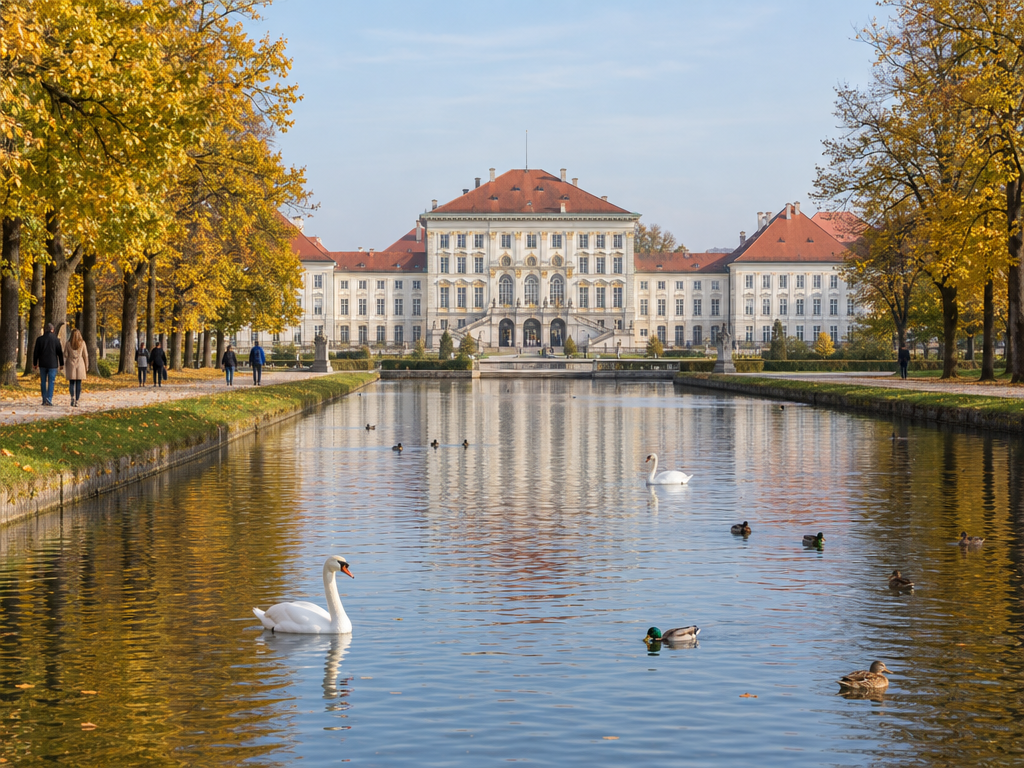
Nymphenburg Palace (Schloss Nymphenburg) is the former summer residence of the Wittelsbach dynasty in the west of Munich and is open daily from 9 am to 6 pm from April to 15 October, and from 10 am to 4 pm in winter. The combined ticket for the palace, the Marstallmuseum and the park pavilions costs €20 in summer and €16 in winter; the palace park is free. The park pavilions, such as the Amalienburg and Badenburg, are closed from 16 October to the end of March.
We run a boarding house with 54 apartments at Ländstraße 6 in Lehel, opening in autumn 2027. Nymphenburg is at the other end of the city from us, yet it is one of the outings we recommend most often: tram 17 runs from Isartor right up to the palace without changing. This guide sums up opening hours, tickets and park rules, and shows you how to plan your visit from central accommodation in Munich.
In this article:
- Nymphenburg Palace at a glance
- History of Nymphenburg Palace
- Inside Nymphenburg Palace
- Marstallmuseum and Nymphenburg porcelain
- Pavilions in the palace park
- Nymphenburg Palace Park
- Nymphenburg Canal: gondolas and ice skating
- Tickets and admission
- Getting there from Lehel and parking
- Botanical Garden and Hirschgarten
- How much time to allow
- Conclusion
- Frequently asked questions
Nymphenburg Palace at a glance: opening hours and admission
The table summarises the opening hours and prices for the individual parts of the palace complex. The information comes from the official website schloss-nymphenburg.de run by the Bavarian Palace Administration. It may change, so please check the official site before your visit.
| Area | April to 15 October | 16 October to March | Admission |
|---|---|---|---|
| Palace | daily 9 am to 6 pm | daily 10 am to 4 pm | €10, concessions €9 |
| Marstallmuseum with Porcelain Museum | daily 9 am to 6 pm | daily 10 am to 4 pm | €8, concessions €7 |
| Park pavilions | daily 9 am to 6 pm | closed | €6, concessions €5 |
| “Nymphenburg” combined ticket | Palace, Marstallmuseum and park pavilions | Palace and Marstallmuseum | Summer €20 (conc. €18), winter €16 (conc. €14) |
| Palace park | May to September 6 am to 9.30 pm, April and October 6 am to 8 pm | November to March 6 am to 6 pm | free |
A note on timing: winter opening applies from 16 October. The park pavilions then close and the palace shuts at 4 pm. So if you want to see the Amalienburg, you need to come by mid-October or wait until April.
Nymphenburg Palace in Munich: history of the summer residence
The history of Nymphenburg Palace begins in 1664. After the birth of the heir to the throne, Max Emanuel, Elector Ferdinand Maria gave his wife Henriette Adelaide of Savoy a country estate outside the city. Over roughly a hundred years, the cube-shaped central building grew into a complex with side wings, galleries and pavilions.
For the Wittelsbachs, Nymphenburg was the summer residence, while the Munich Residenz in the old town remained the seat of government. King Ludwig II was born in the palace in 1845. The north wing now houses the Museum Mensch und Natur (Museum of Man and Nature), and the Nymphenburg Porcelain Manufactory has been working at the northern palace roundel since the 18th century.
Inside Nymphenburg Palace: the Stone Hall and the Gallery of Beauties
The tour of Nymphenburg Palace takes you through the princely living quarters in the central building and the adjoining pavilions. You do not need a guided tour; with your timed ticket you simply walk through the rooms yourself. Around an hour is enough for the main route.
The Stone Hall
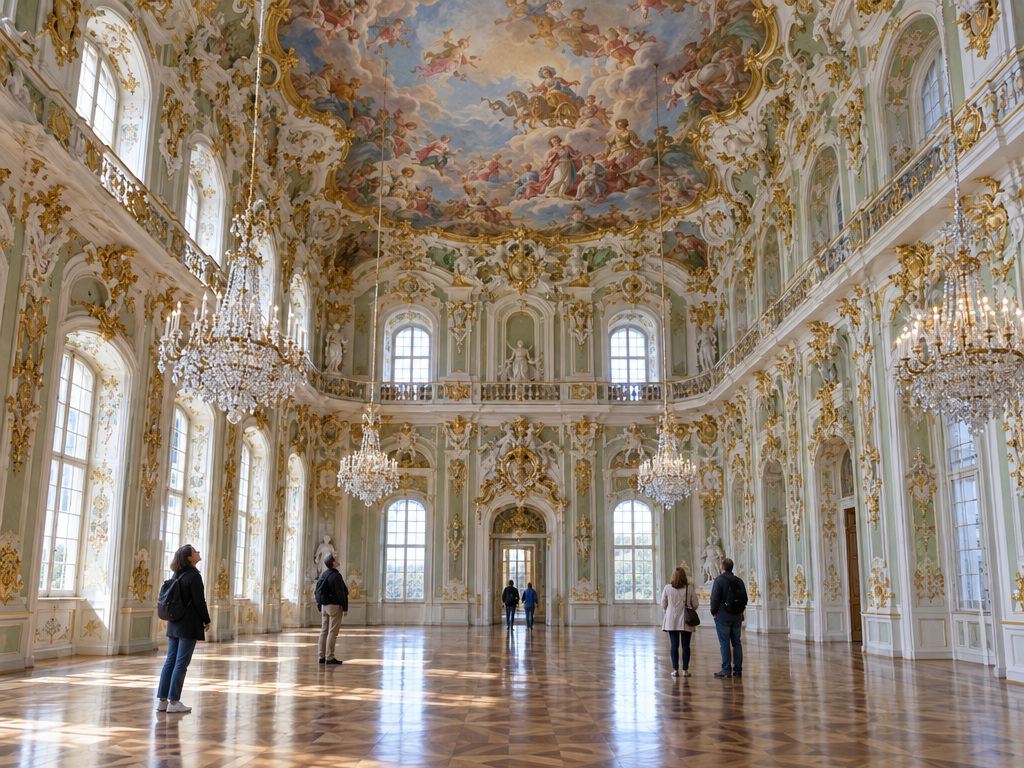
Right at the start you enter the Steinerner Saal (Stone Hall), the central banqueting hall spanning three storeys. The ceiling fresco is by Johann Baptist Zimmermann, and the stucco work is in the Rococo style. According to Munich Tourism, the hall has remained largely unchanged since 1758. From the windows you look out over the canal towards the city on one side and the park on the other.
King Ludwig I’s Gallery of Beauties
The best-known feature is the Schönheitengalerie (Gallery of Beauties) in the southern pavilion. King Ludwig I commissioned portraits of women he considered particularly beautiful, most of them painted by the court painter Joseph Stieler. Among them is the portrait of the dancer Lola Montez, whose affair with the king contributed to his abdication in 1848. The selection is remarkable: alongside noblewomen hang the daughters of townspeople and a shoemaker’s daughter.
The tour also includes the room where King Ludwig II was born and a Chinese lacquer cabinet. If you opt for admission to Nymphenburg Palace, you will see Baroque, Rococo and Neoclassicism side by side in a short space of time.
Marstallmuseum and Nymphenburg porcelain
The Marstallmuseum (carriage museum) is in the south wing, in the former stables. It displays more than forty coaches and sleighs from the era of the electors and kings, along with harnesses and saddles. King Ludwig II’s ceremonial sleighs and state coaches, dripping with gold, are the reason many visitors make the detour.
On the upper floor, the Museum Nymphenburger Porzellan shows a private collection from the manufactory spanning the 18th to the 20th century. The ticket covers both exhibitions. If you only have an hour to spare, you will see more in the Marstallmuseum than in the park pavilions, especially in winter when these are closed.
Tram 17 from Isartor straight to the palace
Our 54 apartments on Ländstraße in Lehel are around a four-minute walk from the Isartor tram stop. Every apartment has its own kitchen, fast Wi-Fi and a 24-hour safe check-in, and there are washing machines and dryers in the building. We open in autumn 2027; you can read more about our holiday apartments in Munich on the homepage.
Pavilions in the palace park: Amalienburg, Badenburg, Pagodenburg and Magdalenenklause
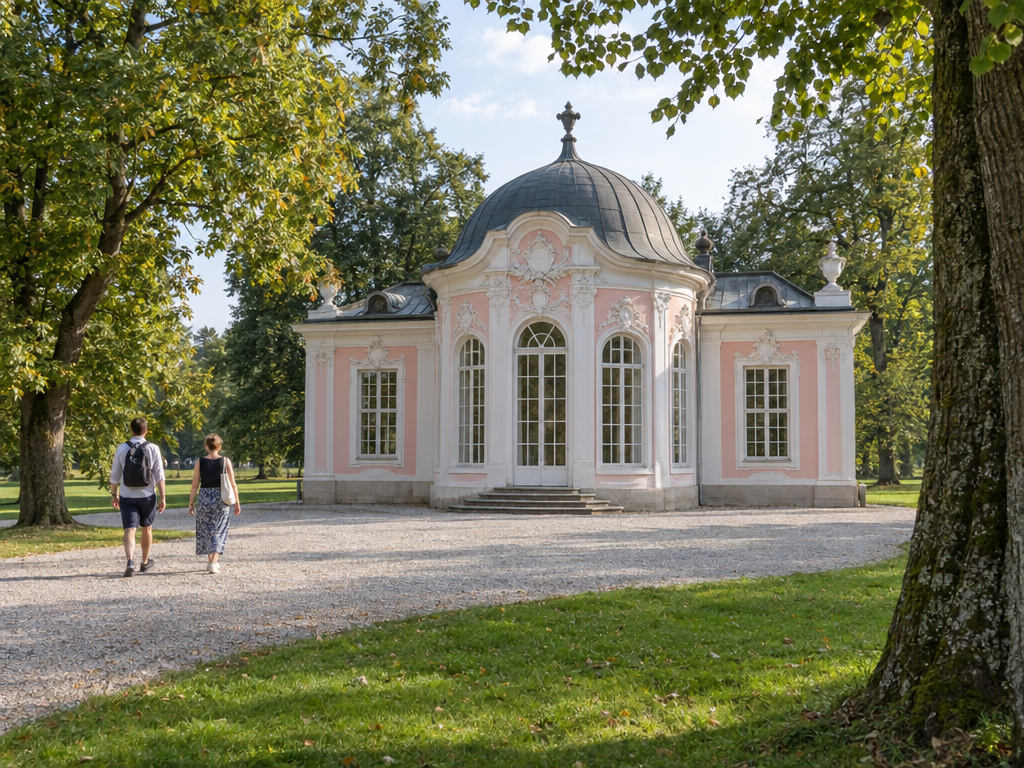
Four small palaces stand in the palace park, known as the Parkburgen (park pavilions). They were the electors’ retreats for hunting, bathing, taking tea or prayer. All four are only open in the summer season, i.e. from April to 15 October, daily from 9 am to 6 pm (as of October 2026). Tickets are not sold at the pavilions themselves but at the palace ticket office or in the official online ticket shop.
Amalienburg
The Amalienburg is a small Rococo hunting lodge, built between 1734 and 1739 to designs by François Cuvilliés for Elector Karl Albrecht and his wife Maria Amalia. It is famous for its round Hall of Mirrors with silver stucco on a pale blue background. The Amalienburg is regarded as one of the most important Rococo buildings in Europe and, with only a few rooms, can be seen quickly.
Badenburg
The Badenburg was a bathhouse with a heated pool, which was very advanced for its time. It stands by the large lake in the southern part of the park. Besides the tiled bathing hall, you will see a banqueting hall and small living rooms.
Pagodenburg
The Pagodenburg stands by the small lake in the northern part of the park. Elector Max Emanuel used the pavilion as a tea house, and its rooms are decorated with tiles and lacquer paintings in the Chinese taste of the period. It is the smallest of the four pavilions.
Magdalenenklause
From the outside, the Magdalenenklause looks like a ruined hermitage. The cracks in the plaster are intentional: Max Emanuel had it built as a place of retreat and prayer. Inside are a grotto chapel and simple living quarters.
It takes ten to fifteen minutes to walk between each of the pavilions. If you want to see all four, allow a good two hours for the park and pavilions. With a pushchair or in bad weather, it is often enough to stick to the Amalienburg and Badenburg.
Nymphenburg Palace Park: free entry, opening hours and rules
Nymphenburg Park covers around 180 hectares and is one of the best-known gardens in Germany. In front of the palace lies the Baroque parterre with flower beds and statues, and behind it begins the landscape park with lakes, meadows and old trees. Admission to Nymphenburg Palace Park is free.
Palace park opening hours
The opening hours of Nymphenburg Palace Park vary with the season. At the main gate: May to September 6 am to 9.30 pm, April and October 6 am to 8 pm, November to March 6 am to 6 pm (as of October 2026, source: schloss-nymphenburg.de). According to Munich Tourism, the fountains run daily from Easter to mid-October from 10 am to 12 noon and from 2 pm to 4 pm.
Dogs, cycling and lawns
Dogs are allowed in Nymphenburg Park, but according to the park regulations they must be kept on a short lead and may not swim in the lakes and canals. Bicycles are not permitted on the paths, not even pushed. Barbecues are prohibited, and you should keep off the lawns and planted areas.
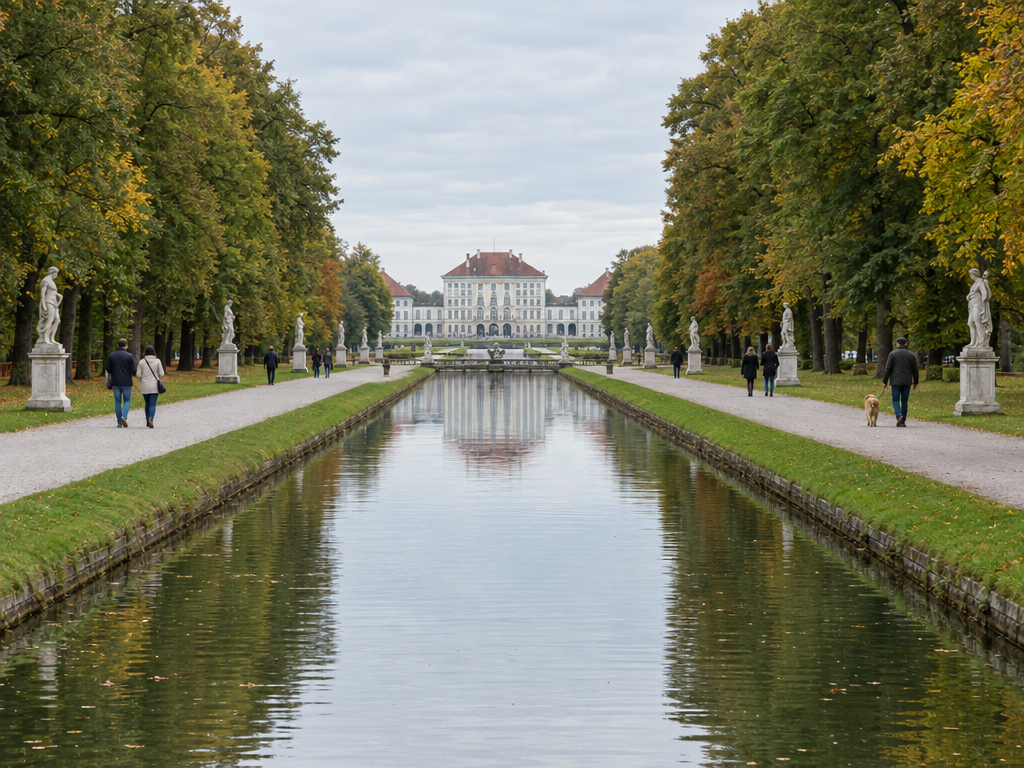
For dog owners this means the park is good for a long walk on the lead, but not for running around. If you want to give your dog a proper run, you will find more space along the Isar. The park rules are posted at the entrances.
Palm House and palace café
In the northern part of the park stands the Palmenhaus, a historic glasshouse. It is home to the Schlosscafé im Palmenhaus, a good place for a break between the palace and the pavilions. The café’s current opening hours are on its own website.
Nymphenburg Canal: gondolas in summer, ice skating in winter
The Nymphenburg Canal links the palace with the city and runs up to the palace roundel in front of the building. Inside the park it continues as the central canal to the great cascade. You can walk along the bank on straight paths that are also popular with Munich’s joggers.
According to Munich Tourism, gondola rides on the palace park canal run daily in fine weather from late March to mid-October. The gondola does not operate in winter. You can find out about prices and the departure point on site.
Ice skating at Nymphenburg Palace is only possible when it has been cold for long enough and the city declares the ice safe. The canal between the Hubertus Fountain and the palace roundel, in front of the palace on the city side, then becomes a meeting place for skaters and Bavarian curlers (Eisstockschützen). Walking on ice in the palace park itself is prohibited. If you are planning temporary housing in Munich over the winter, you have the best chance of catching one of these days.
Tickets for Nymphenburg Palace: combined ticket and time slots
Tickets for Nymphenburg Palace are available at the ticket office in the palace and in the official online shop of the Palace Administration. For the palace you choose a time slot. According to the official website, entry is possible up to one hour after your chosen time; tickets cannot be refunded or exchanged once purchased.
- “Nymphenburg” combined ticket: palace, Marstallmuseum and park pavilions, €20 in summer, concessions €18
- Combined ticket in winter: €16, concessions €14, excluding the closed park pavilions
- Individual tickets: palace €10, Marstallmuseum €8, park pavilions €6
- Palace park: free admission
As of October 2026, source: schloss-nymphenburg.de. According to Munich Tourism, admission to the museums is free for children and young people under 18. Children under 14 must be accompanied by an adult.
Is the combined ticket worth it? In summer it costs €20 instead of €24 for the three individual tickets, so it pays off as soon as you visit all three areas. If you are in town on business and only have two hours free after a meeting, you are better off with the single palace ticket followed by a walk through the park. Guests staying in serviced apartments in Munich often make use of a free afternoon this way.
Nymphenburg Palace: getting there from Lehel and parking
Getting there from Lehel is easy. All times are guide values from our front door, excluding waiting time; the MVG app shows current connections.
- Tram 17: around four minutes on foot to the Isartor stop, then without changing via Karlsplatz (Stachus) and the central station to the Schloss Nymphenburg stop. The journey takes about 30 minutes.
- U-Bahn and tram: take the U4 or U5 from Lehel to the central station and change to tram 17 there. This is only worthwhile if there is no tram due at Isartor.
- S-Bahn and bus: from Isartor take the S-Bahn to Laim, then continue by bus to the Schloss Nymphenburg stop.
From the tram stop it is a five- to ten-minute walk along the canal to the entrance. An MVV day ticket is worthwhile if you are also heading into the old town or to the Hirschgarten on the same day.
Parking at Nymphenburg Palace
If you come by car, according to Munich Tourism there are around 450 free parking spaces at Nymphenburg Palace, with disabled parking directly in front of the palace. On sunny summer weekends they are often full by midday. We still recommend the tram, as driving from Lehel through the city centre is hardly any quicker. If you travel with a wheelchair, our guide to booking an accessible holiday apartment lists the questions to ask.
Hotels near Nymphenburg Palace?
There are only a few places to stay right by the palace, as the area is mainly residential. For a city break, that is no disadvantage: tram 17 gets you there from the old town in half an hour, and in the evening you are staying where the restaurants and museums are. If you are staying several nights and want to cook for yourself, take a look at an aparthotel in Munich.
Botanical Garden and Hirschgarten nearby
Munich-Nymphenburg Botanical Garden
Directly north of the palace park is the Botanical Garden at Menzinger Straße 65, three tram 17 stops beyond the palace. It is open daily from 9 am to 6 pm in summer and from 9 am to 4.30 pm in winter; the glasshouses close 30 minutes earlier. A day ticket costs €5.50, concessions €4, and admission is free for under-18s (as of October 2026, source: muenchen.de). On rainy days, the glasshouses make a good addition to the palace.
Königlicher Hirschgarten
South of the palace lies the Königlicher Hirschgarten (Royal Deer Garden), one of the city’s largest beer gardens, complete with a deer enclosure. It is a 20- to 25-minute walk from the palace. In summer it makes a good end to a day in the park. Which other gardens are worth a visit and what the rules are for bringing your own food are explained in our guide to Munich beer gardens.
How much time for Nymphenburg? Our plan for a half or full day
An hour is enough for the palace alone, and another for the Marstallmuseum. With the park pavilions and a walk through the park, you can easily spend four to five hours. Our suggestion for summer: go to the palace first thing in the morning while it is still quiet, then the Amalienburg and Badenburg, a lunch break at the palace café, and in the afternoon the Pagodenburg, Magdalenenklause and Marstallmuseum.
In winter, half a day is enough. The palace and Marstallmuseum close at 4 pm, the pavilions are shut and it gets dark early in the park. In that case it is best to arrive around 10 am and add on the Botanical Garden.
With children, the Museum Mensch und Natur in the north wing is worth a look; it is small and inexpensive. We have collected more ideas for visiting Munich with kids in a separate guide. Pushchairs get around the park easily, but the cramped rooms of the pavilions fill up quickly.
If Nymphenburg gives you a taste for more palaces, you will find Schleissheim Palace, Herrenchiemsee and Neuschwanstein in our guide to day trips from Munich. Schleissheim, with its Baroque court garden and canal, is Nymphenburg’s little brother and can be done in half a day by S-Bahn.
Conclusion: Nymphenburg Palace with a combined ticket in summer, as a half-day trip in winter
Nymphenburg Palace is best visited between April and mid-October, when the €20 combined ticket also includes the park pavilions and the park stays open into the evening. In winter, half a day is enough for the palace and the Marstallmuseum, and the palace park is free all year round. If you are staying longer for a semester, a project or a move, we offer furnished apartments in Munich with a direct tram connection to Nymphenburg.
Frequently asked questions about Nymphenburg Palace
How much does admission to Nymphenburg Palace cost?
An individual ticket for Nymphenburg Palace costs €10, concessions €9. The combined ticket for the palace, Marstallmuseum and park pavilions costs €20 in summer and €16 in winter (as of October 2026).
When is Nymphenburg Palace open?
Nymphenburg Palace is open daily from 9 am to 6 pm from April to 15 October, and daily from 10 am to 4 pm from 16 October to the end of March. It is closed on 1 January, Shrove Tuesday and 24, 25 and 31 December.
Is there an admission charge for Nymphenburg Palace Park?
No, Nymphenburg Palace Park is free. The main gate is open from 6 am to 9.30 pm from May to September, until 8 pm in April and October, and until 6 pm from November to March.
Are the park pavilions open in winter?
No, the Amalienburg, Badenburg, Pagodenburg and Magdalenenklause are closed from 16 October to the end of March. From April to 15 October they are open daily from 9 am to 6 pm.
Can I take my dog into Nymphenburg Palace Park?
Yes, dogs are allowed in Nymphenburg Palace Park but must be kept on a short lead. They are not allowed to swim in the lakes and canals.
How do I get to Nymphenburg Palace?
The easiest way is tram 17 to the Schloss Nymphenburg stop; the tram stops at Isartor, Karlsplatz and the central station, among others. From Isartor the journey takes around 30 minutes.
Is there parking at Nymphenburg Palace?
Yes, there are around 450 free parking spaces at Nymphenburg Palace. On sunny weekends they are often full by midday.
How long do you need for Nymphenburg Palace?
Around an hour is enough for the palace alone. With the Marstallmuseum, the park pavilions and a walk through the park, you should allow four to five hours.

Daniel Schulz · Managing Director of residir GmbH
He has eight years of experience in letting and managing serviced apartments and has looked after more than 80,000 guest stays. More about Daniel Schulz