
By Daniel Schulz, residir GmbH · Last updated: 13 October 2026
Lehel, Munich, is a neighbourhood on the eastern edge of the Old Town, and together with it forms City District 1, Altstadt-Lehel. It lies between the Altstadtring (the inner ring road), the Isar and the English Garden, and is considered Munich’s oldest suburb. Today Lehel is a quiet residential quarter of late-19th-century townhouses, home to St. Anna’s church, Maximilianstraße and the Haus der Kunst, and served by the U4 and U5 to Lehel station.
At Ländstraße 6 in Lehel we run a boarding house with 54 apartments, opening in autumn 2027. Our street is just 98 metres long and takes its name from the old raft landing on the Isar. Many guests have never heard of Lehel before arriving, even though they have long since walked through it on the way from the Isartor to the English Garden. This guide explains what makes the neighbourhood tick. Walking times are measured from Ländstraße and correct as of October 2026.
In this article:
- Lehel Munich at a glance
- The history of Lehel
- Architecture: St. Anna, Maximilianstraße, Haus der Kunst
- Living in Lehel
- Cafés and restaurants in Lehel
- U-Bahn, tram and S-Bahn
- Shopping and markets
- The Isar and the English Garden
- A walk through Lehel
- Conclusion
- Frequently asked questions
Lehel Munich at a glance: location and boundaries within Altstadt-Lehel
Altstadt-Lehel is the most central of the 25 Munich neighbourhoods (official city districts). According to the city’s statistics office, around 21,100 people lived there in 2019, on 314.57 hectares. The Old Town with Marienplatz, Graggenau and Kreuzviertel lies inside the Altstadtring, Lehel to the east of it. In everyday speech locals usually just say “Altstadt Lehel”, without the hyphen.
Lehel’s boundaries are clear-cut: to the west the Altstadtring with Thomas-Wimmer-Ring, Karl-Scharnagl-Ring and Franz-Josef-Strauß-Ring, to the east the Isar. In the south the neighbourhood ends at Ludwigsbrücke, in the north at Max-Joseph-Brücke, and further north at Königinstraße. The southern part of the English Garden already belongs to it. Its neighbours are Schwabing and Maxvorstadt, and across the river Haidhausen and Bogenhausen.
For us, Lehel is the quieter side of Altstadt-Lehel. Marienplatz is a good ten minutes’ walk away, yet in the side streets you hear hardly any traffic in the evening. That mix is exactly why we are opening our boarding house in Munich right here.
| Topic | Lehel in a nutshell |
|---|---|
| City district | 1 Altstadt-Lehel (together with the Old Town) |
| Boundaries | Altstadtring, Isar, Ludwigsbrücke, Max-Joseph-Brücke |
| Postcode | mostly 80538 (e.g. St.-Anna-Platz, Ländstraße) |
| U-Bahn | U4 and U5, Lehel station |
| Tram | 16 (Lehel, Nationalmuseum/Haus der Kunst), 19 (Maxmonument) |
| S-Bahn | Isartor, all lines on the central trunk line |
| Banks of the Isar | approx. 2 min on foot |
| Isartor | approx. 4 min on foot |
| Maximilianstraße | approx. 5 min on foot |
| Viktualienmarkt | approx. 9 min on foot |
| Marienplatz | approx. 12 min on foot |
| English Garden | under 20 min on foot |
The history of Lehel: woodland, rafters and Munich’s oldest suburb
The name most likely comes from “Lohe”, an old word for an open riverside woodland of the kind typical of the Munich gravel plain. The original Lehel was a small wood by the Isar, criss-crossed by streams. Whether you say “Lehel” or “Lechel” is something Munich locals still argue about today.
As early as the 14th century, under Ludwig the Bavarian, people who were denied the right to live inside the city – usually because they were poor – settled here. Day labourers, washerwomen, millers and craftsmen lived in small lodging houses outside the walls. In 1724 Lehel was brought within Munich’s Burgfrieden (the city’s jurisdictional boundary), making it the city’s oldest suburb. For a time it was officially called St.-Anna-Vorstadt, but the name never really caught on.
From the middle of the 19th century the area changed dramatically. Middle-class apartment buildings replaced the lodging houses, and the quarter of ordinary working people became a sought-after residential area. Those buildings still define Lehel today.
Rafters and Ländstraße
For Lehel, the Isar was both a blessing and a curse. The untamed river often flooded the neighbourhood, but it also brought the rafts. They delivered timber, furniture, beer and food from the Bavarian uplands, and anyone who wanted to could travel by raft as far as Passau or even Vienna.
The lower landing stage lay on the left bank of the Isar between the old stone bridge and Maximiliansbrücke, and this is where most rafts tied up. Our Ländstraße is named after it. The 1880 address book still lists it as “An der Länd”; the name Ländstraße first appears in 1893. Today its 98 metres link Thierschstraße with Steinsdorfstraße on the riverbank.
These days raft trips are purely an outing. The rafts from Wolfratshausen moor at the Floßlände (raft landing) in Thalkirchen, built in 1899 to replace older landings that were closed at the time.
Stay at the old raft landing
Our boarding house at Ländstraße 6 has 54 apartments, each with its own kitchen, two minutes from the Isar and four minutes from the Isartor. We open in autumn 2027 and are already taking enquiries. The building has an outdoor sauna, and we have put together separate tips on the best Munich spa and wellness options.
Architecture in Lehel: St. Anna, Maximilianstraße and the Haus der Kunst
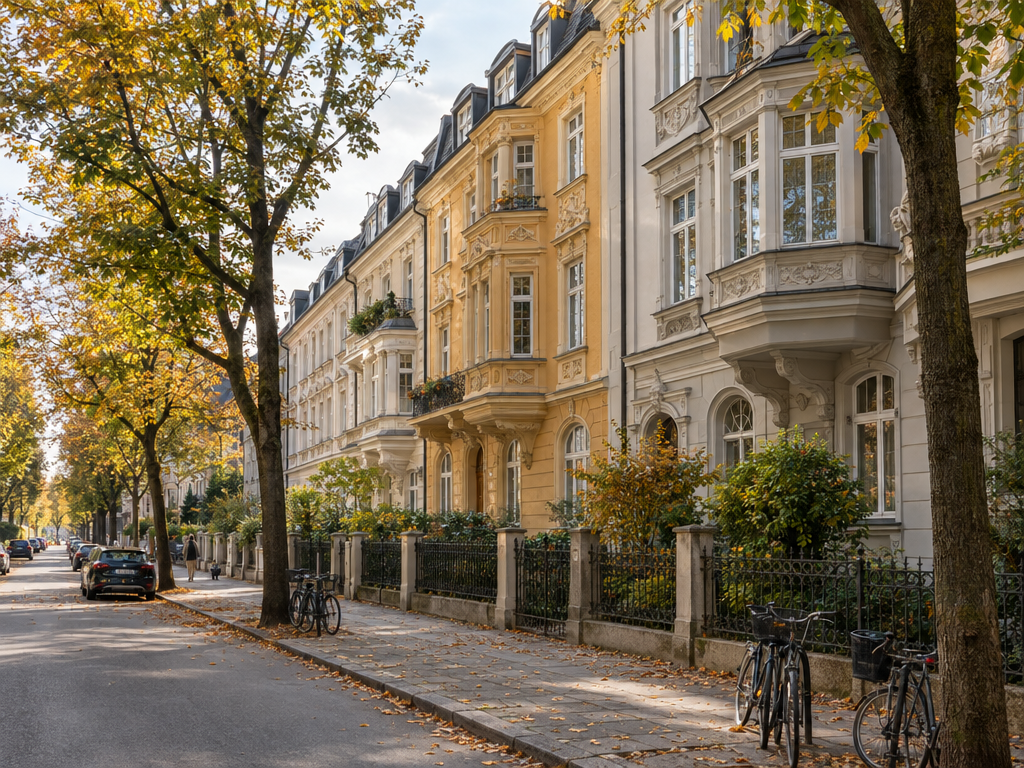
Walking through Lehel, what you mostly see are facades from the Gründerzeit (the late-19th-century boom years): neo-Baroque and neo-Gothic oriels, stucco and tall windows. Locals like to compare the neighbourhood with Paris. In between stand a handful of buildings that draw visitors from all over the city.
St. Anna im Lehel: two churches on one square
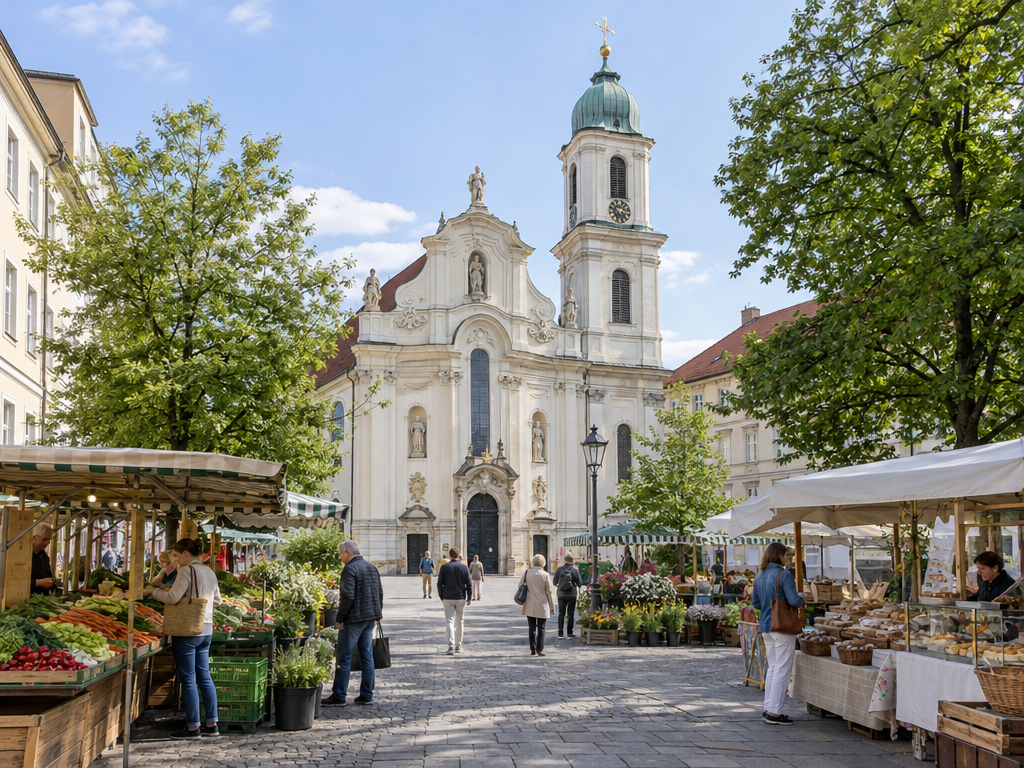
Two churches face each other across St.-Anna-Platz. The Klosterkirche St. Anna im Lehel (St. Anne’s Abbey Church) was built to plans by Johann Michael Fischer, with the foundation stone laid in 1727. It is regarded as the first Rococo church in Old Bavaria; the frescoes were painted by Cosmas Damian Asam, while his brother Egid Quirin created the stucco and sculptures.
During the air raid of 29 April 1944 the church burnt out, leaving only its outer walls. Reconstruction began in 1946, the facade was rebuilt in 1968, and work on the interior continued until 1979.
The parish church of St. Anna opposite was built by Gabriel von Seidl between 1887 and 1892 in neo-Romanesque style, because the old church had become too small for the growing neighbourhood. Incidentally, the writer Lion Feuchtwanger grew up at St.-Anna-Platz 2, as a plaque recalls.
St. Lukas on Mariannenplatz
Right by the Isar stands the Protestant St. Luke’s Church, completed in 1896. It is considered the only almost entirely preserved Protestant church of the Historicist period in Munich. If you are looking for St. Lukas in Munich, you will find it on Mariannenplatz, where the comedian Karl Valentin lived for almost 30 years. From us it is about five minutes along the river.
Maximilianstraße, Munich
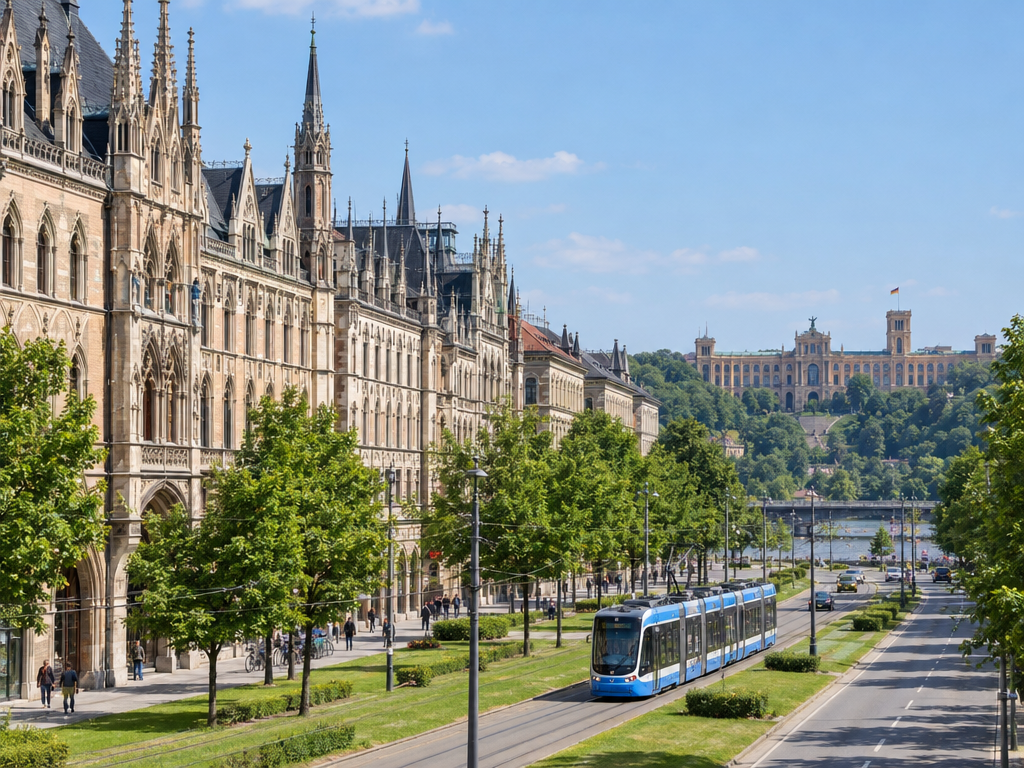
King Max II had Maximilianstraße laid out at his own expense, with construction starting on 8 July 1853. Its distinctive “Maximilian style” is the work of Friedrich Bürklein. The western section with its luxury boutiques belongs to the Old Town; east of the Altstadtring the street becomes wider and greener.
At the Maxmonument of 1875 the street crosses Lehel. Here you will find the government of Upper Bavaria and the Museum Fünf Kontinente (Museum of Five Continents), with more than 160,000 objects from non-European cultures. At the far end you look across the Isar to the Maximilianeum. For more places nearby, see our guide to things to do in Munich.
Prinzregentenstraße and the Haus der Kunst
Prinzregentenstraße runs along the northern edge of the neighbourhood. Along it you will find the Prinz-Carl-Palais, the Bavarian National Museum in a building by Gabriel von Seidl, and the Sammlung Schack (Schack Collection). The Haus der Kunst hosts changing exhibitions of contemporary art, and the Goldene Bar sits on its terrace.
The Archäologische Staatssammlung (Bavarian State Archaeological Collection) by the English Garden covers 120,000 years of Bavarian history. For culture lovers, Lehel easily fills a whole rainy day.
Living in Lehel: a quiet residential quarter full of period buildings
Lehel is first and foremost a residential area, and many addresses are simply given as München-Lehel. There are hardly any clubs and little through traffic, but plenty of schools, nurseries and period flats with high ceilings. On weekday mornings you will see more parents with children in Lehel than tourists.
The neighbourhood is not cheap. Almost all the old buildings have been renovated, and Lehel ranks among the most expensive residential areas in the city. If you want to rent a flat in Lehel, you will need patience and a matching budget. Our guide on how to rent an apartment in Munich explains how the search works. Buying a flat in Lehel is much the same story: properties rarely come up.
That is why many newcomers to Munich start off in a furnished place and look for something permanent from there at their leisure. For this phase we have a dedicated page on temporary housing in Munich.
The neighbourhood has literary connections, too. Rainer Maria Rilke lived at Widenmayerstraße 32 and Ludwig Ganghofer at Steinsdorfstraße 10. In the TV series, the workshop of Meister Eder and his Pumuckl (a much-loved German children’s character) was at Widenmayerstraße 2. Lion Feuchtwanger sat his school-leaving exams at the Wilhelmsgymnasium on Thierschstraße.
There are only a few hotels in Lehel, the best known being the Vier Jahreszeiten on Maximilianstraße. So if you are looking for a hotel in Lehel, you will often find apartments rather than traditional rooms. If you are staying in Lehel for a few weeks and working on a laptop during the day, our guide to workation stays in a holiday apartment has tips on desks and Wi-Fi.
Cafés and restaurants in Lehel: what the neighbourhood has to offer
The cafés in Lehel are small and frequented more by neighbours than by tour groups. The City of Munich’s business directory lists these addresses, among others (as of October 2026):
- Gandl at St.-Anna-Platz 1, opposite the church
- Dukatz at St.-Anna-Straße 11
- Leib & Seele at Oettingenstraße 36 in northern Lehel
- Stemerowitz, a patisserie and café at Emil-Riedel-Straße 2
The city portal describes the café-restaurant La Stanza as a local institution. The Goldene Bar at the Haus der Kunst is more of an afternoon or evening spot. For a café in Lehel at the weekend, a quick phone call beforehand is usually enough – compulsory reservations like those in Glockenbach are rare here.
If you would like to go out for breakfast, you will find more addresses in our guide to breakfast in Munich. The choice of restaurants in Lehel is fairly limited. For a wider selection, cross the Isar to Haidhausen or head to the Tal, both about ten to 20 minutes on foot. Opening hours change frequently, so please check them on the venue’s website.
Lehel U-Bahn, tram and S-Bahn: getting around
Lehel U-Bahn station is on Thierschplatz. The U4 and U5 stop here, reaching Odeonsplatz, Karlsplatz (Stachus) and the central station within a few minutes. From Ländstraße it is roughly a three-minute walk to Lehel U-Bahn.
Tram 16 also stops at Lehel on Thierschplatz. It runs via Maximilianstraße to the central station and, in the other direction, via Nationalmuseum/Haus der Kunst to Bogenhausen. Tram 19 also runs along Maximilianstraße, stopping at Maxmonument, with the N19 at night.
The nearest S-Bahn station is Isartor on the central trunk line, four minutes from us. From there you can reach Ostbahnhof, Marienplatz and the central station, and the airport on the S1 or S8. Business travellers use this connection a lot – find out more on our page about serviced apartments in Munich. Lines and engineering works change, so check the MVG (Munich’s transport operator) for the latest information.
Shopping in Lehel: farmers’ market, bakeries and Maximilianstraße
Lehel is well equipped for everyday needs: bakeries, pharmacies, florists and supermarkets are all within the neighbourhood or around the Isartor. The city’s business directory shows what is currently available, sorted by street.
Every Thursday a farmers’ market selling regional produce takes place on St.-Anna-Platz, from 10:30 am to 6 pm according to the city portal. It is known for the cakes from Plöckl, which come from a farm near Dachau. For a bigger shop, the Viktualienmarkt is a nine-minute walk away.
For fashion and jewellery, head to the western part of Maximilianstraße, between the National Theatre and the Altstadtring. In previous years the Hofflohmarkt (courtyard flea market) in Lehel took place around St. Anna. When we researched this guide, no 2026 date was listed for Lehel; new schedules appear on the Hofflohmärkte website about a week in advance.
The Isar and the English Garden on your doorstep
From Ländstraße you reach the banks of the Isar in two minutes. Opposite lies the Praterinsel, which besides the Museumsinsel is the only built-up island on the Isar in Munich, home to the Alpine Museum. You cross over via Mariannenbrücke and continue via the Wehrsteg footbridge to the Museumsinsel. Heading north, the riverside path leads into the English Garden in Munich; highlights and park rules are covered in a guide of their own.
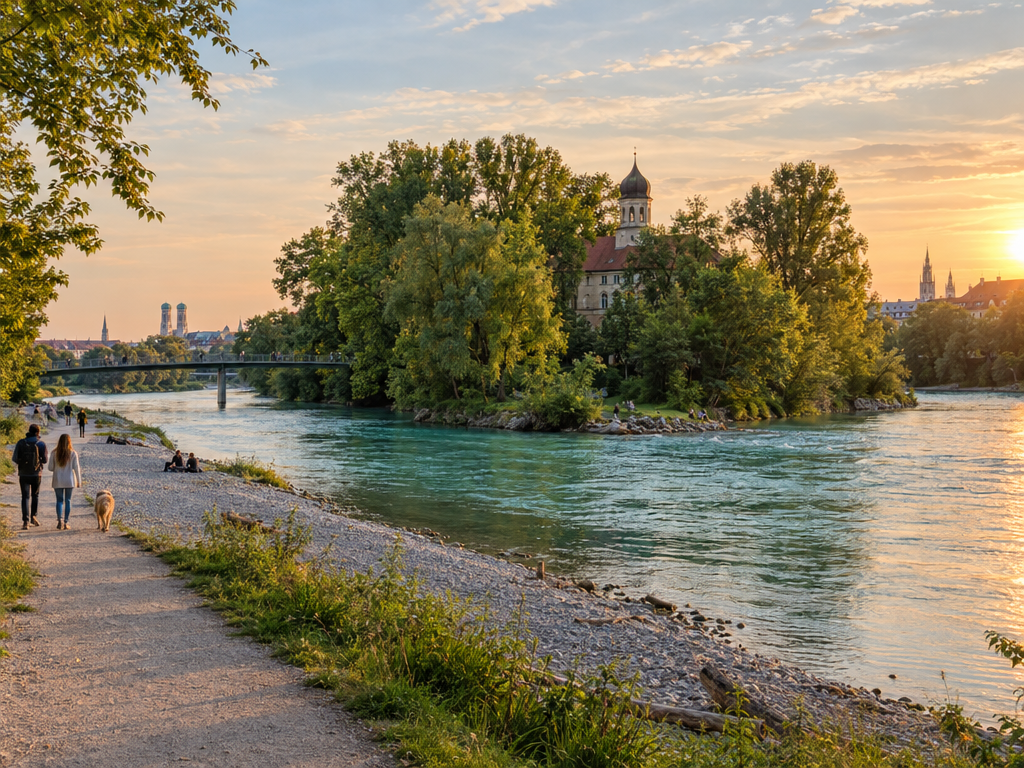
At around 376 hectares, the English Garden is larger than New York’s Central Park, and its southern section belongs to Lehel. At the Haus der Kunst the Eisbach flows into the park, about 18 minutes from us. Walking routes, bathing spots and the current situation at the surfing wave are described in our guide to the Isar in Munich.
For dog owners this location is a real bonus, as the first walk of the day starts right on the riverbank. Depending on the apartment category, dogs are welcome on request – details are on our page about dog-friendly apartments in Munich.
A walk through Lehel: our route from Ländstraße
This is the loop we walk with guests who want to get to know the neighbourhood in two to three hours. With breaks for coffee and a look inside the churches, it easily turns into half a day.
- Ländstraße → banks of the Isar: 2 minutes, then downstream to Maximiliansbrücke
- Maximiliansbrücke → Maxmonument and Museum Fünf Kontinente: about 5 minutes
- Along Thierschstraße to St.-Anna-Platz: abbey church and parish church, farmers’ market on Thursdays
- On north to Prinzregentenstraße: National Museum and Haus der Kunst
- Into the English Garden at the Eisbach, then back via Mariannenplatz and St. Lukas
In the evening we like to head back down to the Isar or, in summer, to one of the Munich beer gardens. From the Isartor it is only a few minutes to the Tal if you fancy dinner in the Old Town.
Conclusion: Lehel as a quiet base for exploring Munich
Lehel combines the calm of its period streets with short distances to the Old Town, the Isar and the English Garden. If you want to explore Munich from here, from autumn 2027 you will find your holiday apartment in Munich on Ländstraße.
Frequently asked questions about Lehel in Munich
Where is Lehel in Munich?
Lehel lies east of Munich’s Old Town, between the Altstadtring, the Isar and the English Garden. To the south it ends at Ludwigsbrücke, to the north at Max-Joseph-Brücke. Marienplatz is about ten to 15 minutes away on foot.
Which city district does Lehel belong to?
Lehel belongs to City District 1, Altstadt-Lehel. It covers the Old Town inside the Altstadtring and Lehel to the east of it, and is Munich’s most central district.
Where does the name Lehel come from?
The name Lehel most likely comes from “Lohe”, an old word for an open riverside woodland. The original Lehel was a small wood by the Isar with many streams. Many locals pronounce it “Lechel”.
Which U-Bahn line goes to Lehel?
The U4 and U5 U-Bahn lines serve Lehel, and the station is called Lehel. Tram 16 also stops at Thierschplatz and tram 19 at Maxmonument; the nearest S-Bahn station is Isartor.
What is Lehel’s postcode?
Most of Lehel has the postcode 80538, including St.-Anna-Platz and Ländstraße. For streets on the edge of the neighbourhood, it is worth checking the exact address.
Is Lehel a good area to live in?
Yes, Lehel is considered a quiet and sought-after residential area with many renovated period buildings, schools and short walks to the Isar. However, it is one of Munich’s most expensive neighbourhoods, and vacant flats are rare.
What is there to do in Lehel?
In Lehel you can visit the churches of St. Anna and St. Lukas, stroll along Maximilianstraße and visit the Haus der Kunst or the Museum Fünf Kontinente. The banks of the Isar, the Praterinsel and the English Garden are right on the neighbourhood’s doorstep.

Daniel Schulz · Managing Director of residir GmbH
He has eight years’ experience in letting and managing serviced apartments and has looked after more than 80,000 guest stays. More about Daniel Schulz