
By Daniel Schulz, residir GmbH · Last updated: 13 October 2026
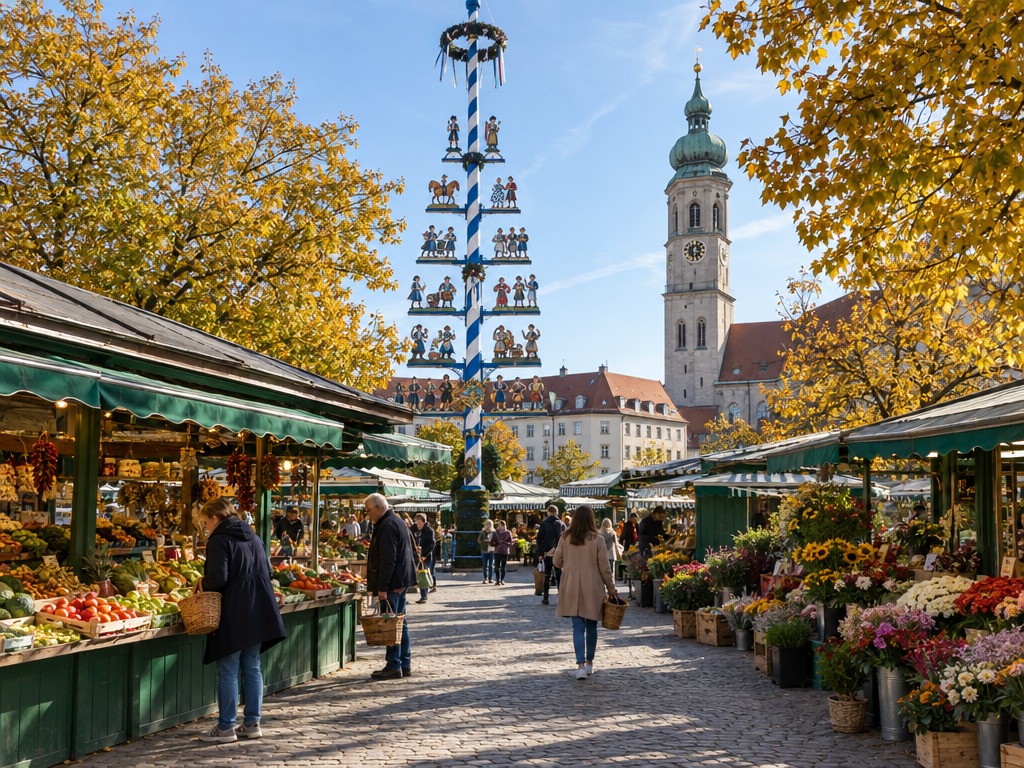
The Viktualienmarkt is Munich’s best-known food market and sits right in the heart of the old town, between Marienplatz and Isartor. The stalls are usually open Monday to Friday from 8 am to 8 pm and on Saturdays from 8 am to 3 pm; on Sundays the Viktualienmarkt in Munich is closed. More than 100 traders sell fruit, vegetables, meat, cheese, bread, flowers and spices, and there is a beer garden beneath the maypole.
From our boarding house at Ländstraße 6 in Lehel, it is about a nine-minute walk to the market. For us it is something like the neighbourhood larder: a picnic for the Isar, herbs for dinner, a coffee standing at the counter. If you book one of our holiday apartments in Munich with its own kitchen, you will probably make this walk more often than the one to Marienplatz.
In this article:
- Viktualienmarkt Munich at a glance
- Viktualienmarkt opening hours
- Stalls at the Viktualienmarkt
- Food, breakfast and coffee
- The Viktualienmarkt beer garden
- Maypole, fountains and history
- Carnival, Fountain Festival and Winterzauber
- Guided tours and tasting tours
- Getting there and parking
- Tips for your visit
- Frequently asked questions
Viktualienmarkt Munich at a glance
We have gathered the key facts in a table. The market is free to enter and so central that you can walk there from almost any accommodation in Munich in the city centre.
| Topic | Guide value |
|---|---|
| Location | Old town, between Marienplatz, Alter Peter and Isartor |
| Opening hours | Mon–Fri approx. 8 am–8 pm, Sat approx. 8 am–3 pm, Sun closed |
| Core hours for all stalls | Mon–Fri 10 am–6 pm (Nov–March until 5 pm), Sat 10 am–3 pm |
| Traders | more than 100 across around 18,600 m² |
| Admission | free |
| Beer garden | in good weather, bringing your own food is allowed |
| Nearest stop | Marienplatz (S-Bahn, U3, U6), exit Viktualienmarkt/Tal |
| From Ländstraße in Lehel | approx. 9 min on foot |
Viktualienmarkt opening hours: when the stalls are open
Officially, the market is open Monday to Friday between 8 am and 8 pm and on Saturdays between 8 am and 3 pm. That is only the outer framework, however. Each trader sets their own hours; only the core hours are compulsory: from April to October 10 am to 6 pm on weekdays, 10 am to 5 pm in the winter months, and 10 am to 3 pm on Saturdays. Some stalls also take a day off during the week.
What this means for you: if you want to buy cheese at half past seven in the evening, you will often find the shutters down. The umbrella stalls selling fruit and flowers sometimes pack up early in rain or storms, too. The choice is at its best in the morning; most traders are fully set up from about 9 am.
The Viktualienmarkt on Sundays and public holidays
The Viktualienmarkt is closed on Sundays. The stalls usually stay shut on public holidays too – and Bavaria has a few more of those than the rest of Germany, such as Epiphany, Corpus Christi and the Assumption. The beer garden goes by the weather and its own opening times, so it may still be open on those days.
Viktualienmarkt today: is a spontaneous visit worthwhile?
On weekdays, almost always. Saturday morning is when the market is liveliest and busiest; from about 1 pm it quietens down, and at 3 pm most stalls close. If you want to experience the market at a relaxed pace, come on a weekday between 9 and 11 am. That is when mostly locals are shopping, and you may still be offered a taste at the cheese counter.
Viktualienmarkt Munich: stalls and what you will find where
The market is divided into sections that feel as though they have grown organically over the years. There are permanent kiosks with green wooden shutters, open umbrella stalls and small halls. A map is of little help – you are better off simply wandering round. These areas are particularly worthwhile:
- Fruit and vegetables: the largest share of the stalls, with regional produce and exotic fruit. In autumn there are chanterelles and pumpkins, in spring asparagus from Schrobenhausen.
- Butchers and sausages: several butchers line up along the Metzgerzeile (butchers’ row). Here you will find Leberkäs (Bavarian meatloaf), Weißwürste (white sausages) and game.
- Fish: fishmongers with counters, some of which also sell fish rolls to take away.
- Cheese, bread and delicatessen: cheese from Bavaria, France and Italy, bakers, olives, spices and vinegar.
- Flowers and plants: on the side facing Frauenstraße, along with a long-established shop for seeds and gardening supplies.
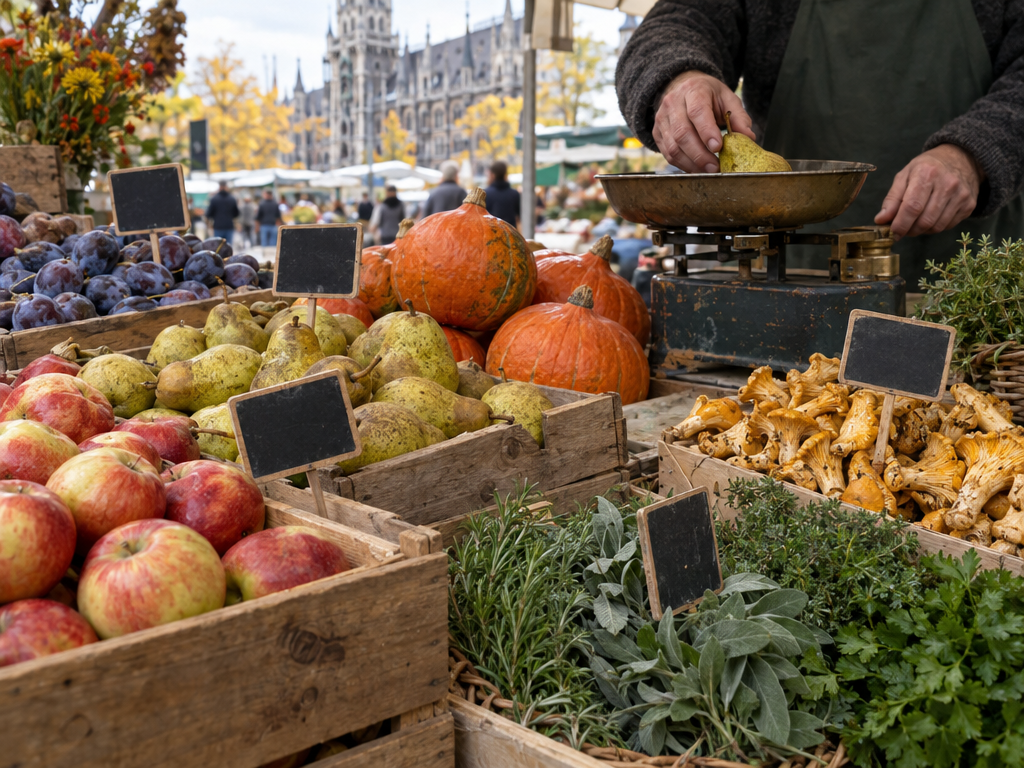
To be honest, the Viktualienmarkt is not cheap. You will pay noticeably more for fruit, meat and cheese than at the supermarket. In return, the quality is high and the traders are happy to advise you, as long as there is not a queue at the counter. Small quantities are no problem – every stall will sell you a piece of mountain cheese for your picnic.
Many guests who work in Munich for several weeks do their weekly shop here. If you are considering temporary housing in Munich, it is worth factoring the market into your choice of neighbourhood. From Lehel it is quicker to reach than many a supermarket in the outer districts.
Nine minutes to the Viktualienmarkt
All 54 of our apartments on Ländstraße in Lehel have their own kitchen. What you buy at the market in the morning, you can cook yourself in the evening. We open in autumn 2027 and are already taking enquiries.
Eating at the Viktualienmarkt: breakfast, snacks and coffee
People do not just come to the Viktualienmarkt to shop. Many stalls sell food to eat on the go, and around the market there are benches, standing tables and small taverns. Lunch for under 15 euros is perfectly possible here if you stick to the snack stalls (as of October 2026).
Breakfast at the Viktualienmarkt
The classic breakfast in Munich is Weißwürste with sweet mustard and pretzels. According to an old rule, they should never hear the noon bells, so they are eaten before twelve. Along the butchers’ row and in the beer garden you can usually get them from mid-morning. If you prefer something lighter, pick up a butter pretzel from the baker and freshly squeezed orange juice from one of the juice stalls.
Cafés and coffee at the market
Several small coffee bars and bakeries sell coffee to take away or to drink standing up. Do not expect a quiet café with a large terrace right on the market – seats are scarce and quickly taken on Saturdays. On the edge of the market, towards Frauenstraße and Rosental, there are cafés with indoor seating.
A restaurant near the Viktualienmarkt, or cook for yourself?
Around the market you will find Bavarian inns, soup kitchens and international cuisine. They are busy at lunchtime and quieter in the evening. Even so, we recommend shopping at the market at least once and cooking for yourself. An aparthotel in Munich with a kitchen is far better suited to this than a hotel room, where fish from the market would at best end up in the washbasin.
The Viktualienmarkt beer garden
In the middle of the market, under chestnut trees and next to the maypole, lies one of the few Munich beer gardens in the old town. One special feature: the beer changes. The six big Munich breweries take turns on tap, with a different one every five to six weeks. The current brewery is shown at the bar.
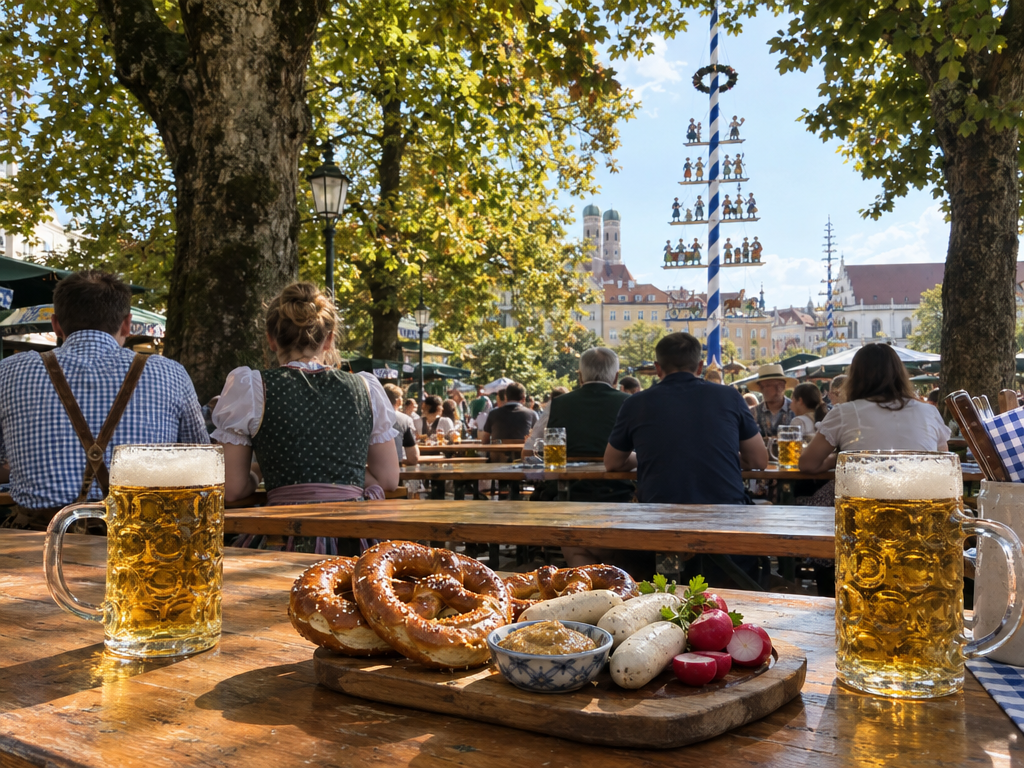
As in every traditional Munich beer garden, you are allowed to bring your own food. Only the drinks have to be bought on site. That makes the Viktualienmarkt beer garden a good-value lunch stop: a Leberkäs roll from the butcher, a radish from the vegetable stall and a beer from the bar. It is open when the weather allows; in the rain or in the depths of winter, the benches often stay empty.
Our tip for visitors with a dog: the beer garden is outdoors and usually relaxed, but on busy Saturdays it gets cramped between the benches. For the rest of the day, the Isar is closer than many people think.
Maypole, fountains and a little history
The market was founded in 1807, when King Max I Joseph had the food market moved here from today’s Marienplatz in Munich because the old square had become too small. Over the following decades the site was extended several times. Badly damaged in the Second World War, it was even considered for demolition. The people of Munich rebuilt it nonetheless, and since 1975 the market has been a pedestrian zone.
The name comes from the old word “Viktualien” for foodstuffs, derived from the Latin victualia. Incidentally, it is pronounced with an F at the start: “Fiktualienmarkt”. Since 2014, the market tradition has been listed in Bavaria’s register of intangible cultural heritage.
The Viktualienmarkt maypole
The blue-and-white maypole in the centre is the market’s meeting point. The first one was put up on 4 May 1962. Since then it has been replaced with a new one every few years, and raising it is a celebration with brass band music. The figures on the crossbars depict the city’s trades and breweries.
The fountains of Munich’s folk singers
Between the stalls stand six fountains with figures of well-known Munich folk singers and comedians: Karl Valentin, Liesl Karlstadt, Weiß Ferdl, Ida Schumacher, Elise Aulinger and Roider Jackl. The Karl Valentin figure was installed in 1953. Look at the figures’ hands – there is often a fresh flower placed there by traders or regulars.
If you combine your market visit with a city walk, you will find the Alter Peter right next door and Isartor a few steps further on. We describe our route through the old town in the article on things to do in Munich.
Festivals through the year: Carnival, Fountain Festival and Winterzauber
Carnival at the Viktualienmarkt
On Shrove Tuesday, the market women dance. At the Tanz der Marktweiber (dance of the market women), the female traders perform rehearsed dances in costume, and from late morning the market is packed with people in fancy dress. In 2027, Shrove Tuesday falls on 9 February. Come early – by around midday it is almost impossible to get anywhere near the stage.
Fountain Festival at the Viktualienmarkt
Traditionally on the first Friday in August, the traders decorate the six fountains with flowers, accompanied by free music and cabaret performances. Going by this rule, in 2027 it would be 6 August. Check the exact date and programme on the official City of Munich website shortly beforehand.
Winterzauber and Christmas market
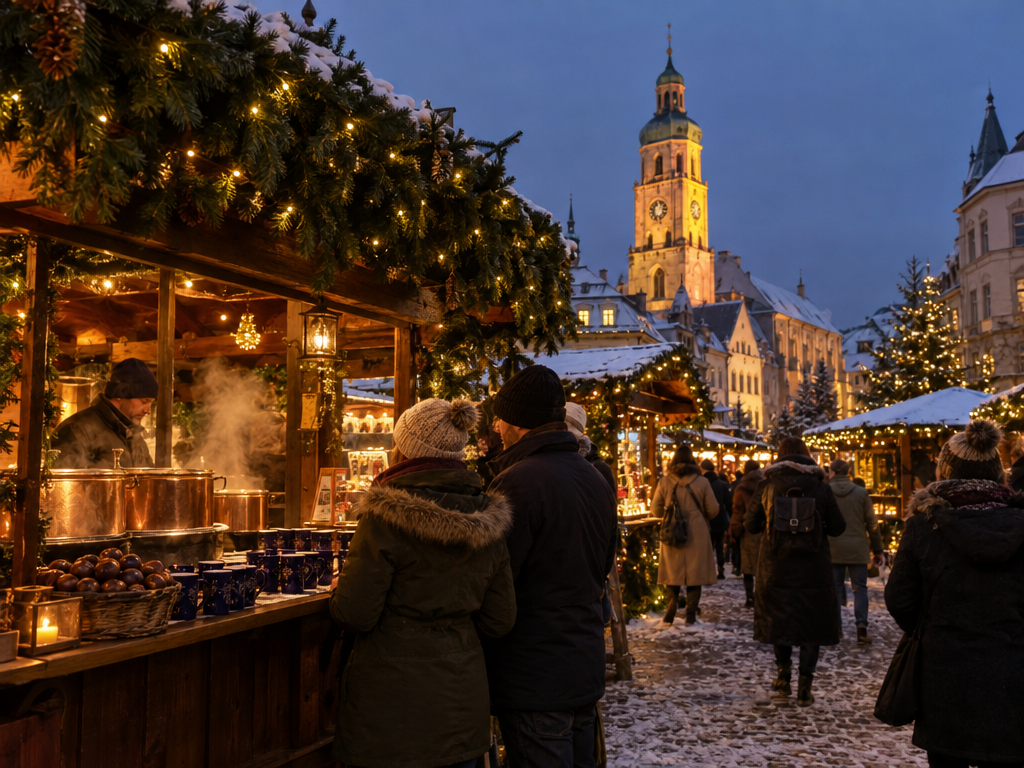
During Advent, the market turns into the Winterzauber am Viktualienmarkt (winter magic). The stalls are lit up, and there is mulled wine, punch and roast chestnuts. It is not a classic Christmas market with nativity stalls and crafts – you will find that a few minutes away at the Munich Christmas market on Marienplatz, the Christkindlmarkt. The Viktualienmarkt version is quieter, though, and more of a meeting place for locals after work.
Viktualienmarkt guided tours: food and tasting tours
Several companies run culinary tours of the market. They go by names such as Schmankerltour (delicacies tour), Schlemmertour (gourmet tour) or Probiertour (tasting tour) and work in a similar way: over two to three hours, a small group goes from stall to stall, tasting cheese, sausage, bread and fruit while hearing stories about the market and the trading families.
A Viktualienmarkt tour costs roughly 40 to 80 euros per person depending on the provider and scope, tastings included (guide value, as of October 2026). Tours usually take place on weekdays or Saturday mornings. If you prefer to go it alone, you can do your own round: buy a little something at three or four stalls and eat it all together in the beer garden.
For business travellers especially, a tour like this makes a nice change from the hotel restaurant, and it also works as an outing with colleagues. If you are in the city regularly for work, you will find our serviced apartments in Munich just a nine-minute walk from the market.
Getting to the Viktualienmarkt and parking
The nearest station is Marienplatz, served by the S-Bahn trunk line as well as the U3 and U6. Take the Viktualienmarkt/Tal exit, from where it is two or three minutes on foot. Bus routes 52 and 62 normally stop right by the market. Because of a diversion, the stop may currently be skipped in one direction, so check with the MVG (Munich transport company) before you travel.
Parking at the Viktualienmarkt
We would advise against driving to the Viktualienmarkt. The market itself is a pedestrian zone, and on-street parking in the old town is scarce and expensive. There are several multi-storey car parks nearby, but a few hours there can quickly cost double figures. It is cheaper to leave the car behind and come by U-Bahn or S-Bahn.
Our route from Lehel
From Ländstraße 6 we walk to Isartor, which takes four minutes, and from there along Westenriederstraße to the market – about nine minutes on foot in total. On the way back we like to make a detour to the Isar, just two minutes from the building. For guests with a four-legged friend, this combination of old town and riverbank is especially handy; find out more on our page about dog-friendly apartments in Munich.
Tips for visiting the Viktualienmarkt in Munich
- Come early: on weekdays between 9 and 11 am, the full range is on offer and the crowds are still small.
- Bring cash: many stalls take cards, but not all. For small amounts, cash is often quicker.
- Bring a bag: shopping bags or a small rucksack are more practical than lots of paper bags.
- Viktualienmarkt photos: the best light is in the morning, when the sun falls across the Tal onto the stalls. For a view over the whole market, climb the tower of the Alter Peter.
- Look first, then buy: ask for a taste – it is customary at cheese and fruit stalls.
A note, because the two are often confused: the Pasinger Viktualienmarkt is a separate, smaller market in the Pasing district in the west of Munich. It has its own opening hours and is around 20 minutes from the city centre by S-Bahn. So if you search for “Viktualienmarkt Pasing”, you will not end up in the old town. We introduce Munich’s other permanent markets and the weekly neighbourhood markets in our guide to the Munich farmers markets.
If you want to see how busy it is before you go, search for a live webcam of Munich overlooking the Viktualienmarkt. Such cameras are run by city portals and weather services, for example, but the images are not always up to date. Visitors from abroad will find the market under the same name – in English it is simply called the Viktualienmarkt, Munich.
Conclusion: the Viktualienmarkt belongs on every Munich itinerary
The Viktualienmarkt is not a museum but a market where locals genuinely do their shopping. Come on a weekday morning, grab a bite at the stalls and take a seat in the beer garden if the weather is fine. The stalls are closed on Sundays and public holidays, and on Saturdays they shut at 3 pm. If you would like to stay nearby and cook what you buy, you will find our holiday apartments in Munich in Lehel from autumn 2027, a nine-minute walk from the market.
Frequently asked questions about the Viktualienmarkt
When is the Viktualienmarkt open?
The Viktualienmarkt is usually open Monday to Friday from 8 am to 8 pm and on Saturdays from 8 am to 3 pm. Only the core hours are binding for all stalls: 10 am to 6 pm on weekdays (until 5 pm from November to March) and 10 am to 3 pm on Saturdays. As of October 2026.
Is the Viktualienmarkt open on Sundays?
No, the Viktualienmarkt is closed on Sundays. The stalls usually stay closed on public holidays too; only the beer garden may be open, depending on the weather.
How many stalls are there at the Viktualienmarkt?
More than 100 traders sell their goods at the Viktualienmarkt across around 18,600 square metres. They include fruit and vegetable stalls, butchers, fishmongers, cheese and delicatessen stalls, bakers and florists.
Can you eat at the Viktualienmarkt?
Yes, many stalls sell snacks such as Leberkäs rolls, white sausages, soups or fish rolls. In the beer garden you are allowed to bring your own food and only buy drinks on site.
Which beer is served in the Viktualienmarkt beer garden?
In the Viktualienmarkt beer garden, the six big Munich breweries take turns. A different beer is served roughly every five to six weeks, and the current brewery is displayed at the bar.
When is the Winterzauber at the Viktualienmarkt?
The Winterzauber takes place during Advent. The stalls are lit up and sell mulled wine, punch and roast chestnuts.
How do I get to the Viktualienmarkt?
The easiest way is by S-Bahn, U3 or U6 to Marienplatz, exit Viktualienmarkt/Tal. From Lehel it is about a nine-minute walk to the market via Isartor.
What is the Pasinger Viktualienmarkt?
The Pasinger Viktualienmarkt is a separate, smaller food market in the Pasing district in the west of Munich. It has nothing to do with the Viktualienmarkt in the old town and has its own opening hours.

Daniel Schulz · Managing Director of residir GmbH
He has eight years’ experience in letting and managing serviced apartments and has looked after more than 80,000 guest stays. More about Daniel Schulz