
By Daniel Schulz, residir GmbH · Last updated: 13 October 2026
If you want to rent an apartment in Munich, you need three things above all: a complete application folder, quick responses to new listings and a little patience. Munich’s housing market is one of the tightest in Germany, and good rental flats often attract dozens of applicants. With the right documents, several search channels and a temporary place to stay in the city, your chances improve considerably.
Every year in Lehel we see people move to Munich for a new job and need somewhere to stay first. The questions are almost always the same: where do I search, what does the landlord want to see, and how much can a deposit be? Our tips for finding a flat in Munich answer them step by step, as of October 2026. This text is not legal advice; in the event of a dispute, a Mieterverein (tenants’ association) or a lawyer can help.
In this article:
- Renting a flat in Munich: the process
- Ways to find a rental flat in Munich
- Documents for your flat application
- Flat viewings
- Costs: deposit, agent’s fee and rent
- One room, two rooms or more
- Flats in Munich by neighbourhood
- Where to live while you search
- Tenancy agreement and moving in
- Conclusion
- Frequently asked questions
| Topic | Quick answer |
|---|---|
| Length of search | usually several weeks to several months |
| Key documents | Mieterselbstauskunft (tenant self-disclosure form), proof of income, SCHUFA credit report, ID, Mietschuldenfreiheitsbescheinigung (confirmation of no rent arrears) |
| Deposit | no more than 3 months’ rent excluding service charges, payable in 3 instalments (Section 551 BGB) |
| Agent’s fee | usually paid by the landlord (Bestellerprinzip, “the party who commissions pays”, since 1 June 2015) |
| Subsidised flats | registration with the city via SOWON, processing takes around 8 months |
| After moving in | get the Wohnungsgeberbestätigung (landlord’s confirmation of residence) and register within 2 weeks |
Rent an apartment in Munich: the process step by step
If you want to rent a flat in Munich, treat the search like a small project. Most rejections happen not because applicants are unsuitable, but because others were quicker or had more complete documents. This sequence has proven effective:
- Set your budget: add up the Warmmiete (rent including heating and service charges), deposit and moving costs.
- Define your search criteria: size, neighbourhoods, maximum commute to work.
- Prepare your application folder digitally, as a single PDF.
- Set up search alerts on several portals and turn on notifications.
- Reply to new listings within a few hours.
- Attend viewings and be ready to say yes on the spot.
- Check the tenancy agreement, complete a handover report, move in and register your address.
Munich’s housing market is a landlord’s market. The city itself advises flat hunters to always search the private market alongside municipal offers. Expect it to take weeks to months, and longer for large flats in popular neighbourhoods.
If you need to find a flat in Munich quickly for a new job, you will rarely manage it from afar. It is more practical to have accommodation in Munich for your first few weeks, from where you can get to viewings at short notice. A Tuesday evening viewing in Sendling is easy to make from Lehel, but not from Hamburg.

Finding a rental flat in Munich: portals, cooperatives and subsidised housing
You will rarely find a rental flat in Munich through a single channel. If you want to rent a flat in Munich, using several channels in parallel lets you see more offers before they are taken.
Property portals and private landlords
Most flats in Munich are advertised on the big property portals and classifieds sites. Set up search alerts with push notifications there, because popular listings are often deactivated after just a few hours. Paid premium memberships sometimes give you a head start, but they are no guarantee.
If you want to rent a flat in Munich offered by a private landlord, a personal message often works better than a standard text. Write two or three sentences about your job, household and move-in date. Be wary of listings asking you to transfer money before a viewing: that is a typical scam.
Cooperative flats (Genossenschaftswohnungen) in Munich
A Genossenschaftswohnung (flat owned by a housing cooperative) in Munich is usually cheaper than a comparable flat on the open market, but the waiting lists are long. You become a member, pay cooperative shares instead of a traditional deposit and then usually live there long term. Many cooperatives periodically stop accepting new members, so it is worth contacting several.
Social housing, the Wohnberechtigungsschein and the München Modell
For a Sozialwohnung (social housing flat) in Munich, you need to register with the Amt für Wohnen und Migration (Office for Housing and Migration), which in everyday language is often called a Wohnberechtigungsschein or WBS (housing eligibility certificate). You apply online via the SOWON portal or on paper. According to the city, processing takes around eight months, after which you may apply for up to three suitable offers at the same time (as of October 2026). So if you are looking for a WBS flat in Munich, you need patience and should keep searching in parallel.
München Modell flats are aimed at middle-income households. The rent is below the open market but above that of social housing. With the city’s approval notice, you apply directly to the landlords; München Modell flats are not allocated via SOWON but are advertised on the well-known property portals, among other places. Income limits apply to both programmes.
Employers, your network and taking over a lease
Ask your new employer. Larger companies often have company flats, reserved quotas or a relocation service with contacts to landlords. For the first few months, many companies book serviced apartments in Munich for their new staff, giving them time for their own search.
Your personal network counts too: colleagues who are moving out are often looking for a Nachmieter (someone to take over the tenancy), and the landlord is grateful for a recommended applicant. A short post on social media or on your employer’s noticeboard sometimes achieves more than twenty enquiries via portals.
Arrive first, then search at your own pace
From autumn 2027, we will be letting 54 furnished apartments with their own kitchen, washing machines and fast Wi-Fi at Ländstraße 6 in Lehel. From Lehel U-Bahn (underground) station, you can reach viewings all over the city. If you are looking for temporary housing in Munich for your first few months, you can already send us an enquiry.
Documents for your flat application: self-disclosure form, SCHUFA and more
Landlords in Munich often decide on the day of the viewing. If you have your complete application with you, you have an advantage. A complete folder includes:
- Mieterselbstauskunft (tenant self-disclosure form): a form with details about you, your job, income and household
- Proof of income for the last three months, or your employment contract if you are just starting a job
- A SCHUFA-Auskunft (German credit report) or other proof of creditworthiness
- A copy of your ID card or passport and, if applicable, your residence permit
- A Mietschuldenfreiheitsbescheinigung (confirmation from your current landlord that you have no rent arrears)
- A short cover letter with a photo, optional
Filling in the self-disclosure form is voluntary, but many landlords require it. Questions relevant to the tenancy are permitted, such as about income, occupation and the number of occupants. You do not have to answer questions about religion, political affiliation or family planning. For permitted questions, however, your answers should be accurate, as false information can later jeopardise the tenancy agreement.
The SCHUFA report for a flat application comes in two forms. Under Article 15 GDPR, you are entitled to a free copy of your data once a year, but it is not intended for landlords and contains a lot of data that is nobody else’s business. For applications, SCHUFA offers a separate credit report, which may be subject to a fee depending on the product. Order it in good time, as delivery can take a few days.
A Mietschuldenfreiheitsbescheinigung confirms that you have paid your previous rent on time. Your current landlord is not obliged to issue one. If they refuse, bank statements showing your rent payments over recent months will help. If you have previously lived with your parents or abroad, explain this in one sentence in your cover letter.
Flat viewings in Munich: come prepared
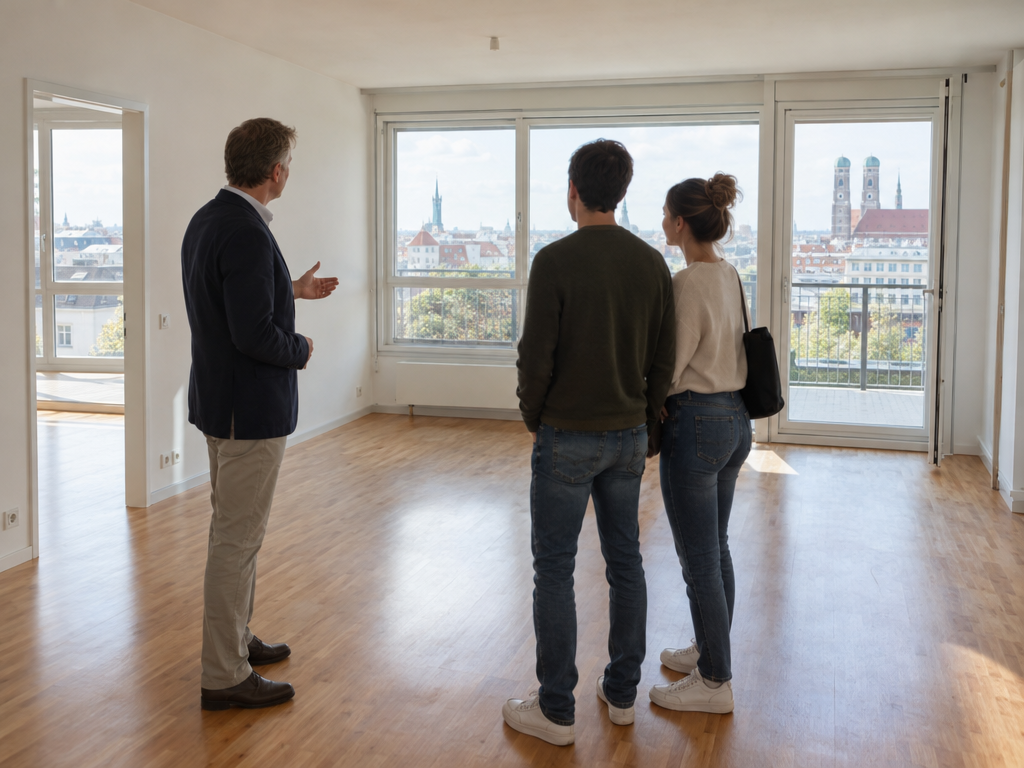
For sought-after flats in Munich, many interested parties often turn up to a viewing at the same time. Landlords and agents then have only a few minutes per person. Be punctual, bring your folder in print and digitally, and ask two or three specific questions.
You should clarify these points at the viewing:
- The amount of the basic rent, service charges and heating costs, and the type of heating
- The condition of the windows, bathroom and kitchen, and any visible damp or mould
- The move-in date and whether you are expected to buy a fitted kitchen from the outgoing tenant
- Any fixed term, graduated rent or index-linked rent in the contract
- What the landlord’s next steps are and when they will decide
Take photos of the rooms and floor plan if allowed. After three viewings in one day, memories become blurred. A short message the same evening saying you would like to take the flat puts you back in the landlord’s mind.
Costs when renting a flat: deposit, agent’s fee and rent
The deposit (Kaution)
The deposit for a flat is limited by law. Under Section 551 BGB (German Civil Code), it may be no more than three times the monthly rent, not counting advance payments for service charges. If you pay the deposit in cash, you may pay it in three equal monthly instalments, the first of which is due at the start of the tenancy.
The landlord must keep the deposit separate from their own assets. Instead of cash, some landlords also accept a bank guarantee or a deposit insurance policy. Ask about this if you are short of funds when moving.
Agent’s fee and the Bestellerprinzip
Since 1 June 2015, the Bestellerprinzip (“the party who commissions the agent pays”) has applied to rental flats. An agent may only charge you, as a flat hunter, a fee if they search for a flat exclusively on your behalf and only receive the instruction from the landlord as a result (Section 2(1a) of the Wohnungsvermittlungsgesetz, the Housing Brokerage Act). If an agent offers a flat that was already on their books, the landlord pays.
Ablösen (payments to take over a kitchen or furniture) are permitted if they are in reasonable proportion to the value. Excessive transfer payments as a condition for the tenancy agreement are a warning sign.
Rents: just a brief overview
Munich has the highest rents of any major German city. The city’s rent index for 2025 shows an average Nettokaltmiete (basic rent excluding service charges and heating) of €15.38 per square metre, and asking rents for new lettings are usually considerably higher. How the rent index works and what it means for your rent is explained in our guide to the Munich rent index.
Affordable flats in Munich are found mainly on the outskirts, in older buildings or through cooperatives. If you want to rent a flat in Munich cheaply, be prepared to accept commutes of 30 to 40 minutes by S-Bahn (suburban train) or U-Bahn.
One room, two rooms or more: which flat in Munich suits you
Demand is highest for small flats. Students, graduates starting their careers and commuters are all looking for a one-room flat in Munich at the same time, so offers disappear quickly. A two-room flat in Munich is also highly contested, because couples and singles working from home compete for the same flats. (Note that German listings count rooms excluding kitchen and bathroom.)
There are often slightly fewer applicants per listing for a three-room or four-room flat in Munich. This is mainly down to price: larger family flats quickly become so expensive that the pool of applicants shrinks. For families, it is worth looking at new-build areas on the outskirts and at cooperatives.
If you are only in the city for a few months, you often do not need a rental flat of your own with a kitchen to buy and furniture to move. A furnished flat costs more per month but saves on purchases and can be rented for shorter periods. A room in a flatshare in Munich is the cheaper alternative.
Flats in Munich by neighbourhood: Schwabing, Pasing and Lehel
The city has 25 districts, and the differences in price and atmosphere are considerable. We have put together an overview of Munich neighbourhoods and their pros and cons in a separate guide. Here are just the key points for your flat search.
If you want to rent a flat in Schwabing, you pay for period buildings, cafés and proximity to the English Garden. Competition is fierce, especially for small flats. A flat in Pasing is usually somewhat cheaper; this district in the west has its own mainline station and S-Bahn connection, and it is around 15 minutes to the city centre by S-Bahn.
Lehel, where our building is located, is one of the most expensive areas. Vacant flats are rare, but the old town and the Isar are right on your doorstep. What everyday life in Lehel, Munich feels like is described in our portrait of the neighbourhood.
If you want to rent a flat in Munich or the surrounding area, also look at the towns along the S-Bahn lines, for example to the north and east of the city. Rents there are sometimes lower, but what matters is the actual journey time to work, not the distance on the map.
Flat hunting in Munich: where to live while you search
Looking for a flat in Munich is easier if you already live in the city. You can get to viewings at short notice, get to know the neighbourhoods and give landlords a specific move-in date. There are several options for this period.
A Zwischenmiete (temporary sublet) in Munich is often the cheapest option: someone is abroad for a few months and sublets their furnished flat. For this, the main tenant needs the landlord’s permission. Make sure this is in place before you transfer any money.
A boarding house in Munich is easier to plan as a temporary solution. You pay a monthly rent including electricity, Wi-Fi and bed linen, have your own kitchen and can usually extend flexibly if the search takes longer. Especially when your moving date is fixed but the flat is not, this takes a lot of pressure off.
For tradespeople and project teams staying only a few weeks, a rental flat of their own is not worthwhile. Here, workers’ accommodation in Munich with a kitchen is the simpler solution; the company books and is invoiced directly.
A fixed-term tenancy agreement for a flat is another option. For ordinary rental flats, however, a fixed term is only permitted with a legally recognised reason, such as the landlord’s own use or planned conversion work (Section 575 BGB). We explain the rules in our guide to the fixed-term lease in Germany.
Signing the tenancy agreement and moving in
Read the tenancy agreement carefully before you sign. Pay attention to the rent and service charges, any graduated or index-linked rent, and the rules on Schönheitsreparaturen (cosmetic repairs such as repainting) and keeping small pets. Unclear clauses are usually cheaper to clarify through a tenants’ association than in a dispute later on.
When the keys are handed over, complete a handover report with meter readings and photos of any existing damage. Sign it together with the landlord and keep a copy. This protects you when you move out and the deposit is to be returned.
After moving in, you have two weeks to register at the Bürgerbüro (citizens’ office). For this you need the Wohnungsgeberbestätigung (landlord’s confirmation of residence) from your landlord. The easiest way is to ask for it when you collect the keys.
Conclusion: prepare well and search locally
You are most likely to succeed in renting a flat in Munich with a ready-made application folder, several search channels and quick responses to new listings. If you bridge the first few months in one of the furnished apartments in Munich let on a temporary basis, you can attend viewings at short notice and see the neighbourhoods for yourself before you sign.
Frequently asked questions about finding a flat in Munich
How can I find a flat in Munich quickly?
The fastest way is with a complete digital application folder, search alerts on several portals and an immediate response to new listings. Many rental flats in Munich are gone within a few hours, so being reachable and sending a short, personal message to the landlord count.
What documents do I need to rent an apartment in Munich?
The usual documents are a Mieterselbstauskunft (tenant self-disclosure form), proof of income for the last three months, a SCHUFA credit report, a copy of your ID and often a Mietschuldenfreiheitsbescheinigung (confirmation of no rent arrears) from your previous landlord. Self-employed people usually include their latest tax assessment or a confirmation from their tax adviser.
How much can the deposit for a flat be?
The deposit may be no more than three months’ rent excluding service charges (Section 551 BGB). Tenants may pay it in three equal monthly instalments, with the first instalment due at the start of the tenancy.
Do I have to pay an agent’s fee as a tenant in Munich?
Generally not. Since 1 June 2015, the Bestellerprinzip has applied: whoever commissions the agent pays them, and for rental flats that is almost always the landlord. Tenants only pay if the agent searches for a flat exclusively on their behalf.
How long does it take to find a flat in Munich?
Plan for several weeks to several months. How long it takes depends mainly on your budget, the size of flat and the neighbourhood; affordable one-room and two-room flats in central locations are in particularly high demand.
How do I get a social housing flat in Munich?
For a subsidised flat, you register with the City of Munich’s Amt für Wohnen und Migration (Office for Housing and Migration), online via the SOWON portal or using a paper form. According to the city, processing takes around eight months, after which you can apply for up to three flats at a time via SOWON.
Where do I live until I have found a flat in Munich?
Many newcomers to Munich bridge the search with a furnished flat, a boarding house or a temporary sublet. That way you can attend viewings in person and get to know the neighbourhoods before signing an open-ended tenancy agreement.

Daniel Schulz · Managing Director of residir GmbH
He has eight years of experience letting and managing serviced apartments and has looked after more than 80,000 guest stays. More about Daniel Schulz