
By Daniel Schulz, residir GmbH · Last updated: 13 October 2026
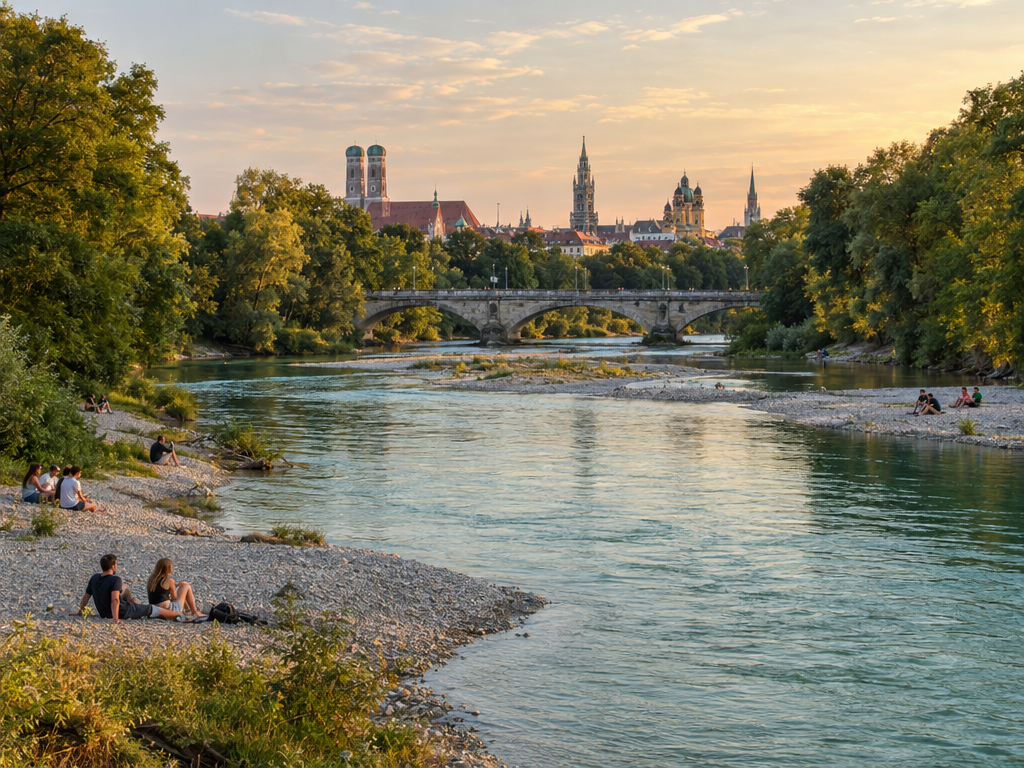
The Isar in Munich flows for around 14 kilometres right through the city, and for many locals it is the most important place to be in summer. The finest stretches are the Isarauen (Isar meadows) with the Flaucher in the south, the gravel banks between Reichenbachbrücke and Wittelsbacherbrücke, and the Praterinsel, the Müller’sches Volksbad and the Maximiliansanlagen in Lehel, Munich. Swimming is allowed in many places, but because of the cold water and strong current only for confident swimmers and when the water level is low.
We run a boarding house with 54 apartments at Ländstraße 6 in Lehel, opening in autumn 2027. It is about two minutes from our front door to the riverbank, so all the routes in this article start from Lehel. Our advice for your first hour in Munich: the Isar rather than Marienplatz. Walking times are guide figures as of October 2026.
In this article:
- The Isar in Munich at a glance
- A walk along the Isar from Lehel
- Isarauen and Flaucher
- The Eisbach and the Eisbach wave
- Swimming in the Isar: spots and safety
- The Isar cycle path and bike rides from Munich
- Barbecues and beer gardens by the Isar
- With a dog by the Isar
- The Isar through the year
- Conclusion
- Frequently asked questions
The Isar in Munich at a glance: the best spots by the river
The Isar rises in the Karwendel mountains in Tyrol and flows into the Danube near Deggendorf after almost 300 kilometres. As a city river, it is unusual: the water is clear and greenish, the bed is full of gravel, and in the south of the city it looks almost like a wild river. That is thanks to the Isar Plan, under which the city restored around eight kilometres of the river to a more natural state between 2000 and 2011.
The table shows the spots along the Isar in Munich that guests ask us about most often. If you choose accommodation in Munich close to the river, you can reach most of them on foot.
| Place | What to expect | From Lehel approx. |
|---|---|---|
| Isar riverbank on Ländstraße | Riverside paths, meadows, gravel banks | 2 min on foot |
| Praterinsel | Island with old factory buildings, Alpine Museum | 5 min on foot |
| Maximiliansanlagen | Park path along the high bank, views over the city | 8 min on foot |
| Müller’sches Volksbad | Art Nouveau indoor pool at Ludwigsbrücke | 10 min on foot |
| Museumsinsel | Deutsches Museum, riverside paths | 12 min on foot |
| Eisbach | Side channel in the English Garden, surf wave | 18 min on foot |
| Friedensengel | Golden Angel of Peace statue above Prinzregentenstraße | 20 min on foot |
| Gravel banks at Reichenbachbrücke | Most popular city beach, busy in the evening | 20 min on foot |
| Wittelsbacherbrücke | Wide gravel banks, start of the Isarauen | 30 min on foot |
| Flaucher | Gravel islands, beer garden, barbecue zones | 20 min by bike |
A walk along the Isar from Lehel: Praterinsel, Volksbad and Maximiliansanlagen
Our favourite walk along the Isar in Munich takes about an hour and starts right outside the door. It crosses two islands and both riverbanks without you ever having to walk along a road. The loop is loveliest in the early evening, when the sun sits low over the old town.
Praterinsel
From Ländstraße, head north and cross a footbridge onto the Praterinsel. This narrow island lies between two arms of the Isar and is home to the brick buildings of a former liqueur factory. Today it hosts events, and the Alpine Museum of the German Alpine Club (Deutscher Alpenverein) is based here. It is best to check opening times on the museum’s website.
On the Praterinsel in Munich, it is worth looking south: here the water rushes over a weir, showing just how much power the river has even on calm days.
Maximiliansanlagen and the Friedensengel
Cross the Kabelsteg footbridge to the east bank and climb up into the Maximiliansanlagen. The park runs along the high bank from the Maximilianeum to the Friedensengel; the paths are shady and pleasant even in high summer. From up here you look through the trees down onto the Isar and the towers of the old town.
At the northern end, the golden Friedensengel (Angel of Peace) stands on its column above Prinzregentenstraße. From there, cross the Luitpoldbrücke back to the west bank and follow the Isar back to Lehel, or turn north towards the Eisbach.
Müller’sches Volksbad and Museumsinsel
Heading south, the loop takes you to the Müller’sches Volksbad at Ludwigsbrücke. This Art Nouveau baths opened in 1901 and is still an ordinary municipal indoor pool with a sauna and steam bath. If you only want to see the Müllersches Volksbad from outside, take the riverside path on the east bank. For a visit inside, check the current opening times with Stadtwerke München (the municipal utility); prices and rules for the sauna are covered in our guide to the best Munich spa options.
Opposite lies the Museumsinsel with the Deutsches Museum. From the bank there you can see the Isar split and flow back together again. Guests looking for a boarding house in Munich for several weeks often name this walk as the reason they would rather stay in Lehel than on the edge of the city.
Isarauen and Flaucher: gravel banks in the south of the city
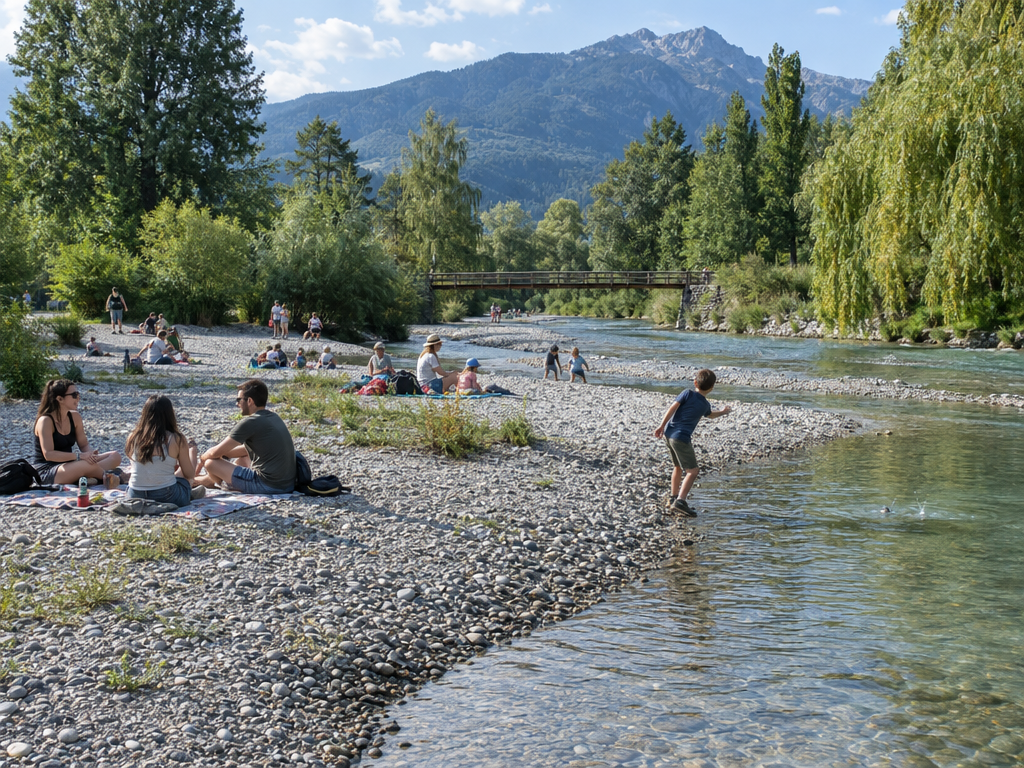
South of the Museumsinsel, the Isar widens. Between Reichenbachbrücke and Wittelsbacherbrücke lie the gravel banks that become the city centre’s Isar beach in summer. In the evening, students, families and people fresh from work sit here, and sometimes someone plays the guitar. On warm weekends it gets correspondingly busy.
The Isarauen in Munich
Beyond Wittelsbacherbrücke the Isarauen begin. Here the river once again has shallow banks, side channels and small islands, with old trees in between. There are paths on both sides; on the west side in Sendling you will find the municipal rose garden (Städtischer Rosengarten), where you can stroll through the flower beds free of charge.
Flaucher
The Flaucher is the best-known stretch of the Isarauen. A long wooden footbridge links the gravel islands, and in the water there are small channels and pools where children can play too. On the bank there is a beer garden, as well as designated barbecue zones and an area where nude bathing is a long-standing tradition.
On foot it takes a good hour from Lehel to the Flaucher in Munich, or about 20 minutes by bike along the river. A little further south are the Floßlände (raft landing) in Thalkirchen and Hellabrunn Zoo.
Two minutes to the Isar, dogs welcome too
Our boarding house on Ländstraße is right by the river in Lehel, and your morning walk starts on the bank opposite. Dogs are welcome on request, depending on the apartment category.
The Eisbach and the Eisbach wave: what you need to know now
The Eisbach is an artificial side channel of the Isar that flows through the English Garden and rejoins the river further north. It is fast, cold and in many places deeper than it looks. From Lehel it takes about 18 minutes on foot, past the Haus der Kunst, to the bridge on Prinzregentenstraße.
For decades this was the site of the Eisbach wave, where surfers rode a standing wave in the middle of the city. Since autumn 2025 the wave had disappeared at times following work on the channel bed, and its restoration was debated for a long time. Check the local news shortly before your visit to find out whether people are surfing there at the moment.
There is a smaller wave on the Isar in Munich at the Floßlände in Thalkirchen. It is intended only for experienced surfers, but you can watch from the bank.
Swimming in the Eisbach is life-threatening, even for strong swimmers: the current drags you under bridges and grilles. We describe the English Garden itself, with the Monopteros and the Chinese Tower, in detail in our guide to the English Garden in Munich.
Swimming in the Isar in Munich: spots, currents and safety
For many people, a dip in the Isar is part of summer in Munich. It is allowed in most places, but there are no official supervised bathing spots on the river. So you swim at your own risk, and you should take that seriously. Almost every summer, the Munich papers report fatal accidents on the Isar.
Where you can swim
The main swimming spots on the Isar in Munich are the shallow side channels at the Flaucher and the gravel banks between Reichenbachbrücke and Wittelsbacherbrücke. In many places the water there is only knee-deep, which is enough to cool off. In the main channel it gets deep quickly, and the current is stronger than it looks from the gravel bank.
What to bear in mind when swimming in the Isar
- Cold water: The water temperature of the Isar in Munich rarely rises above 20 degrees, even in high summer, and is often well below that. Go into the water slowly.
- Current: Only swim in the Isar where you can stand, and never alone. Always keep children within reach.
- Weirs and bridges: Keep your distance from weirs, for example at the Praterinsel. Do not jump off bridges.
- After rain: After thunderstorms or snowmelt, the water level rises quickly and the river becomes murky and torrential. Stay on the bank then.
- Alcohol: A large share of accidents happen in the evening after partying on the riverbank.
The current level and water level of the Isar in Munich are published by the Bavarian flood warning service (Hochwassernachrichtendienst Bayern), which usually also lists the Isar’s water temperature. If you want to see how busy the gravel banks are beforehand, you can also find webcams on the Isar in Munich online.
If you prefer swimming in a pool, go to the Müller’sches Volksbad or, in summer, one of the Stadtwerke’s outdoor pools. The Schyrenbad is close to Wittelsbacherbrücke and just a few minutes from the gravel banks.
The Isar cycle path: bike rides along the Isar from Munich
The Isarradweg (Isar cycle path) runs for around 300 kilometres from the source in the Karwendel to the confluence with the Danube. For guests in Munich it is mainly interesting as a day route, as the riverside paths start right in the city. From Lehel you can get straight onto the Isar cycle path without crossing a major road.
Cycling south along the Isar
The classic bike ride along the Isar from Munich heads south. Via the Flaucher and Thalkirchen you ride into the Isar valley, where the banks become steep and wooded. After about ten kilometres you pass under the Großhesselohe Bridge; up on the slope is the Waldwirtschaft Großhesselohe with its beer garden.
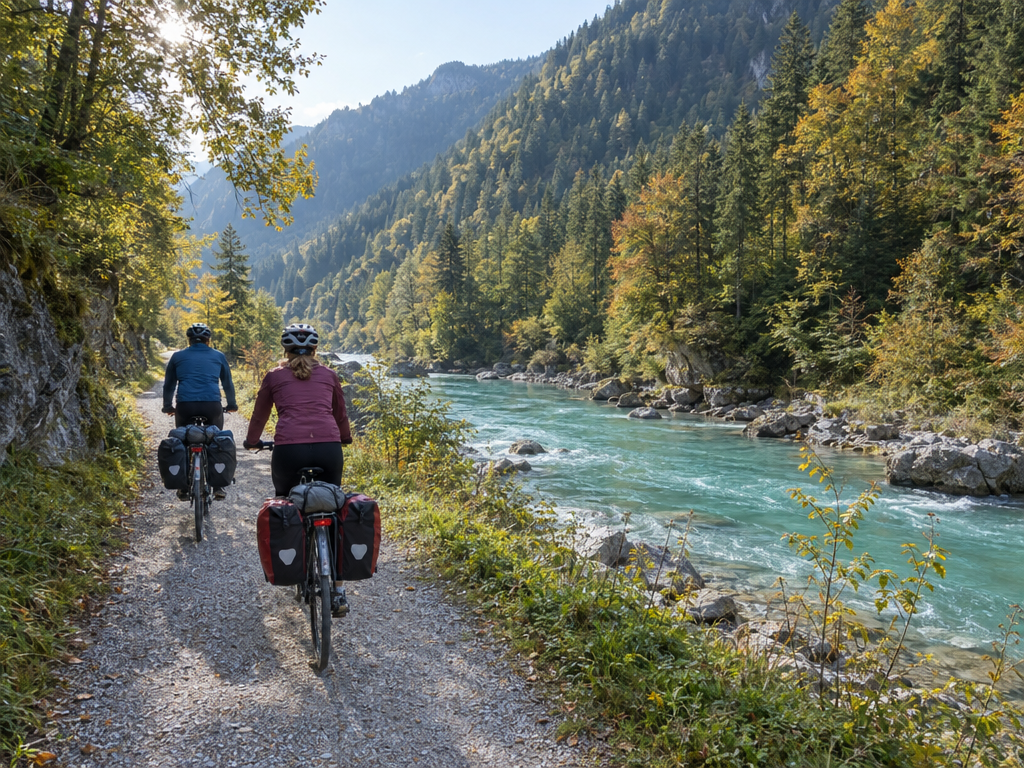
If you keep going, you reach Schäftlarn Abbey with its beer garden after around 25 kilometres and Wolfratshausen after about 35 kilometres. From there, the S7 takes you and your bike back into the city. We present more ideas, including rafting on the Isar from Wolfratshausen, in our guide to day trips from Munich.
Cycling north along the Isar
Heading north, the route is flatter and quieter. Beyond the English Garden, the path runs through the meadows to Garching and on to Freising, a good 40 kilometres. You return on the S1. A bike ride along the Isar in Munich in this direction is particularly worthwhile on hot days, when the paths in the south are crowded.
You can hire bikes through the MVG bike-sharing scheme and from rental shops in the city centre. If you are staying in Munich for several months for a project, it is often better to buy a second-hand bike. For stays that long, temporary housing in Munich usually works out cheaper than a string of hotel nights.
Barbecues and beer gardens by the Isar
Barbecues by the Isar in Munich are only allowed in designated barbecue zones, the largest of which are in the Isarauen around the Flaucher. The City of Munich publishes exactly where you may barbecue and which rules apply on its website. Please take your rubbish home with you, as the bins along the bank overflow quickly on fine evenings.
If you would rather not barbecue yourself, you will find Munich beer gardens by the Isar at the Flaucher, at the Großhesselohe Bridge and at Schäftlarn Abbey. The nearest to Lehel is the Chinese Tower in the English Garden, around 30 minutes on foot along the river.
With a dog by the Isar
For dogs, the Isar is the best place in Munich to run free. The riverside paths in Lehel, the Maximiliansanlagen and the Isarauen in the south are extensive, and there is water to drink almost everywhere. Before eight in the morning you will meet more dogs than people there.
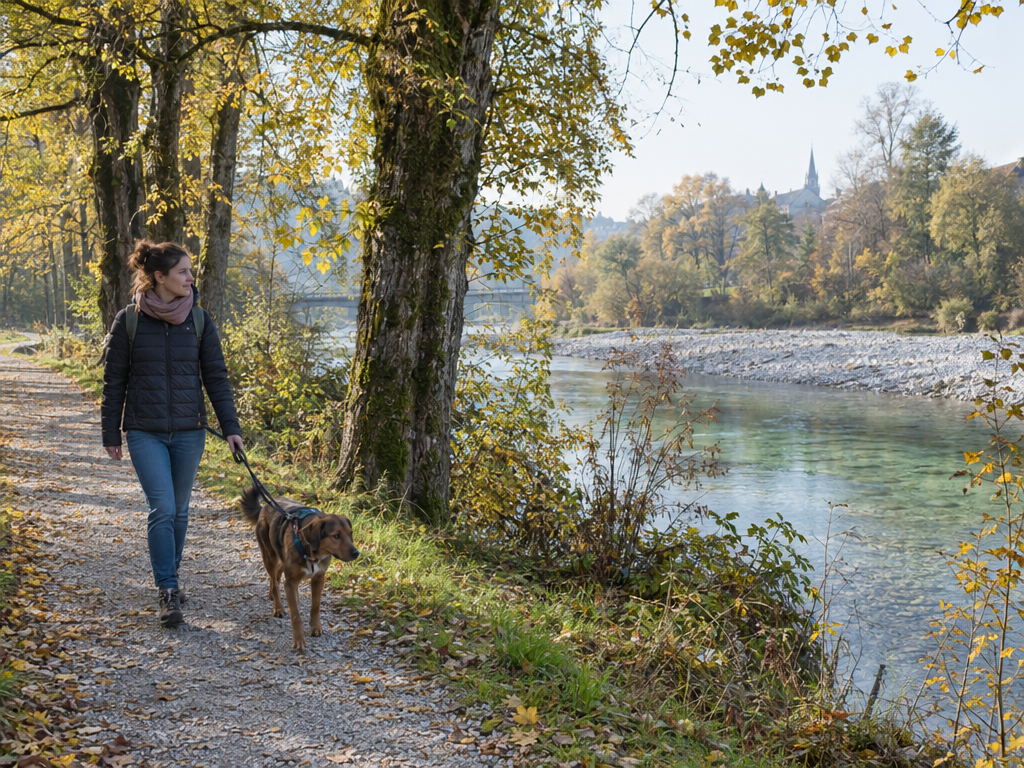
There are a few rules you should know. Dogs must be kept on a lead in many sections, especially large dogs, so look out for the signs and the City of Munich’s regulations. In summer the gravel banks are full of families and picnic blankets, so a lead is the better choice there anyway. Keep poo bags in your pocket.
The current is dangerous for dogs too. Only let your dog into the water in shallow side channels, not in the main channel and never in the Eisbach. How guests with four-legged friends stay with us is explained on our page about dog-friendly apartments in Munich.
The Isar in Munich through the year
In spring the Isar carries a lot of meltwater from the mountains, and the gravel banks are partly flooded. From June the water calms down and the city moves to the riverbank. July and August are the months for swimming, barbecues and long evenings on the gravel banks.
The Isarauen are at their most beautiful in autumn: the trees change colour, the paths are empty and the light is clear. Business travellers use the riverside paths all year round for a run before their first meeting, especially those staying in serviced apartments in Munich close to the river. In winter the side channels freeze over on cold days, and you have the river almost to yourself.
Conclusion: the Isar in Munich on foot, by bike and in the water
In Munich, the Isar is not an afternoon outing but a place for every day: a run in the morning, a bike ride at lunchtime and an evening on the gravel bank. When swimming, take care because of the cold and the current; everything else needs no planning at all. Our holiday apartments in Munich in Lehel open in autumn 2027, a two-minute walk from the riverbank.
Frequently asked questions about the Isar in Munich
Where is the Isar in Munich at its most beautiful?
The Isar in Munich is at its most beautiful in the Isarauen at the Flaucher, on the gravel banks between Reichenbachbrücke and Wittelsbacherbrücke, and in Lehel around the Praterinsel, the Müller’sches Volksbad and the Maximiliansanlagen. For bike rides, the Isar valley south of the Großhesselohe Bridge is well worth it.
Can you swim in the Isar in Munich?
Yes, swimming in the Isar is allowed in most places in Munich, but there is no supervision and you swim at your own risk. The shallow side channels at the Flaucher and the gravel banks at Reichenbachbrücke are the most suitable spots. The water is cold, the current strong, and you should not go in after rain.
How warm is the Isar in Munich in summer?
The water temperature of the Isar in Munich rarely rises above 20 degrees, even in high summer, and is often well below that. Current temperature and water level readings are published by the Bavarian flood warning service (Hochwassernachrichtendienst Bayern).
Does the Eisbach wave still exist?
Since autumn 2025 the Eisbach wave had disappeared at times following work on the channel bed, and its restoration was debated for a long time. Check the local news shortly before your visit to see whether people are currently surfing there (as of October 2026).
How far is the Flaucher from the city centre?
From Isartor and Lehel it takes a good hour on foot along the river to the Flaucher, or about 20 minutes by bike. By public transport, take the U-Bahn to Brudermühlstraße and walk about ten minutes from there.
Where does the Isar cycle path start in Munich?
In Munich, the Isar cycle path runs along both banks right through the city, so you can join it at any bridge. Popular day rides head south to Schäftlarn Abbey or Wolfratshausen and north to Freising, returning by S-Bahn in each case.
Are barbecues allowed by the Isar in Munich?
Barbecues by the Isar in Munich are only allowed in designated barbecue zones, the largest of which are in the Isarauen around the Flaucher. The City of Munich publishes the current rules on its website.
Can dogs run off the lead by the Isar?
That depends on the section. Leads are compulsory in many areas along the Isar, especially for large dogs, so look out for the signs on site. Dogs should only go into the water in shallow side channels, never in the main channel or the Eisbach.

Daniel Schulz · Managing Director of residir GmbH
He has eight years of experience in letting and managing serviced apartments and has looked after more than 80,000 guest stays. More about Daniel Schulz