
By Daniel Schulz, residir GmbH · Last updated: 14 October 2026
Bavarian food is hearty, down-to-earth and closely tied to beer and the Brotzeit (a traditional cold snack platter): roast pork with dumplings, Weißwurst with a pretzel, Leberkäs, Obatzda and Kaiserschmarrn are among the best-known dishes. In Munich you can enjoy these classics in traditional inns, beer gardens and at the market. Many of them are also easy to make yourself with just a few ingredients in a holiday apartment with its own kitchen.
Our building at Ländstraße 6 is in Lehel, just a few minutes’ walk from Isartor, Platzl and the Viktualienmarkt. Around the corner you will find butchers, bakeries and traditional inns – everything you need to taste and recreate the local cooking. This guide explains the typical dishes, when people eat them and how to cook three of them in your apartment. Information correct as of October 2026.
In this article:
- Bavarian specialities at a glance
- The Bavarian Brotzeit
- Bavarian meat dishes
- Bavarian desserts and sweet dishes
- Drinks
- Munich specialities and etiquette
- Where to eat Bavarian food in Munich
- Bavarian cooking in your holiday apartment
- Shopping for ingredients
- Seasonal specialities
- Vegetarian Bavarian food
- Souvenirs
- Conclusion
- Frequently asked questions
| Dish | What it is | When to eat it |
|---|---|---|
| Weißwurst with Brezn | Scalded veal sausage with sweet mustard | Mid-morning, traditionally before 12 noon |
| Obatzda | Cheese spread made from soft cheese, butter and paprika | With a Brotzeit, in the beer garden |
| Leberkäs | Baked meat loaf, served warm in a bread roll | At lunchtime or as a snack from the butcher |
| Schweinsbraten | Roast pork with crackling, dumplings and dark beer gravy | At lunchtime, traditionally on Sundays |
| Schweinshaxe | Crispy roast pork knuckle | Lunch and dinner in traditional inns |
| Kaiserschmarrn | Shredded pancake dusted with icing sugar | As a main course or dessert |
| Steckerlfisch | Mackerel grilled on a wooden skewer | In beer gardens and at funfairs |
Bavarian food and specialities: what defines the cuisine
Bavarian cuisine is farmhouse and tavern cooking. It is built on pork, potatoes, dumplings, cabbage, dairy products and flour-based dishes, and there is almost always a beer to go with it. Many Bavarian specialities came about because every part of the animal was used and bread, flour and eggs were always in the house.
Typical Bavarian food follows a fixed daily rhythm. Mid-morning there is Weißwurst or a Brotzeit, at lunchtime the hot main meal, in the afternoon coffee and cake, and in the evening another cold Brotzeit. That is why traditional inns often offer their widest choice at lunchtime, while in the evening some dishes are only available while stocks last.
Bavarian food also varies within Bavaria itself. In Franconia, bratwurst and Schäufele (roast pork shoulder) play a bigger role; in Swabia it is Spätzle; and in Old Bavaria around Munich it is Weißwurst, Leberkäs and roast pork. The typical Bavarian dishes described here mainly refer to Old Bavaria and Munich.
The Bavarian Brotzeit: Obatzda, Radi, Brezn and Leberkäs
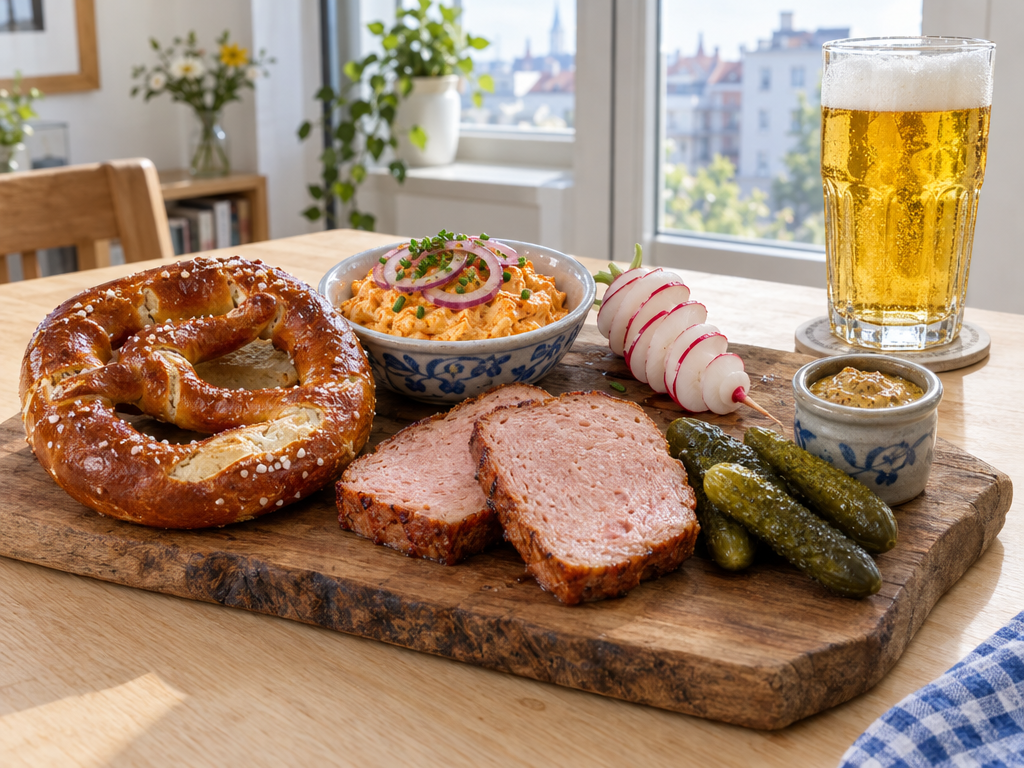
The Brotzeit is a cold meal eaten between main meals – mid-morning, in the beer garden or in the evening. A classic Bavarian Brotzeit consists of bread or a pretzel, butter, cold cuts, cheese, Obatzda, radish and gherkins, served on a wooden board. In traditional inns, a selection of several items is often called a „Brotzeitbrettl“.
Obatzda
Obatzda is a spread made from ripe Camembert or Brie, butter, onions, paprika and a little caraway. The spelling varies, and on menus you will also see Obazda or Obatzter. „Bayerischer Obazda“ has been registered as a protected geographical indication in the EU since 2015.
Radi and Brezn
Radi is a white radish that is cut into a spiral and salted. After a few minutes the salt draws out the water, the radish „weeps“ and becomes milder. The Brezn, also called Brezen in Munich, is the lye pretzel with the fat belly and thin arms, often sprinkled with coarse salt.
Leberkäs
Despite its name, Leberkäse (literally „liver cheese“) is not cheese and, in Bavaria, contains no liver either. It is made from finely minced pork and beef with bacon and is baked in a tin in the oven. At the butcher’s counter you can get Leberkäs warm in a bread roll with sweet mustard, often from early in the morning.
Bavarian meat dishes: roast pork, pork knuckle and dumplings
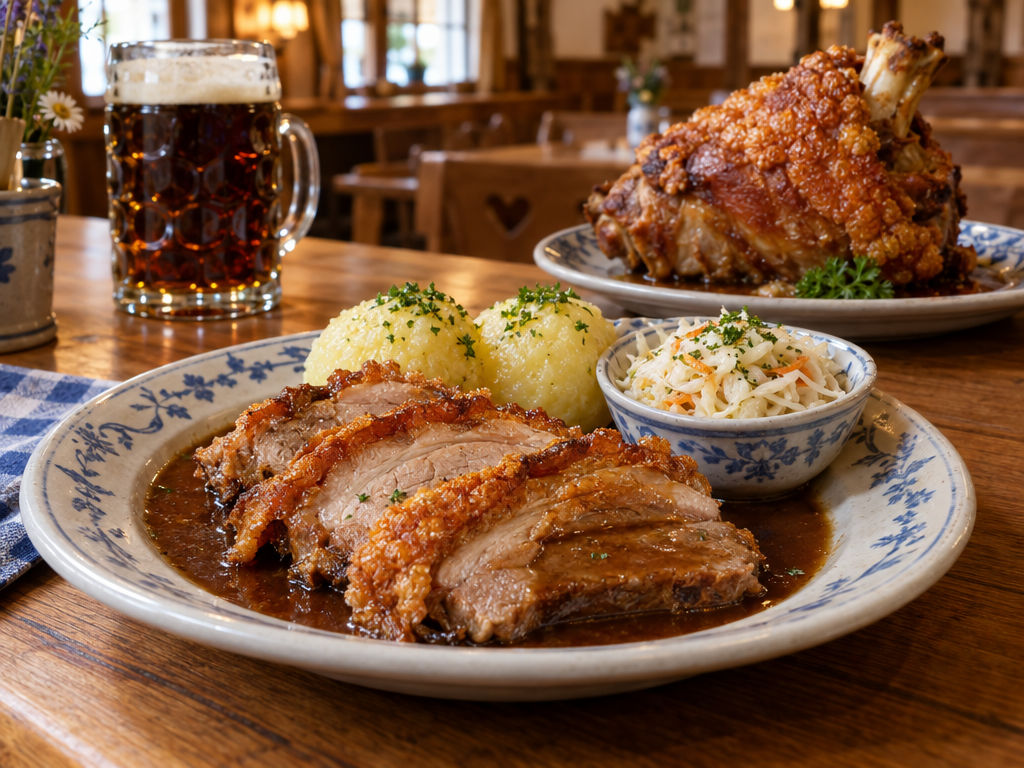
The best-known Bavarian dishes are hot meat dishes. Schweinsbraten is made from shoulder or belly, roasted in the oven with crackling and served with dark beer gravy. It comes with potato or bread dumplings and coleslaw or braised red cabbage.
Schweinshaxe (pork knuckle) is the dish many visitors associate with Munich. It is slow-cooked and then roasted until the crackling crunches – one portion is enough for a big appetite. Almost every menu also features boiled beef with horseradish, creamy veal goulash, Fleischpflanzerl (what Munich calls meatballs) and half a roast chicken.
Bread dumplings and potato dumplings
Semmelknödel (bread dumplings) are made from stale bread rolls, milk, eggs, onions and parsley; Kartoffelknödel (potato dumplings) from raw and cooked potatoes. Locals often order potato dumplings with roast pork and bread dumplings with mushrooms in cream sauce. With Bavarian meat dishes the side is almost always listed on the menu, but you can often swap it.
Bavarian sweet dishes: Kaiserschmarrn, Dampfnudeln and Auszogne
In Bavaria, sweet dishes are not just dessert. Many families eat Kaiserschmarrn or Dampfnudeln as a main course, traditionally on meat-free days such as Fridays. If you have a sweet tooth, you will find these Bavarian specialities in traditional inns, cafés and mountain huts.
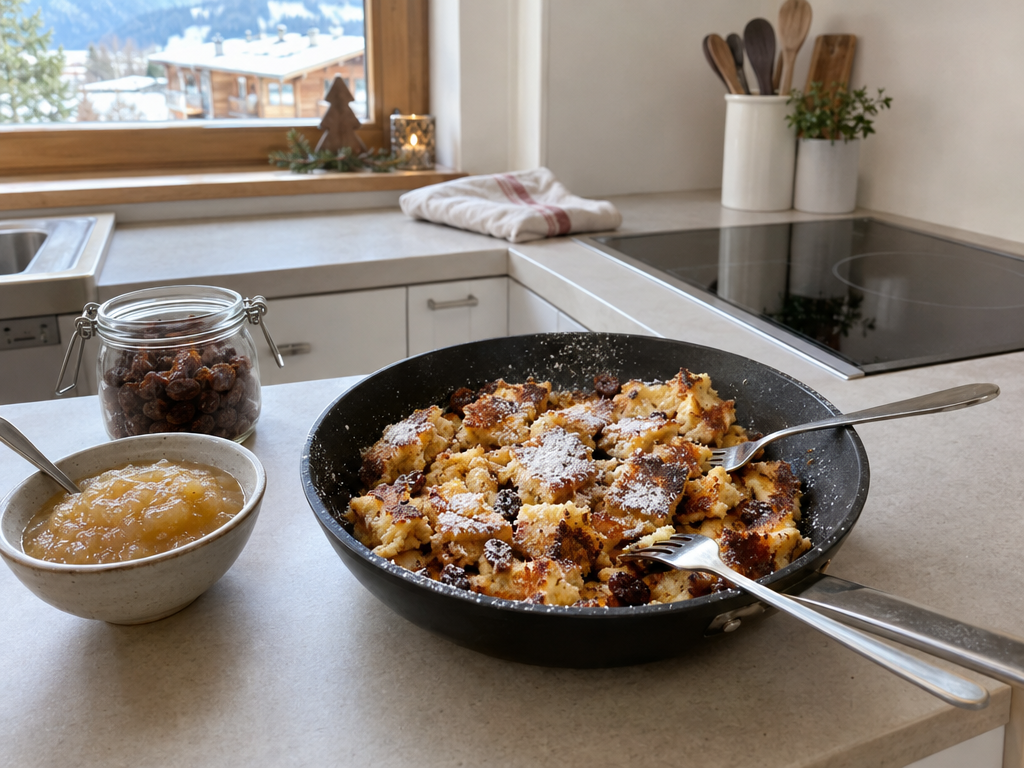
- Kaiserschmarrn: a thick pancake that is torn into pieces in the pan and served with icing sugar and apple purée or stewed plums. It originates from Austria but is just as popular in Bavaria.
- Dampfnudeln: yeast dumplings cooked in a pan with milk, butter and sugar. A caramelised crust forms underneath while the top stays soft. They are served with vanilla sauce.
- Rohrnudeln: similar to Dampfnudeln, but baked in the oven and often filled with plums.
- Auszogne: a yeast pastry fried in lard, thin in the middle with a thick rim, also known as Kirchweihnudel. Bakeries sell them mainly around Kirchweih (the church fair festival) in October.
- Apple strudel: served with vanilla sauce or cream and found on almost every other inn’s menu.
Drinks to go with Bavarian food
Beer is part and parcel of Bavarian cuisine. In Munich people mainly drink Helles, a mild, pale lager, and Weißbier (wheat beer), which is often enjoyed mid-morning with Weißwurst. In beer gardens and at Oktoberfest, beer is served in a Maß, a one-litre stein.
If you would like less alcohol, order a Radler (beer with lemonade) or a Russ’n (wheat beer with lemonade). The most popular soft drinks are Apfelschorle (apple juice with sparkling water) and Spezi, a mix of cola and orange soda. Almost all Munich breweries now offer alcohol-free wheat beer.
Munich specialities and etiquette: Weißwurst, Brezn and Semmel
If you are looking for typical Munich food, you will end up with a handful of classics that exist in this form mainly in the city. The Munich Weißwurst, made from veal, bacon, parsley and lemon, is the best known. Then there are Leberkäs, Munich Helles and the Prinzregententorte, a cake made from several thin layers of sponge with chocolate cream, named after Prince Regent Luitpold.
An old rule applies to Weißwurst: eat it before 12 noon – it should never hear the midday church bells. It is served in hot water with a pretzel and sweet mustard. Where to get a good breakfast in Munich with Weißwurst and how it works is explained in our dedicated guide.
A few rules at the table
- Weißwurst is „gezuzelt“, i.e. sucked out of its skin, or cut open lengthways. Both are fine – ketchup, on the other hand, is not.
- Weißwurst comes with sweet mustard; Leberkäs does too, or with a medium-hot one.
- You order a Semmel or a Brezn, not a Brötchen (the standard German word for bread roll). People will still understand you, though.
- In busy inns it is normal to share a table with strangers. Briefly ask whether a seat is free, and leave tables marked with a Stammtisch (regulars’ table) sign alone.
- In beer gardens you may bring your own food to tables without a tablecloth; drinks are bought on site.
If you want to explore the old town on foot and stop off at an inn along the way, it is best to stay centrally. Accommodation in Munich‘s old town or in neighbouring Lehel saves you trips by underground or taxi after your second beer.
Eating Bavarian food in Munich: inns, beer gardens and markets
There are three places where eating Bavarian food in Munich works particularly well. The traditional inns and brewery taverns in the old town serve the classic dishes from lunchtime until evening. In summer, the beer gardens are the place for a Brotzeit, roast chicken and Steckerlfisch. And at the stalls of the Viktualienmarkt you can grab a Leberkäs roll, Weißwurst and Obatzda standing up.
The best-known inn is the Hofbräuhaus Munich on Platzl, around seven minutes’ walk from Ländstraße. The menu features classics such as pork knuckle and roast pork, and in the evening it is often busy and loud. If you prefer somewhere quieter, try Bavarian cuisine in Munich at lunchtime on a weekday, when most inns have room.
Steckerlfisch, usually a mackerel, is grilled on a skewer over charcoal and served whole on paper. You will find it at dedicated fish stalls in the larger beer gardens and at Oktoberfest. Expect to queue, because every fish is grilled fresh.
An honest tip: in the restaurants right on Marienplatz and in Tal you pay city-centre prices, and the quality varies. A look at the daily specials helps, because inns that cook from scratch change their dishes with the seasons. Booking is worthwhile almost everywhere at weekends and for groups of four or more.
Your own kitchen, seven minutes from the Hofbräuhaus
In autumn 2027, a total of 54 apartments from 25 to 50 m² will open at Ländstraße 6. Each has its own kitchen, so you can eat lunch at an inn and prepare your Brotzeit at home in the evening. Location and apartment categories are shown on our page about holiday apartments in Munich.
Bavarian cooking in your holiday apartment: three easy recipes
Bavarian cooking might sound like roasting tins and ovens, but many simple Bavarian dishes need nothing more than a frying pan and a bowl. The three recipes below serve two people and are ready in 15 to 30 minutes. If you are after recipes for large roasts, you are better off at an inn, as a Schweinsbraten needs three hours in the oven.
Obatzda recipe: cheese spread for your Brotzeit
- 200 g ripe Camembert or Brie
- 50 g soft butter
- 1 small onion, very finely diced
- 1 tsp sweet paprika, a pinch of caraway, salt and pepper
- 1 to 2 tbsp lager, if you like
Mash the cheese with a fork and work it into the butter until you have a coarse mixture. Stir in the onion, spices and the beer if using. Leave the Obatzda to rest in the fridge for 30 minutes and serve with pretzels, radish and chives.
One-pan Kaiserschmarrn recipe
- 3 eggs, separated
- 125 g flour, 200 ml milk, a pinch of salt
- 1 tbsp sugar, a handful of raisins if you like
- 2 tbsp butter for frying, icing sugar and apple purée to serve
Whisk the egg yolks, flour, milk and salt until smooth, beat the egg whites with the sugar until stiff and fold them in. Pour the batter into a pan of hot butter, let it set over a medium heat, turn it and tear it into pieces with two forks. Add a little more butter and sugar, let it caramelise and serve with icing sugar and apple purée.
Leberkäse with fried egg and Bavarian potato salad
- 2 thick slices of Leberkäs from the butcher
- 2 eggs
- 500 g waxy potatoes
- 1 small onion, 150 ml hot meat or vegetable stock
- 2 tbsp vinegar, 3 tbsp oil, salt, pepper, 1 tsp mustard
Bavarian potato salad is dressed with stock and vinegar. Boil the potatoes in their skins, peel them and slice them while still warm. Mix the onion, hot stock, vinegar, mustard and oil, pour over the potatoes and leave for 20 minutes until the salad is nicely moist – „schlotzig“, as the Bavarians say. Mayonnaise has no place in it in Bavaria.
Fry the Leberkäs in a pan for two to three minutes on each side until it has a brown crust. Fry two eggs alongside and place them on the slices. Leberkäse with a fried egg is a lunchtime classic in Munich’s inns and ready in a quarter of an hour at home.
If you are staying in Munich for longer and cook regularly, you need more than a kitchenette. Furnished apartments in Munich with a fully equipped kitchen make it easier to cook during the week and head to the inn at the weekend.
Shopping for ingredients: butcher, baker and market
For Leberkäs, Weißwurst and cold cuts, go to the butcher. Weißwurst is made fresh and should be eaten the same day; Leberkäs is available warm in slices or cold in one piece. Buy pretzels and bread rolls from the bakery in the morning – by the afternoon they are often no longer quite fresh.
Radish, potatoes, cheese for your Obatzda and vegetables can be found at the city’s markets. From Lehel it is around nine minutes to the Viktualienmarkt, and on Thursdays a farmers’ market sets up on St.-Anna-Platz. Which markets are open on which days is listed in our guide to the Munich farmers markets.
Supermarkets also stock ready-made Obatzda, pre-cooked dumplings and bake-at-home pretzels. That is fine for one evening, but you will clearly taste the difference compared with fresh Obatzda from the market. On Sundays, butchers, bakers and markets in Bavaria are closed, with very few exceptions.
Seasonal specialities: asparagus, Wiesnhendl and Starkbier
Some Bavarian delicacies are only available at certain times of year. If you are planning your trip, you can take this into account.
| When | Speciality | Note |
|---|---|---|
| Fasching (carnival, January to February) | Krapfen | Filled yeast doughnuts in every bakery |
| Lent (February to April) | Starkbier | Dark, strong beers in the breweries |
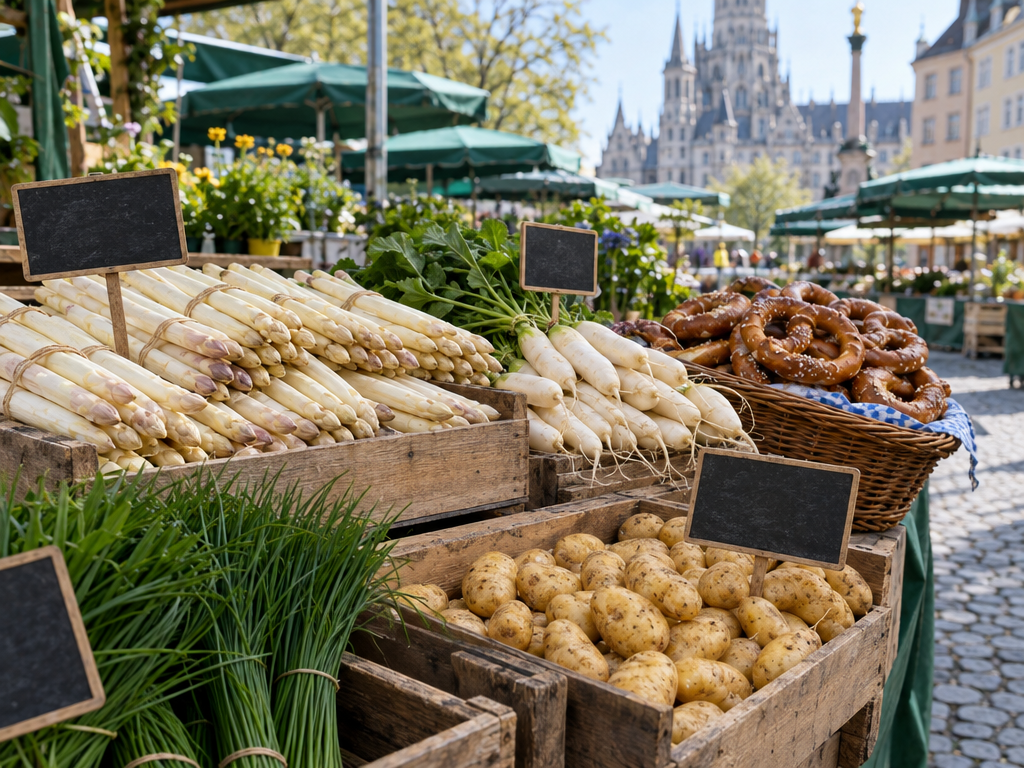
| April to 24 June | White asparagus | From Schrobenhausen and Abensberg, with ham and potatoes |
| Summer | Steckerlfisch, Radi | Beer garden season |
| Late September to early October | Wiesnhendl | Half a roast chicken at Oktoberfest |
| October and November | Kirchweih goose, Auszogne, St Martin’s goose | Kirchweih on the third Sunday in October, St Martin’s Day on 11 November |
| Advent | Mulled wine, gingerbread, candied almonds | At the Christmas markets |
The asparagus season traditionally ends on St John’s Day, 24 June. Until then, almost every inn has a separate asparagus menu. The Wiesnhendl is half a crispy roast chicken that you order in the Oktoberfest tents.
Vegetarian Bavarian dishes
Bavarian cuisine has a reputation for being meat-heavy, but it has more meat-free dishes than many people expect. Many vegetarian Bavarian dishes come from the tradition of meat-free Fridays and Lent.
- Kasspatzn: Spätzle with mountain cheese and crispy fried onions, originally from the Allgäu but widely available in Munich.
- Bread dumplings with creamy mushrooms: mushrooms in cream sauce, made with fresh chanterelles in late summer and autumn.
- Krautkrapfen: pasta dough filled with sauerkraut, rolled up and fried in a pan.
- Obatzda with pretzel and radish: as a complete Brotzeit.
- Kaiserschmarrn and Dampfnudeln: as a sweet main course.
These days almost every inn has two or three vegetarian dishes; vegan options are rarer. Ask about the dumplings, as bread dumplings are sometimes made with bacon and sauces often with meat stock.
Bavarian specialities to take home
If you are looking for Bavarian specialities to take home as gifts, choose things that will survive the journey. Sweet mustard, beer from a Munich brewery, gingerbread, a piece of mountain cheese and spice mixes for Obatzda all work well. Weißwurst and fresh Obatzda, on the other hand, only keep for a short time and do not belong in your hand luggage.
For business travellers with little time to shop between appointments, the old town is within walking distance of Lehel. In serviced apartments in Munich with a kitchen, you can keep mustard and cheese in the fridge until you leave.
Conclusion
The best way to get to know Bavarian food in Munich is to mix inns, beer gardens and your own kitchen: Weißwurst before noon, roast pork or Kaiserschmarrn at lunchtime, and in the evening a Brotzeit with Obatzda and radish that you prepare yourself in a boarding house in Munich with its own kitchen.
Frequently asked questions about Bavarian food
What is typical Bavarian food?
Typical Bavarian food includes roast pork with dumplings, pork knuckle, Weißwurst with a pretzel, Leberkäs, Obatzda and radish as part of a Brotzeit, and sweet dishes such as Kaiserschmarrn and Dampfnudeln. To drink, there is Helles or wheat beer.
What are typical Munich specialities?
Munich’s best-known specialities are the Munich Weißwurst, Leberkäs, Munich Helles and the Prinzregententorte. You can find many dishes of Bavarian cuisine in any traditional inn in Munich.
Why is Weißwurst eaten before 12 noon?
The rule dates back to the days before refrigerators, when the freshly scalded sausages had to be eaten quickly. Today, eating Weißwurst in the morning is mainly a tradition, but many inns still only serve it until midday.
Is there liver in Leberkäs?
No, Bavarian Leberkäs contains no liver. It is made from finely minced pork and beef with bacon and baked in the oven. Outside Bavaria, however, a product called Leberkäse without the word „Bayerischer“ (Bavarian) must contain liver.
What is the difference between Obatzda and Obazda?
There is no difference – both are spellings of the same cheese spread made from ripe soft cheese, butter, onions and paprika. „Bayerischer Obazda“ has been an EU protected geographical indication since 2015.
Which Bavarian dishes are vegetarian?
Vegetarian options include Kaiserschmarrn, Dampfnudeln, Obatzda with a pretzel, Kasspatzn, bread dumplings with creamy mushrooms and Krautkrapfen. Almost every inn in Munich has at least two meat-free dishes on the menu.
Where can you eat Bavarian food in Munich?
In Munich you can eat Bavarian food above all in the traditional inns and brewery taverns of the old town, in the beer gardens and around the Viktualienmarkt. If you want to cook yourself, buy the ingredients from the butcher, the baker and the weekly markets.
Which Bavarian dishes are easy to cook yourself?
Obatzda, Kaiserschmarrn and Leberkäse with fried egg and potato salad are all easy. None of the three needs an oven – a frying pan, a saucepan and a bowl are enough.

Daniel Schulz · Managing Director of residir GmbH
He has eight years’ experience in letting and managing serviced apartments and has looked after more than 80,000 guest stays. More about Daniel Schulz